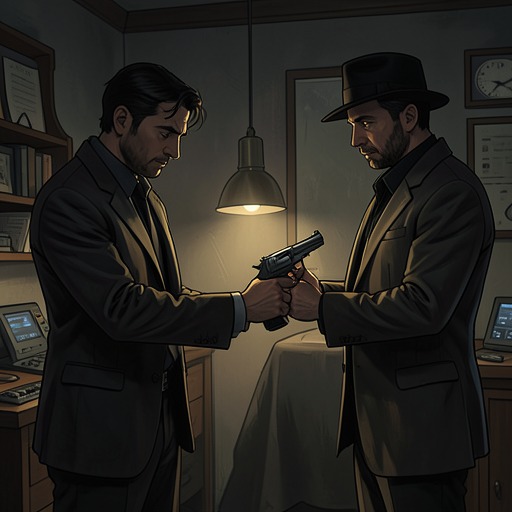
Spade proposes Wilmer as the fall guy
The Maltese FalconSam Spade proposes Wilmer Cook as the fall guy when he argues that the police must be given a culprit for the murders. The plan is both a tactical move in the falcon negotiation and an expression of Spade’s professional code: he will not evade the law by relying on the others’ departure, because his continuing work in San Francisco depends on being able to deliver someone for prosecution. His proposed solution therefore puts Wilmer forward as the convenient suspect while making the group confront what their escape would cost Spade.
The need for a culprit
The proposal emerges after Spade has established that he possesses the falcon, despite Joel Cairo’s reminder that the others have him surrounded. Spade puts aside the envelope of money and insists that another matter must be settled first: the police need a victim they can charge with the three murders. Cairo immediately disputes the count, arguing that Floyd Thursby must have killed Miles Archer. Spade rejects the attempt to narrow the case and says that the others have not yet heard enough to understand what is at stake.
Spade’s insistence grows out of his experience with police and legal authorities. He says that he has repeatedly defied officials, but has always kept in mind the day when he would have to answer for his actions. On that day, he needs to be able to bring a suspect to headquarters and present the police with a criminal. He considers that prospect essential to continuing his work: if he cannot produce a culprit when called to account, his reputation and ability to operate will collapse. The principle is practical rather than sentimental, founded on his understanding of how a detective remains viable in a city where police scrutiny is inevitable.
Spade’s case for the plan
Casper Gutman argues that this case is an exception and that Spade is being paid well enough to accept the risk. Spade rejects the bargain. He distinguishes his own position from that of Gutman and the others, who can go to New York, Constantinople, or somewhere else, while he must remain in San Francisco and continue doing business there. A one-time escape from consequences, he argues, would damage his ability to use his methods in future cases.
Spade also contends that leaving the police without a culprit is more dangerous for everyone. The police are not idle, he says, but waiting for developments, and they already know he is deeply involved. If the investigation continues without a fall guy, they may eventually uncover information about the falcon; Gutman and his associates would then have to flee with it, undermining their chance to make money. By contrast, a suspect delivered to the authorities could satisfy the investigation and allow it to stop before the falcon becomes the focus. Spade frames the choice as a shared interest, even though the immediate burden falls on the proposed suspect.
Why Wilmer is chosen
Spade points to Wilmer as the suitable candidate because, as Spade asserts, Wilmer actually shot both Thursby and Captain Jacobi. He proposes that the group attach the necessary evidence to Wilmer and turn him over to the police. The suggestion startles the others: Cairo reacts with open amazement, and Brigid O’Shaughnessy stares at Spade in confusion. Gutman first laughs at the proposal, then apologizes and agrees to hear the reasoning behind it, while stressing his personal attachment to Wilmer.
Spade’s explanation depends on his reading of District Attorney Bryan’s priorities. He believes Bryan would prefer a case that looks secure on paper and might drop a doubtful prosecution rather than risk losing at trial. In Spade’s view, the authorities may be willing to let other guilty accomplices go if concentrating on one defendant makes conviction easier. He therefore proposes giving Bryan a choice between a complicated case involving everyone and a simpler prosecution focused on Wilmer, which Spade claims Bryan would find attractive. This is Spade’s assessment of how the prosecutor will behave, not proof that the authorities have already accepted the arrangement.
The two killings can, in Spade’s account, be joined through the existing theory that Thursby was a gunman and Wilmer was one too. Spade argues that if the same gun was used in both shootings, the bullets could match. He further reasons that once Wilmer is convicted of Thursby’s murder, the authorities need not bring a separate trial for Jacobi’s killing; they could close the record by assigning that murder to him as well. The proposal thus rests on building a prosecution that is straightforward enough to satisfy the authorities, rather than on a full inquiry into every participant.
Stakes and significance
The fall-guy proposal is a negotiation tactic, but it also states the limits Spade places on his own freedom of action. He refuses Gutman’s suggestion that he simply make an exception, because doing so would jeopardize the professional credibility on which his future work depends. His insistence that he must give the police a victim contrasts with the others’ ability to disappear, turning his local obligations into leverage in the bargaining over the falcon.
At the same time, the plan exposes a bleak procedural logic. Spade expects a prosecutor to favor a manageable conviction over a case that includes all the guilty parties, and he offers to help make that choice possible by concentrating responsibility on Wilmer. The proposed outcome is therefore not a simple restoration of justice: it is a calculated way to contain police attention, preserve the falcon’s prospects as a source of profit, and protect Spade’s place in his profession. The strategy makes the machinery of prosecution part of the contest itself, with a suspect’s usefulness measured by how effectively he can close the case.