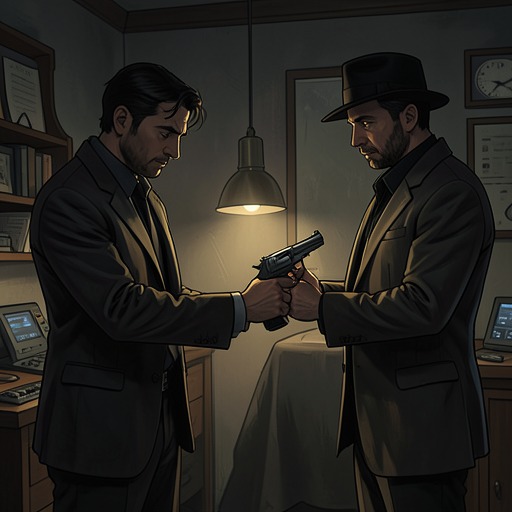
Spade subdues Wilmer and hands him over as a scapegoat
The Maltese FalconSam Spade’s plan to make Wilmer Cook the fall guy turns a negotiation over the black bird into an immediate contest of force, then into a police report. Spade argues that the authorities need one manageable suspect for the murders of Floyd Thursby and Captain Jacobi; when Wilmer raises his pistol, Spade disarms him and declares the plan accomplished. He later gives the police Wilmer’s name and identifies his associates, converting a private arrangement into a public accusation.
Background and Stakes
By the time Spade proposes a fall guy, Casper Gutman’s party has the black bird, and Spade has their attention—and, as Joel Cairo points out, their leverage over him. Spade insists that the police cannot simply be left to wait: they know he is deeply involved, and he believes they will eventually uncover information about the bird unless he gives them a victim. His proposal is therefore meant to protect the group’s chance to sell the bird as well as to contain the investigation.
Spade points to Wilmer as the obvious candidate. He says Wilmer actually shot both Thursby and Jacobi, and that the young gunman is already suited to the role. Gutman initially objects, while Cairo insists that Thursby alone killed Spade’s partner, Miles Archer. The disagreement exposes the plan’s central tension: the group needs an account that will satisfy the police, but its members do not agree even on how many killings the account must cover.
The Proposed Arrangement
Spade presents the fall-guy strategy as a calculation about prosecution, not as a promise to establish everyone’s guilt. He argues that District Attorney Bryan would prefer a case that can be tried and won over a more complicated prosecution involving several equally guilty accomplices. In Spade’s view, Bryan can be encouraged to concentrate on Wilmer, dismiss talk of the black bird as an attempt to confuse the case, and avoid pursuing the rest of the group.
The arrangement is not yet secure when Spade outlines it. Gutman questions whether Wilmer’s arrest might give the police a new lead to the bird rather than stop them, and Spade has to press the point that the police are waiting for him to act. His answer is that he cannot afford to do nothing: with suspicion already surrounding him, handing over one suspect is the practical way to limit the danger. The proposal thus converts the group’s fear of exposure into a bargain over who will bear the legal risk.
Wilmer Is Subdued
The argument breaks off when Wilmer cries out and raises his pistol. Gutman catches Wilmer’s wrist and forces the gun downward as he rises; Cairo grabs Wilmer’s other arm. With the two men restraining him, Wilmer stops struggling. Spade then gets up from the sofa, pushes Cairo aside, and strikes Wilmer twice while his arms are held. He checks that Wilmer is not seriously hurt, carries him to the sofa, and searches his clothes, taking a second pistol as well as the weapons already collected.
The scene makes the proposed scapegoat more than a figure in Spade’s argument. Spade holds the pistols and presents the subdued Wilmer as the person the police can be given. Gutman does not answer readily, and Spade warns him not to let Cairo’s influence draw him into another confrontation. The physical struggle has changed the balance of the negotiation: Wilmer is in Spade’s control, while Gutman and Cairo have helped restrain him.
From Bargain to Police Report
After Gutman and Cairo leave, Spade stands still for several minutes, then uses the telephone to contact Sergeant Tom Polhaus. He reports that Wilmer Cook shot Thursby and Jacobi, describes Wilmer and Gutman, identifies Cairo as an associate, and gives Gutman’s Alexandria Hotel address. He also warns Polhaus that Wilmer is capable with a gun and says he has weapons he believes were used in the shootings. The private proposal has become actionable information for the police.
Spade’s account does not amount to a neutral inventory of every participant’s responsibility. It foregrounds Wilmer as the shooter and supplies the police with his associates and location, precisely the focused case Spade had argued they would prefer. The narrative has already supplied a broader chain of events: Gutman says Wilmer shot Jacobi after encountering the captain carrying the bird, and says Wilmer was also responsible for the fire aboard La Paloma. Spade’s call accordingly functions both as disclosure and as selective framing: it gives the police a concrete suspect while leaving the larger group’s involvement to be pursued separately.
Consequence and Significance
The episode ends with Wilmer exposed as the intended fall guy, not with his arrest or a completed prosecution. Spade has announced the strategy, secured the weapons, and directed the police toward Wilmer and the people around him. The consequences are practical rather than conclusive: the police receive names, an address, and a warning, but the evidence here does not establish what charges follow or whether Bryan accepts Spade’s proposed simplification.
Spade’s maneuver also sharpens the difference between knowing what happened and deciding what the authorities will be able to prove. He treats the fall guy as a way to contain an investigation that threatens both himself and the bird’s value, while his police report gives the authorities a starting point without resolving every responsibility. The scene’s decisive shift is from negotiation to custody in all but name: Wilmer is physically disarmed, and Spade turns the leverage he has gained into a lead for the police.