Herbert White–Maw and Meggins employment relationship
The Monkey's PawHerbert White’s employment at Maw and Meggins connects a casual household wish for two hundred pounds to the fatal factory accident that kills him. The company’s payment of exactly that amount brings the relationship into the home as both official compensation and an unbearable reminder of what it cannot replace.
Employment and the First Wish
Herbert works for Maw and Meggins, though the account supplies no details about his position or the terms of his employment. At home, the prospect of clearing the house is raised as a way to make his parents happy. Herbert turns that practical desire into a suggestion that his father wish for two hundred pounds, and his father, holding the monkey’s paw, distinctly makes that wish. Herbert sits at the piano and strikes a few impressive chords as the wish is spoken.
The scene’s lightness gives the sum its later force. The amount first enters the family’s conversation as a useful, jokingly proposed answer to a household need; after Herbert’s death, it returns as the sum the company offers. The narrative does not say that the wish causes the accident, but the exact correspondence binds the wish and the loss together.
The Company’s Message
A representative comes from Maw and Meggins to deliver news. After hesitating at the gate and entering uneasily, he identifies himself as someone sent by the firm. The company’s name, previously attached to Herbert’s employment, now arrives at the family home through a messenger who struggles to speak plainly.
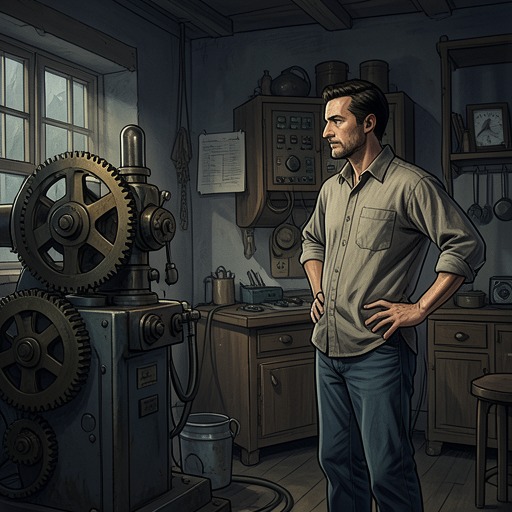
The visitor reports that Herbert was caught in the machinery. His parents receive no account of the accident beyond this stark explanation. The company’s representative expresses sympathy for their loss, while emphasizing that he is only a servant carrying out orders; his manner and words frame the announcement as an institutional message rather than a personal account of what happened at work.
Liability and Compensation
Maw and Meggins explicitly disclaims all responsibility and admits no liability. At the same time, it offers the family a sum in consideration of Herbert’s services, identifying the payment as compensation. The representative presents sympathy and refusal of responsibility in the same visit: the company acknowledges the family’s bereavement while denying that it is liable for the death.
The payment is two hundred pounds, precisely the amount Herbert had proposed as his father’s wish. When Mr. White hears the figure, he asks how much the company is offering; on receiving the answer, he smiles faintly, reaches out as though blind, and collapses unconscious. His wife’s cry goes unnoticed by him. The money therefore has two inseparable meanings in the scene: it is the company’s compensation for Herbert’s service and the fulfillment of the household’s earlier wish, arriving only through his death.
Significance of the Relationship
The employment relationship is disclosed most fully at its ending. Herbert’s work places him in contact with machinery that catches him, while the company’s response reduces its connection to him to a brief statement of sympathy, a disclaimer, and a fixed sum. The story gives no basis for treating the offer as a legally prescribed payment or for calculating its value beyond the narrative; its stated terms are the firm’s refusal of liability and its offer in consideration of his services.
By returning the same amount from wish to compensation, the episode turns money into a measure of the distance between material relief and human loss. The family had imagined two hundred pounds as a way to ease its circumstances; once the firm offers it, the sum cannot be separated from the son who will not come home.