Mrs. White’s Attempt to Open the Door for Herbert
The Monkey's PawMrs. White’s Attempt to Open the Door for Herbert is the desperate final struggle between a mother’s insistence that her dead son has returned and a father’s terror of what the wish has brought back. At the front door, grief drives Mrs. White toward Herbert while Mr. White tries to hold her back; as the bolt begins to slide, he finds the monkey’s paw and spends his last wish. The knocking stops, but the door opens onto an empty road, leaving Mrs. White’s hope answered only by absence.
The wish behind the struggle
The scene grows from the family’s first wish for two hundred pounds. At Herbert’s suggestion, Mr. White had wished for the money while the family was at home; the paw moved when he made the wish, a small physical disturbance that preceded its terrible fulfillment. Herbert was killed in an accident, and a representative of Maw and Meggins offered the bereaved parents two hundred pounds as compensation. When the representative named the sum, Mr. White collapsed. The amount that had once seemed a modest means of easing the family’s financial burden became inseparable from the loss of their son.
After Herbert’s burial, the parents returned to a house marked by shadow and silence. Mr. White used the paw again, wishing Herbert alive. That decision sets the terms of the door scene: the knocking may seem to answer Mrs. White’s longing, but Mr. White knows that the body recovered after the accident was so mutilated that he had recognized his son only by his clothing. He warns her that Herbert has been dead for ten days and asks what the returned figure could be like. His resistance does not erase his own part in bringing about the apparent return; it reflects his fear of the consequence he has already imagined.
From listening to pursuit
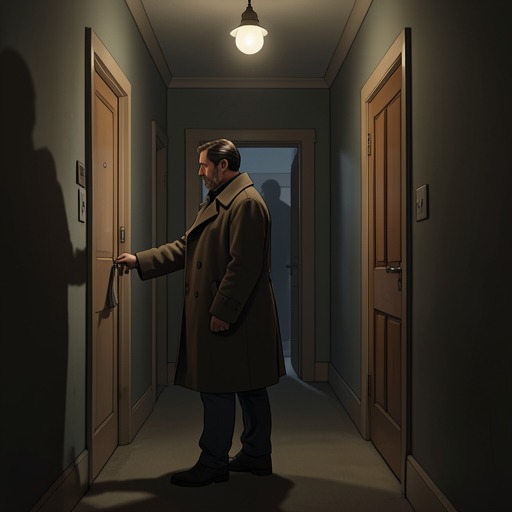
The knocking comes after a tense pause in the dark. Mr. White, chilled and unable to sleep, listens with his wife as the house settles around them. A stair creaks and a mouse runs inside the wall; then, as he goes downstairs for a candle, his match goes out and a faint knock sounds at the front door. He drops the matches and freezes. When the knocking repeats, he flees upstairs; a third knock carries through the house, and Mrs. White wakes and listens.
A louder knock turns the uncertain sound into a claim on the family. Mrs. White cries that it is Herbert and runs for the door. Mr. White reaches her first, catches her by the arm, and holds her tightly, whispering what she intends to do. She struggles mechanically, insists that the caller is her boy, and protests that she had forgotten the cemetery was two miles away. The distance makes her rush to the door more than a simple response to a visitor: she has seized on the sound as proof that the wish has overcome death.
The bolt and the last wish
Mr. White tells his wife not to let the caller in, but she hears his restraint as fear of their own son. Her answer is a renewed demand to be released, followed by a promise that she is coming. When another pair of knocks sounds, she wrenches herself free and runs downstairs. Her husband follows to the landing, appealing to her as she goes, but cannot stop her from reaching the entrance.
At the door, Mrs. White works through the fittings in stages. Mr. White hears the chain rattle back and the bottom bolt drawn slowly from its socket. She calls for him to come down and undo the bolt she cannot reach. Her movements are practical and purposeful, but each one brings the unknown visitor closer to entry. The scene’s horror lies in the collision between the familiar business of opening a household door and the possibility that the figure outside is the mutilated body Mr. White fears.
Instead of going to help with the bolt, Mr. White drops to his hands and knees, groping on the floor for the paw. The knocking becomes a fusillade, and he hears his wife place a chair against the door; then comes the creak of the bolt moving back. He finds the talisman at the last moment and frantically makes his third and final wish. The text does not state the wish’s words, but its immediate effect is unmistakable: the knocking ceases.
An open door and no return
The silence does not undo Mrs. White’s actions. The echoes of the knocking remain in the house; she draws back the chair and opens the door. A cold wind comes up the staircase, while her long, loud wail of disappointment tells Mr. White that no one is there. The street lamp across the way lights a quiet, deserted road. The scene ends not with Herbert’s return but with the absence his mother has reached the door to meet.
The episode brings the story’s connected reversals into a single threshold. Two hundred pounds first appears as a wish, then arrives as payment for Herbert’s death, and finally helps awaken the parents’ hope of reversing that death. At the entrance, Mrs. White acts on maternal attachment and refuses to accept her husband’s account of the danger; Mr. White, who once wished for the money, now spends his last chance to prevent the apparent fulfillment of his second wish. The paw’s final intervention stops the knocking, but the opened door confirms that desire cannot supply a safe or certain restoration. The struggle is therefore both a contest between husband and wife and the physical culmination of the story’s warning about wishing without knowing what its fulfillment entails.