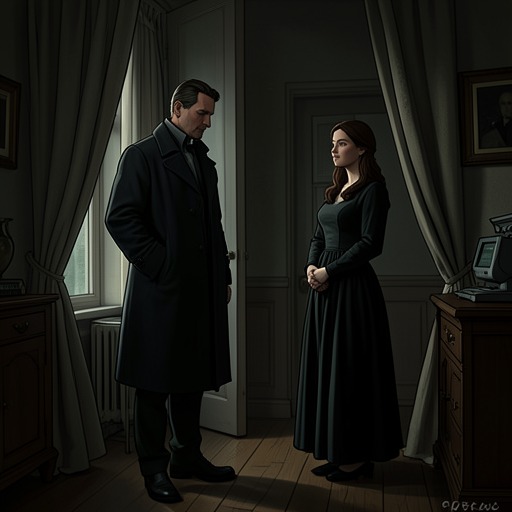
“One way out”
The Murder of Roger Ackroyd“One way out” is a phrase whose meaning turns as the novel closes: Hercule Poirot first uses it to assure Dr. James Sheppard that the murderer cannot escape, and Sheppard then repeats it in his manuscript as he resolves to kill himself with Veronal. The words bind the detective’s certainty to the narrator’s final act, while exposing how Sheppard has reshaped the language of justice to describe his own escape from exposure.
Poirot’s warning
When Sheppard worries that Poirot’s plan may put the murderer on guard and let him flee, Poirot rejects the possibility. He says there is only one way out, and that it does not lead to freedom. The line converts the apparent uncertainty of escape into a grim certainty: the killer is not going to evade the consequences of the crime.
The phrase’s force comes from its compressed contrast. An “out” ordinarily suggests a route to safety, but Poirot immediately denies that implication. His answer is not a detailed account of what will happen; it is a controlled declaration that the murderer’s options have narrowed to a fatal end. The warning also confirms that Poirot believes the murderer is among the people present that night.
Sheppard’s private reprise
At the end of his manuscript, Sheppard recalls fearing that his sister, Caroline, might guess the truth. He remembers her comment about his “strain of weakness,” then concludes that she will never know what he has done. In that private reckoning, he takes up Poirot’s phrase: there is, as Poirot said, one way out.
The echo changes the words’ direction. Poirot had spoken about the murderer in the third person; Sheppard now applies the phrase to himself. He trusts Poirot and Inspector Raglan to manage the case, but wants Caroline spared the knowledge of his guilt. He acknowledges that his death will grieve her, then dismisses that grief as something that will pass. His language turns an impending consequence into something he can choose and control.
Veronal and the ending
Sheppard names Veronal as his method and calls the choice a kind of poetic justice. He refuses responsibility for Mrs. Ferrars’s death, which he describes as the direct consequence of her own actions, yet says he has no pity for himself either. His final decision, “So let it be veronal,” makes the previously figurative “way out” concrete: it is suicide, not freedom from the moral meaning of the crime.
The expression therefore closes on an asymmetry. Poirot’s phrase announces that the murderer cannot escape; Sheppard’s reprise makes clear that he intends to determine how the ending arrives. His planned death will prevent Caroline from learning the truth, but it does not undo the crime or restore the life concealed behind his narrative. The words that first sounded like the detective’s verdict become the murderer’s chosen final act.