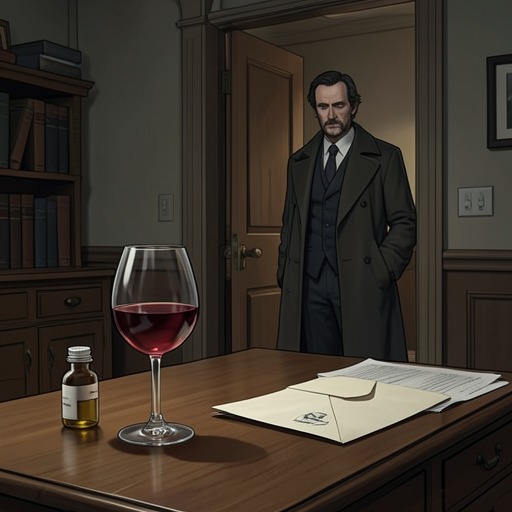
A life calls for a life
The Murder of Roger Ackroyd“A life calls for a life” is the stark moral claim in Mrs. Ferrars’s letter to Roger Ackroyd, where remorse and a demand for punishment meet. Its force comes from the letter’s private appeal: she accepts death for herself while entrusting Roger with judgment of the person who tormented her, a burden that makes the phrase both an apparent call for retribution and a confession of helplessness.
The Letter and Its Immediate Meaning
Roger unfolds the thick sheets and reads the letter aloud until he reaches the sentence that gives the expression its weight. Mrs. Ferrars says she has seen in his face that he understands the life-for-life logic; she is taking what she calls the only road open to her. She leaves Roger the punishment of the person who has made her life hell for the last year, explaining that she withheld the name in person but now intends to write it.
The letter frames her decision as an exchange: her own life is the price, while punishment is assigned to the person she blames. Yet it is not a simple declaration of vengeance. Mrs. Ferrars asks Roger to forgive the wrong she meant to do him, because when the moment came she could not do it after all. The phrase therefore holds together accusation, intended harm, failed resolve, and a plea for forgiveness.
A Private Message and a Suspended Revelation
Roger pauses with his finger on the sheet, then tells Dr. James Sheppard that he must read the rest alone. The message, he says, was meant for his eyes only. That interruption gives the phrase a charged but incomplete setting: the reader hears its governing principle and part of its explanation, while the letter’s intended disclosure remains private at that moment.
The movement from reading aloud to refusing an audience also distinguishes the phrase from ordinary conversation. It is at once a moral proposition addressed to Roger and part of a confidential communication whose full meaning depends on what the letter names. Its apparent clarity—one life answering for another—sits beside the withheld detail that could identify who is to be punished.
The Phrase Against the Novel’s Other Bargains
The wording resonates beyond the letter because the surrounding story repeatedly places people under moral and economic pressure. Mrs. Cecil Ackroyd complains that Roger left twenty thousand pounds to Flora Ackroyd rather than to her, and describes how Roger paid Flora’s bills without giving her an allowance. She says the women had no money they could call their own, while also resenting that Roger left a thousand pounds to Miss Russell. This talk of inheritance and dependence presents a domestic world in which money governs choices and fuels grievance, a worldly counterpoint to the letter’s stark language of life and punishment.
Ralph Paton’s history supplies another contrast between moral reckoning and expedient solutions. Ursula Bourne, one of seven impoverished Irish siblings, chose paid work as a parlour maid rather than becoming a nursery governess; at Fernly Park she proved quick, competent, and thorough. She and Ralph fell in love and married secretly after he persuaded her that his stepfather would not accept a penniless bride. Ralph planned to pay his debts, find work, and reveal the marriage when he could support her, but he hoped instead that Roger might clear those debts while still ignorant of the marriage.
When Roger refused to pay Ralph’s liabilities, he later summoned Ralph and plainly expressed his wish that he marry Flora. Ralph accepted the engagement as a business arrangement: it offered debt relief and a chance to start again, while he vaguely imagined it could eventually be broken off. He hid it from Ursula, whose strong, resolute nature and distaste for duplicity made him fear her reaction. Against these calculated attempts to postpone consequences, Mrs. Ferrars’s sentence sounds absolute. The novel’s surrounding conflicts, however, show how often people seek an easier immediate course rather than face what they owe.
Language of Judgment and Weakness
The phrase’s compact balance makes it memorable: a life is set against a life, as if moral debt could be settled by an equivalent payment. But the letter complicates that apparent symmetry. Mrs. Ferrars does not carry out the wrong she had intended, yet describes herself as having reached a point where death seems the only road available. Her appeal asks Roger to act where her own agency has failed, making the sentence less a triumphant rule of justice than a desperate attempt to hand judgment to someone she trusts.
In the wider pattern of the evidence, the phrase becomes a measure against which other choices can be read. Roger’s control of money affects the futures of Flora, Mrs. Cecil Ackroyd, and Ralph; Ralph’s debts and concealments lead him toward an expedient engagement; Ursula earns her living through work and resists duplicity. The letter’s life-for-life formula cuts through these negotiations with a severe moral claim, while the surrounding circumstances expose how complicated—and unequal—the pressures behind any apparent choice can be.