Dictaphone
The Murder of Roger AckroydThe Dictaphone is the recording device at the center of the false timeline in the murder of Roger Ackroyd. Purchased by Ackroyd and later used by Dr. James Sheppard, it plays a recording of Ackroyd’s voice after Ackroyd is already dead. The sound persuades others that Ackroyd was alive at half-past nine, while the device’s hidden presence and subsequent disappearance conceal how that impression was made. Its function is therefore both practical and narrative: it turns a machine’s playback into apparent testimony, and makes the gap between recorded speech and the moment of speaking decisive to the case.
Purchase and Concealment
A representative of the Dictaphone Company had visited the house on the preceding Wednesday. Ackroyd had promised to invest in a Dictaphone, but did not tell his secretary, Geoffrey Raymond, that he had bought one. Raymond later supposed that Ackroyd intended the purchase as a surprise, consistent with his fondness for surprising people. Poirot confirms that Ackroyd had in fact purchased the device from the representative. The purchase was thus known to Ackroyd and, in a different way, to Sheppard, but not to the secretary who might otherwise have recognized its role sooner.
The device had also passed into Sheppard’s hands before the murder. In his retrospective account, he acknowledges that Ackroyd had given it to him two days earlier to adjust because something had gone wrong. Sheppard persuaded Ackroyd to let him repair it rather than send it back to the company. He then brought it to Fernly Park in his bag on the evening of the murder. This prior access matters: the machine was not an unfamiliar object suddenly introduced into the study, but something Sheppard could handle and alter under the cover of legitimate repair.
The Recorded Voice and the False Timeline
The sound heard at about half-past nine initially seemed to be a real conversation. Poirot draws attention to the wording Raymond had overheard: it resembles language Ackroyd used when dictating letters, and Raymond confirms that Ackroyd had often dictated letters to him in nearly the same terms. Poirot reasons that the formal phrasing is unlikely to belong to casual conversation. The earlier visit from the Dictaphone Company then gives this oddity a material explanation: the voice may have been a recording, not a person speaking in the room.
Poirot identifies the crucial distinction between dictation and playback. A Dictaphone records a voice so that a secretary or typist can later turn it on and hear the voice again. In this case, Poirot concludes that Ackroyd was already dead at half-past nine: what the household heard was the machine speaking, not Ackroyd. The recording consequently creates a false appearance of continued life and obscures the time of death. Rather than treating the sound as direct evidence of who was present, Poirot asks what produced it and when the recorded words were made.
The device’s use also requires particular knowledge. Poirot observes that whoever arranged the playback must have known Ackroyd had bought a Dictaphone and possessed the mechanical ability to make it operate as intended. The machine therefore does more than supply a possible explanation for the voice: its purchase, access, operation, and disappearance become clues that narrow the investigation toward someone familiar with both Ackroyd and the apparatus.
Concealment, Removal, and Exposure
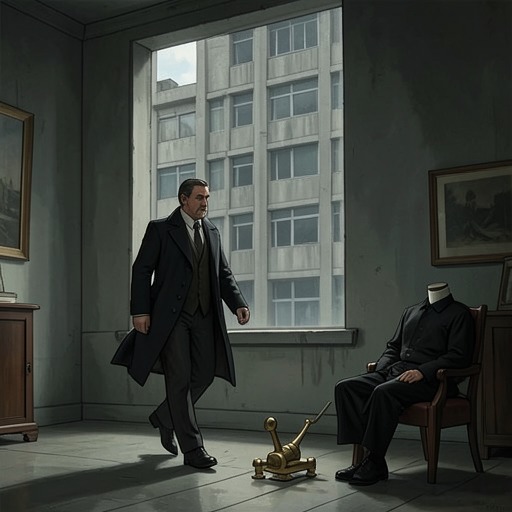
The Dictaphone was set on the table by the study window and timed to play at half-past nine. Sheppard’s account specifies that its mechanism worked on the principle of an alarm clock. He pulled the armchair out so that it hid the device from the doorway. The ordinary furniture arrangement thus became part of the deception: the machine could produce the sound that supported the apparent timeline while remaining out of sight of anyone entering the study.
After the body was discovered, Sheppard sent Parker to telephone the police. During Parker’s absence, Sheppard removed the Dictaphone by putting it into his bag and returned the chair to its proper place against the wall. He describes this as the small task he had to perform, but the action explains why the device was not found among Ackroyd’s effects. Poirot makes that absence a fresh problem in the reasoning: if Ackroyd had been using a Dictaphone, where was it? Its size meant it could not simply disappear into a pocket; the murderer needed a suitable receptacle. Sheppard’s bag, already brought to the house, supplied one.
The machine’s disappearance also links the technical deception to the suspect’s opportunity at the scene. Poirot’s reconstruction emphasizes a person who was present soon after the crime was discovered and could be alone in the study while Parker made the telephone call, as well as someone carrying a container capable of holding the Dictaphone. These circumstances converge on Sheppard. In his own account, he confirms both that he brought the repaired device in his bag and that he removed it when the police were being summoned.
Narrative and Evidentiary Significance
The Dictaphone is a plot device whose operation depends on separating the time of recording from the time of playback. Because the recorded words sound like Ackroyd’s ordinary dictation, they can be mistaken for a live exchange; because the device is hidden and then removed, the people investigating the apparent exchange lack the object that would explain it. The mystery is sustained not by a false voice alone, but by the combination of a recognizable voice, a plausible time-setting mechanism, a concealed position, and the disappearance of the machine.
The object also exposes the limits of apparently straightforward evidence. A voice heard at a particular hour seems to establish that its speaker was alive then, but the Dictaphone breaks that inference: the sound is real, while the implied occasion is not. Poirot’s solution turns on asking whether the overheard words belong to a conversation at all, and on connecting their letter-like phrasing to Ackroyd’s purchase. The recording device therefore stands at the junction of mechanical trickery and selective narration: it manufactures a misleading sound within the story, while Sheppard’s account of his own actions initially withholds what that sound and its removal mean.