Dr. James Sheppard
The Murder of Roger AckroydDr. James Sheppard is the village doctor and the first-person narrator of the investigation into Roger Ackroyd’s murder, but his position as witness and chronicler conceals his decisive role in the crime. His account initially makes him appear to be a discreet professional and a close observer of Hercule Poirot; its ending reveals that he murdered Roger, exploited the village’s habits of gossip and suspicion, and shaped his manuscript to hide what he had done. The story’s central reversal is therefore also a reversal in the status of its narrator: the man apparently recording the evidence has been selecting and arranging it against the reader.
Identity and Setting
Sheppard lives in King’s Abbot, a village whose social life is defined by its dense circulation of information. The village has a railway station, a post office, two competing general stores, and, in the narrator’s summary, gossip as its dominant recreation. Sheppard understands the effects of that network from inside it: he describes Caroline’s servants and tradespeople as an intelligence service and says he routinely withholds information from his sister because she can spread it rapidly. His professional discretion is real as a stated practice, but the narrative later gives that habit a darker double meaning: withholding is not only a way to manage village talk, but also the means by which the narrator hides his own crime.
Sheppard’s professional and local position gives him access to people and information while making his account seem dependable. He knows the village’s principal houses and inhabitants, attends Mrs. Ferrars on the morning of her death, and is on familiar terms with Roger Ackroyd. That authority lends weight to his observations, including the details he chooses to present about the investigation. Yet his narration is not a transparent record. It is a composed account whose apparent candour coexists with the deliberate omission of the act that would explain the case.
From Witness to Investigator
The narrative begins with Sheppard’s professional visit after Mrs. Ferrars dies on the night of September 16–17. He is called at eight on the morning of Friday the 17th and finds that nothing can be done because she has already been dead for some hours. He returns home shortly after nine, worried but insisting in retrospect that he did not foresee the events that would follow. The opening establishes both his medical role and his power to decide what to disclose: before speaking with Caroline, he weighs the consequences of telling her about the death.
The village setting introduces Hercule Poirot as a new neighbour at The Larches. Caroline is frustrated that she can learn little about the foreign newcomer beyond his name and his interest in growing vegetable marrows. She has plenty of questions about his origin, work, family, and marital status, but the information network that usually serves her has failed. The contrast introduces the difference between gossip and investigation: the village accumulates fragments, while Poirot will insist on testing how they fit together. Sheppard, who narrates both worlds, appears positioned to mediate between them.
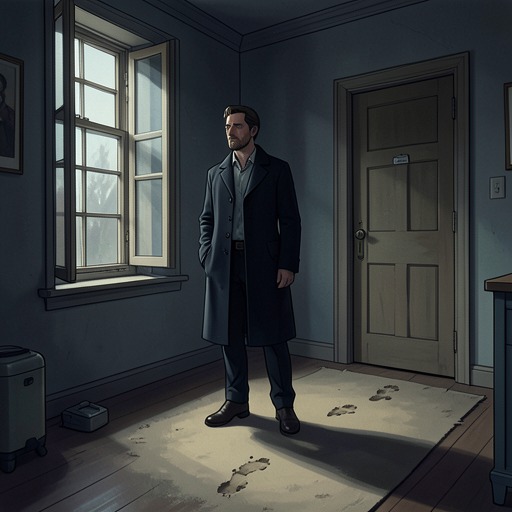
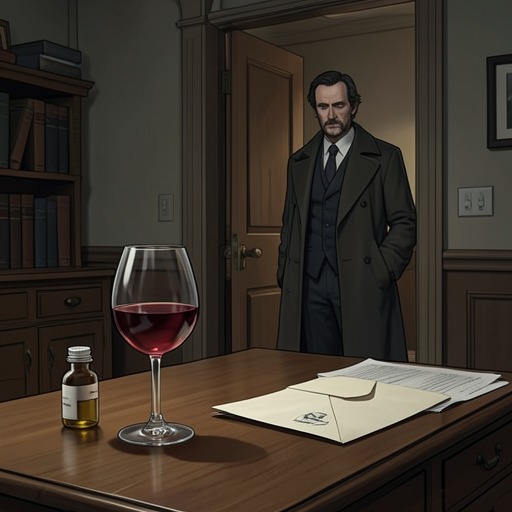
On the night Roger Ackroyd is murdered, Sheppard leaves Fernly Park shortly before nine with a letter still unread. He emphasizes the letter’s arrival at twenty minutes to nine, his departure at ten minutes to nine, and his hesitation at the door as he checks whether anything remains undone. When the murder is discovered, he tells Caroline that Parker has telephoned from Fernly and that Roger has been found dead; he then drives rapidly to the house. This sequence first presents him as the doctor urgently responding to a killing. In the confession, however, the carefully timed departure and the stated telephone summons acquire a second meaning: they are components of the alibi he constructed.
Sheppard subsequently accompanies Poirot and recounts the facts he has already set down. He describes this narration as careful and notes that Poirot listens, asking occasional questions but largely remaining silent. At first, Sheppard sees himself as Poirot’s close companion in the inquiry, following what Poirot sees while failing to read the detective’s mind. He later distinguishes the first phase of the investigation, when he remained at Poirot’s elbow, from the period after Monday evening, when Poirot pursued inquiries without taking him into his confidence. The account thus records a changing partnership while also showing the limits of Sheppard’s apparent access to the detective’s reasoning.
The Murder and the Manufactured Alibi
Poirot traces his suspicion to a discrepancy in Sheppard’s own chronology. The walk from the lodge to the house should take about five minutes, or less by the shortcut to the terrace; nevertheless, Sheppard says he left at ten minutes to nine and passed through the lodge gates at nine. The unexplained interval supplies time for the crime. Poirot reasons that Sheppard could have killed Roger while beside his chair, gone out through the front door, changed into Ralph Paton’s shoes at the summerhouse, and used them to leave misleading prints at the study window. He could then have entered through that window, locked the study door from inside, returned to the summerhouse to change back, and reached the gate by nine. Poirot reports that he tested the sequence and that it took ten minutes, the same interval his reconstruction requires.
The physical and temporal details work together. Sheppard had claimed that the study window was fastened, although Roger had asked whether he had secured it without checking it himself. Poirot recognizes that the claim rested on Sheppard’s word. The footprints and the supposed locked-room problem therefore do not independently establish Ralph’s guilt: in Poirot’s explanation, they are part of a scene Sheppard arranged to direct suspicion elsewhere. The discrepancy is not a minor error in an otherwise sound chronology; it is the opening through which Poirot reconstructs the concealed actions.
Sheppard’s motive is tied to his earlier blackmail of Mrs. Ferrars. Poirot points out that Sheppard, as the doctor attending Ashley Ferrars, had particular knowledge of what caused his death. He had spoken of an inheritance received about a year earlier, but Poirot could find no trace of it; the supposed legacy was an invented explanation for Mrs. Ferrars’s twenty thousand pounds. Sheppard had lost most of that money through speculation, then pressed Mrs. Ferrars too hard. Her suicide was an outcome he had not expected. If Roger learned the truth, Poirot argues, Sheppard would be ruined. The murder was therefore an effort to protect himself from exposure, not an act prompted by the motives the village attaches to other suspects.
The false telephone call also belongs to the construction of the alibi. Poirot admits that the call from King’s Abbot station initially obstructed his reasoning because he thought Sheppard might have invented it outright. In time, he identified a patient Sheppard had seen that Friday morning: the steward of an American liner travelling toward Liverpool that evening, a plausible intermediary for arranging a call. Sheppard’s arrival at Fernly Park allowed him to encounter the body and remove the Dictaphone on which his timed alibi depended. A professional visit, a station call, a hurried drive, and a supposed response to an emergency all serve, in retrospect, as parts of one design.
Concealment, Disclosure, and Poirot’s Investigation
Sheppard’s relationship with Ralph Paton complicates his outward role. Poirot observes that Sheppard went to the Three Boars hoping to find Ralph after the murder, and that he might have met him on the way home instead. Under questioning, Sheppard admits that he had visited Ralph earlier that afternoon. Ralph initially refused to confide in him, but later disclosed his marriage and his predicament. Sheppard understood that the known facts would expose Ralph—or the woman he loved—to suspicion, and he agreed to help him. Poirot concludes that Sheppard succeeded in hiding Ralph from the police.
The hiding place was a nursing home near Cranchester, not Sheppard’s house. Poirot reasoned that a person concealing Ralph would choose somewhere close at hand, considered and rejected a hotel or lodgings, and settled on a home for people described as mentally unfit. To test the idea, he invented a nephew with mental trouble and asked Mademoiselle Sheppard for suitable homes. She named two near Cranchester to which her brother had sent patients. Poirot made inquiries and learned that Sheppard himself had brought a patient to one of them early on Saturday morning. The patient was registered under another name but identified as Ralph; after completing the necessary formalities, Poirot brought him to his own house. The chain of reasoning turns Caroline’s local knowledge into an investigative lead, while revealing that Sheppard’s care for Ralph and his concealment of the young man also protected Sheppard’s own control over the case.
Sheppard also lets information escape in ways that betray both his access and his judgment. At home, goaded by Caroline, he boasts of a gold wedding ring inscribed with a date and the words “From R.” When pressed, he has to say where it was found and give its date, March 13. The disclosure demonstrates that he possesses details of the investigation before Caroline does, but it also shows how readily his confidence can draw him into revealing more than he intends. Elsewhere, when Colonel Carter mentions hearing blackmail connected with Ackroyd’s murder, Sheppard recognizes that the rumour could have come from someone listening at a door. He tells Inspector Davis that Parker must have been close enough to the keyhole to overhear. The scene places Sheppard in the role of a man interpreting how information travels, while the eventual revelation makes his own management of secrets the larger issue.
Poirot’s investigation depends on treating apparent cooperation as incomplete. In his account of the inquiry, Sheppard says he wrote down suggestions and read them aloud, presenting himself as a participant in logical analysis. He also records that he took Poirot’s quiet confidence in Ralph’s innocence as a disagreement with his own assessment. Later, Poirot recalls a gathering at which he accused the people present of concealing something: four disclosed their secrets, but Sheppard did not. Poirot says that he had suspected him all along. The contrast is structural as well as personal: Sheppard’s narrative gives readers an investigator’s notebook, but Poirot is looking beyond the notebook to the gaps the writer has made in it.
The Manuscript and Its Ending
The final confession reinterprets the conspicuous precision of Sheppard’s earlier prose. He quotes his own account of the letter arriving at twenty minutes to nine and his departure at ten minutes to nine, then points to the blank interval that the passage leaves unrecorded. Every word in the quoted account is true, he says; its deception lies in what the account does not tell. The pause at the door, framed as a moment of conscientious reflection, has therefore served as cover for the omitted action. The manuscript’s polished accuracy is not proof of its reliability but one of the devices by which it conceals the truth.
Sheppard says he had intended his manuscript to be published as the history of one of Poirot’s failures. By the time he finishes writing, at five in the morning, that purpose has collapsed: Poirot has solved the case, exposed the narrator, and recovered Ralph. Sheppard’s self-assessment as a writer remains part of the final performance; he takes satisfaction in the neatness of his misleading passage even as he explains the deception. The act of writing becomes both a last attempt at control and the medium through which the crime is finally laid bare.
As a character, Sheppard embodies the novel’s most consequential conflict between information and truth. His medical status, local familiarity, apparent cooperation, and first-person voice grant him unusual authority, while his omissions turn those same advantages into instruments of concealment. The reader is not simply given false facts: the narrator presents carefully selected true facts and leaves the crucial interval blank. His exposure reveals that the mystery has been shaped not only by a hidden killer but by the form of the account itself. He is simultaneously the recorder of the investigation, the protector of a suspect, the maker of a false alibi, and the murderer whose written record cannot finally contain what Poirot has inferred.