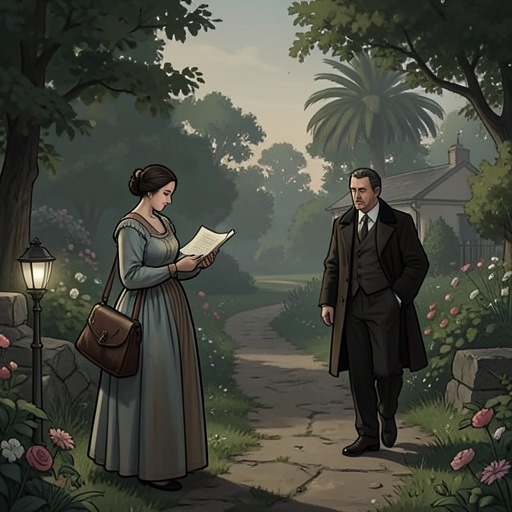
Engagement of Roger Ackroyd and Mrs. Ferrars
The Murder of Roger AckroydThe engagement of Roger Ackroyd and Mrs. Ferrars was a delayed, private commitment that became inseparable from her confession of murder. When she revealed that she had poisoned her husband, Ackroyd’s response exposed the limits of his capacity to forgive and left him weighing his duty against the request for silence she made before her death.
The Private Engagement
Three months before the conversation with Dr. James Sheppard, Ackroyd asked Mrs. Ferrars to marry him. She initially refused, but later consented on the condition that he keep the engagement private until her year of mourning for her husband had ended. Ackroyd considered that period complete after a year and three weeks, and called on her to say that there was no longer an objection to making their engagement public.
The proposed announcement therefore came at a moment when Ackroyd expected their relationship to move from private agreement to public recognition. Instead, Mrs. Ferrars’s unusual manner gave way to a confession that transformed the meaning of their commitment.
Confession and Rupture
Mrs. Ferrars told Ackroyd that she had hated her husband, had grown to love Ackroyd, and had poisoned her husband. The revelation joined the beginning of their prospective marriage to the crime that preceded it: the woman Ackroyd intended to marry disclosed that her previous husband had died by her hand.
Ackroyd’s reaction was one of shock and horror. The narration presents him as a fundamentally law-abiding man, not someone able to set aside a serious crime for the sake of love. His response makes the engagement a test of competing claims: his affection for Mrs. Ferrars on one side, and his civic and moral understanding of murder on the other.
Blackmail and the Demand for Silence
Mrs. Ferrars also disclosed that someone had known of the poisoning and had been blackmailing her for large sums. Ackroyd understood the continuing pressure as a cause of her near-collapse, but she refused to name the blackmailer. Her account introduced a second secret into the engagement: alongside her concealed crime stood an unidentified person exploiting that knowledge.
After seeing how deeply the confession had shocked him, Mrs. Ferrars asked Ackroyd to promise that he would do nothing for twenty-four hours. She said he would hear from her before the period ended, while withholding the blackmailer’s identity. Ackroyd later recognized that she had understood the consequences more quickly than he had: she feared that he might confront the blackmailer, an action that could expose her. He says he did not understand that her promised communication meant suicide, and blamed himself for having driven her to it.
Duty, Loss, and Significance
After Mrs. Ferrars’s death, Ackroyd asked what he ought to do and questioned whether it was right to revive past trouble. The engagement, never yet made public, thus leaves him not with a wedding announcement but with a demand to decide what to do about a confession and an unresolved blackmail secret. His promise of delay, made before he knew what she intended, further complicates the distinction between keeping faith with her request and pursuing the matter after her death.
The relationship matters to the mystery because it links Ackroyd’s private future to the poisoning, the blackmail, and the information he receives shortly before his murder. Its brief course is defined by reversal: the visit intended to remove an obstacle to public engagement instead reveals the crime that makes the engagement morally fraught, and Mrs. Ferrars’s request for a day’s silence becomes a source of regret rather than a path to resolution.