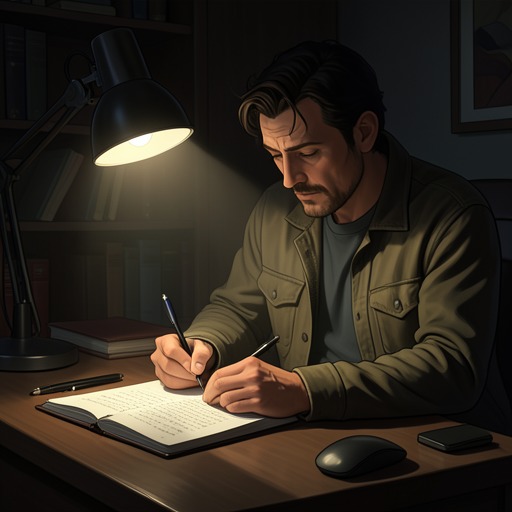
Everyone concerned in them has something to hide
The Murder of Roger Ackroyd“Everyone concerned in them has something to hide” is Poirot’s quiet rule for approaching the Ackroyd case—and, in retrospect, a warning about the account through which the reader encounters it. Concealment is not confined to suspects: it reaches witnesses, household members, and the narrator himself. The phrase turns the investigation from a search for one suspicious person into a scrutiny of everyone’s partial knowledge, including the supposedly complete story being told.
The maxim in the investigation
Poirot states the principle after Dr. James Sheppard asks whether Parker is telling the truth. Poirot distinguishes Parker’s account of the chair from his reliability in other matters, then generalizes: people involved in such cases each have something to conceal. When Sheppard smilingly asks whether he does too, Poirot looks at him attentively and answers that he thinks so. The exchange makes the expression both an investigative method and an early, pointed suspicion of the narrator.
The maxim does not mean that every hidden fact proves murder. The investigation contains different kinds of concealment, and Poirot’s task is to separate their significance rather than treat them as equivalent. His approach challenges the assumption that an apparently relevant statement is complete or that a witness’s certainty establishes what actually happened.
A village of watchers and secrets
The setting gives concealment a social counterpart in gossip. King’s Abbot is described as a village whose recreations can be summed up in that one word; its residents gather information through everyday contacts, yet the flow of talk does not guarantee reliable knowledge. Caroline is especially eager to discover everything about the foreign newcomer at The Larches, from his origins and work to his family. Her curiosity exemplifies the village’s habit of treating private information as a shared pursuit, even as important facts remain inaccessible or misread.
That contrast matters to the maxim. The village is hungry for information, but knowing fragments is not the same as knowing the truth. The case’s participants can each possess a private fact, offer a misleading impression, or remain silent about what they know. The resulting abundance of talk produces clues as well as false confidence.
Concealment inside the evidence
The investigation repeatedly tests what evidence can actually establish. When Inspector Raglan argues that fingerprints on the dagger must belong to someone who was in the house that night, Poirot agrees that the prints were made by someone in the house but proposes that they are Roger Ackroyd’s own. The distinction changes the meaning of the physical evidence: the dead man’s fingerprints could have been placed on the handle after the blow, with the murderer manipulating his hand. A trace can be genuine and still invite a false inference about how it came to be there.
Poirot similarly re-examines the testimony surrounding Flora Ackroyd’s supposed departure from the study. Raglan treats her account and Parker’s observation as proof that Roger was alive at the time. Poirot says Parker saw her outside the door with her hand on its handle, not actually emerging from the room; she may have been on the stairs. The discrepancy is narrow, but it exposes how an apparently straightforward witness statement can acquire more certainty in retelling than the observation supports.
His later reconstruction makes the maxim’s application to Sheppard concrete. Poirot returns to the ten minutes between Sheppard’s reported departure from Fernly Park at ten to nine and his arrival at the lodge gates at nine, against the stated five-minute walk. He explains that the interval could accommodate the murder, a circuit through the summerhouse, a change into Ralph Paton’s boots to create tracks at the study window, and a return to his own shoes before reaching the gate. The discrepancy turns a seemingly incidental measurement into evidence of a concealed sequence—and connects the expression to Sheppard’s hidden use of the dictaphone to establish an alibi.
The narrator’s concealed account
Sheppard’s manuscript makes the maxim reflexive: the person who records the investigation is himself the person whose account must be interrogated. He presents the evening’s movements with exact times, then admits in his concluding pages that he had taken precautions after suspecting that Mrs. Ferrars might have told Ackroyd the truth. He had adjusted the dictaphone and carried it to Fernly Park; the apparent gap in his narrative, between the letter’s arrival at twenty minutes to nine and his departure just before nine, concealed the crucial interval. He observes that the sentences were literally true, while acknowledging that a row of stars after the first would have drawn attention to the blank ten minutes.
This retrospective admission reshapes the earlier narrative. Sheppard describes himself as having told Poirot all the circumstances, yet his report was never a transparent record: its selection and arrangement concealed his own actions. He also explains that Poirot shared discoveries but withheld his vital impressions, while the investigation after Monday divided into separate paths. Knowledge is partial on both sides, but the imbalance is decisive: Poirot recognizes what the narrator’s account leaves unresolved, while the reader initially receives that account as the record of a medical companion to the detective.
Meaning and narrative effect
The expression works on two levels. Within the case, it counsels suspicion toward incomplete testimony without assuming that every secret is equally incriminating. In the novel’s form, it prepares for the reversal in which the apparent recorder of evidence is exposed as the criminal who has shaped that evidence for the reader. The maxim’s quiet second-person challenge to Sheppard is therefore not merely a general observation about suspects; it points toward the central concealed fact in the narrative itself.
Its force also lies in the difference between gossip and detection. King’s Abbot gathers stories readily, but Poirot’s work depends on testing their particulars: who saw Flora, what the fingerprints establish, and how long the walk to the lodge should take. Concealment makes the village’s fragments dangerous when accepted at face value; careful comparison turns them into a route toward the truth.