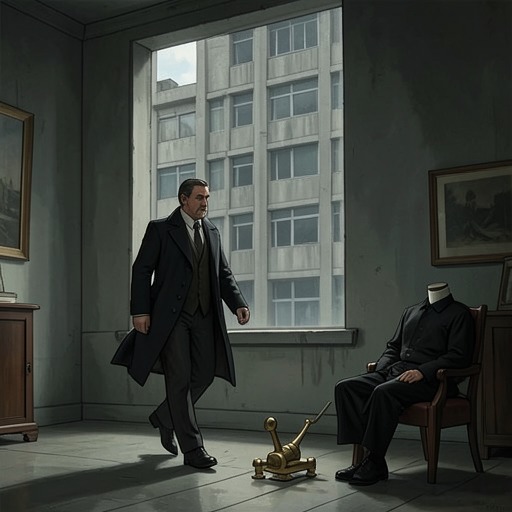
Geoffrey Raymond
The Murder of Roger AckroydGeoffrey Raymond is Roger Ackroyd’s secretary at Fernly Park, a capable and personable young man whose concealed debt makes him an apparent suspect before his testimony helps resolve a central puzzle. His role is tightly bound to the novel’s concern with incomplete knowledge: he has kept a financial embarrassment from the police, yet he also supplies evidence that redirects attention from a supposed visitor in Ackroyd’s study to a mechanical recording.
Identity and Place in the Household
Raymond first appears at Fernly Park carrying papers on his way to Ackroyd’s study, just before dinner. He greets Dr. James Sheppard and asks whether the doctor has come to dine or on a professional call, noticing the black bag Sheppard has set down. The exchange establishes Raymond’s place in the household’s working routine: he is a secretary with access to Ackroyd’s business and papers, and he moves readily between the hall, study, and company assembled for dinner.
At dinner Raymond sits beside Hector Blunt, while Sheppard sits between Mrs. Cecil Ackroyd and Flora Ackroyd. Ackroyd is visibly preoccupied and eats almost nothing; Raymond is among those who keep the conversation going. The scene places him among the household’s witnesses without making him the focus of its private tensions. His social ease later becomes part of how others read him: he is described as fresh and debonair, with an engaging frankness that makes him likeable.
The Study Voice and the Initial Suspicion
Raymond becomes important to the timeline because he reports hearing Ackroyd speaking in the study at half-past nine. He had wanted to ask Ackroyd a question about some papers, but hearing voices, he assumed Dr. Sheppard was still with his employer and withdrew rather than interrupt. At the time, Raymond treated the sound as ordinary conversation; after the murder, it appears to support the possibility that someone was present with Ackroyd later in the evening.
That recollection is not his alone. During Poirot’s final reconstruction, Raymond points out that Blunt, standing outside on the terrace, also heard voices, though he could not make out the words. Blunt had believed Ackroyd was speaking to Raymond. Raymond clarifies that Blunt now knows he was mistaken, while Poirot emphasizes that the exact words Raymond heard are not the only evidence that a voice sounded from the study. Raymond’s insistence matters because it preserves the distinction between what he can attest to and what the sound seemed to mean.
Debt, Confession, and Alibi
Poirot’s challenge that everyone has concealed something prompts Raymond to return to Sheppard and Poirot with a confession. He says his conscience has troubled him since the previous afternoon because he had something up his sleeve. The secret is not a role in the murder but serious debt. Ackroyd’s legacy of five hundred pounds, Raymond explains, arrived just in time to put him back on his feet, with a little left over.
Raymond had withheld this because he expected the police to regard financial need as suspicious. His explanation does not erase the concealment, but it gives it a specific, limited motive: he feared that admitting his debts would make him look guilty. He also provides the fact that protects him from suspicion: he and Blunt were together in the billiard room from a quarter to ten onward, giving him what he calls a watertight alibi. The confession thus separates concealment from criminality, a distinction the investigation must repeatedly make in a community where nearly everyone has something they would rather keep private.
The Dictaphone and the Case’s Resolution
Raymond’s knowledge of Ackroyd’s business helps him understand Poirot’s explanation of the recorded voice. Poirot recalls that a young representative from the Dictaphone Company had visited on Wednesday and learns that Ackroyd purchased a Dictaphone, despite not telling Raymond about the purchase. Raymond immediately grasps the implication: the voice heard in the study could have been produced by the machine. He suggests that Ackroyd may have intended to surprise him and had been experimenting with the device like a new toy.
This realization changes the meaning of Raymond’s earlier evidence. The sound he heard seemed to confirm a conversation with a visitor, but it did not prove that a visitor was physically present. Raymond’s recognition of the Dictaphone connects a mundane business detail to the murder’s deceptive timeline and helps account for how Ackroyd’s voice could appear to continue after the circumstances had changed. His contribution is not the solution by itself; rather, his familiarity with Ackroyd’s affairs allows him to see how the machine fits Poirot’s reconstruction.
Narrative Role
Raymond’s arc is a compact example of the difference between a secret and a crime. His debt gives the police and readers a plausible reason to distrust him, and his confession arrives only after Poirot’s general accusation makes concealment itself feel incriminating. Yet the details he supplies—his companionship with Blunt and his immediate understanding of the Dictaphone—make him more useful as a witness than as a suspect.
His movement from household secretary to questioned witness and then to interpreter of the mechanical clue also supports the novel’s wider investigation of evidence. A voice can be heard accurately and still be misunderstood; an alibi can be valid even when its owner has another embarrassing secret. Raymond’s part in the case turns on these distinctions, and his candid admission helps reveal how suspicion can arise from facts that are real but incomplete.