Hector Blunt
The Murder of Roger AckroydHector Blunt is Roger Ackroyd’s old friend, a renowned big-game hunter whose quiet, watchful presence sets him apart from the people surrounding Ackroyd’s murder. The apparent exception among the household’s potential beneficiaries, he becomes more than a stoic observer when he protects Flora Ackroyd from suspicion: beneath his reserve lies a love he has tried to keep secret. His role turns on that contrast between outward reticence and private feeling, while the investigation tests how easily apparent motives and circumstantial clues can distort judgment.
Identity and Introduction
Blunt is known by reputation as a big-game hunter who has shot wild animals in remote and unlikely places. His friendship with Ackroyd puzzles Dr. James Sheppard because the two men seem so unlike one another. They became friends early in life, and, although their paths have diverged, the bond has endured. Roughly once every two years Blunt spends a fortnight at Fernly Park; an animal’s many-horned head displayed inside the front door stands as a lasting reminder of that friendship.
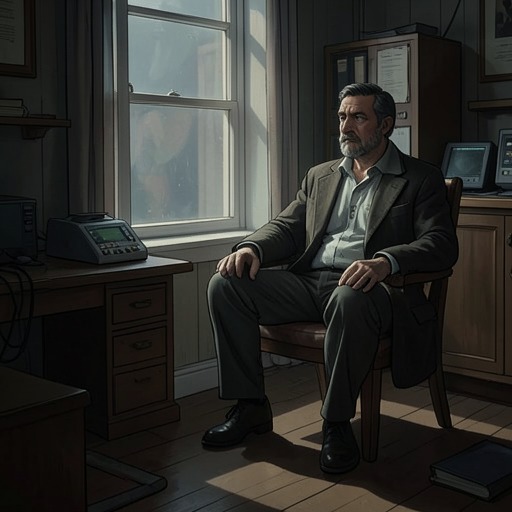
He enters with a deliberate but soft-footed tread. Of medium height and stocky build, he has a mahogany-coloured face and an almost expressionless manner. His grey eyes seem fixed on events at a great distance. He speaks little, and his words come jerkily, as if reluctantly released. When he greets Sheppard, he does so abruptly, then stands squarely before the fireplace, looking over the others’ heads. His stillness is not sociability: it makes him seem present in the room yet absorbed elsewhere.
Under Suspicion
The police initially have reason to focus on Ralph Paton, not Blunt. Paton was seen near Fernly Park at about half past nine, had not been seen since, and was believed to be in serious financial difficulty. The inspector has Paton’s rubber-studded shoes and intends to compare them with the marks at the study window. In the inspector’s reconstruction, Paton could have entered the study, taken the dagger from the silver table, and escaped through the window. Blunt’s importance to this early theory is indirect: it is his presence in the house, and the movements of the other guests, that help establish which opportunities the police imagine for Paton.
Poirot later emphasizes that many people in the house might gain financially from Ackroyd’s death, whereas Blunt is the sole person in his list who does not. This apparent lack of a financial stake seems to separate him from the other suspects. Yet Poirot has also made inquiries into Blunt’s circumstances: a legacy Blunt had mentioned was worth close to twenty thousand pounds. The finding complicates any easy assumption about his finances, but the evidence does not turn the inheritance into a murder motive. Instead, it shows how a large sum, disclosed in the course of the inquiry, can unsettle the neat categories by which suspicion is organized.
The dramatic image of Blunt as an obviously wealthy, famous man is itself undercut by Sheppard’s dry joke about detective fiction. Sheppard imagines the conventional super-detective surrounded by rubies, pearls, and emeralds given by grateful royal clients, then asks sarcastically whether Poirot received an emerald tie pin as large as a plover’s egg. Blunt is not the subject of the joke, but the exchange sharpens the novel’s scrutiny of reputation: fame and social image are not evidence, and neither can substitute for tracing a person’s actual movements and opportunities.
A Quiet Witness
Blunt’s reserve affects what he can contribute to the investigation. Raymond reports that he was on the terrace and heard Ackroyd speaking to someone in the study, although he could not make out the words clearly. Blunt had also heard the voices, but believed at the time that Ackroyd was talking to Raymond. Poirot points out that this belief was mistaken; Raymond responds that Blunt now knows it was not he who was being addressed. The distinction matters: Blunt confirms that a conversation took place, but his initial identification of the other speaker was wrong. His testimony supports the fact of another voice without establishing the speaker’s identity.
That limited witness account belongs to the investigation’s larger effort to distinguish what was heard from what was inferred. The inspector’s early narrative turns the movements around the house into a seamless explanation of Paton’s guilt. Poirot’s method, by contrast, revisits each clue and asks what it actually establishes. Blunt’s presence on the terrace adds a piece to the timeline, but it does not make him an all-knowing witness or validate the inspector’s conclusion.
Protecting Flora
Blunt’s most consequential action occurs when Flora claims she took money and says she did so to shield Paton. As the inspector appears to treat the matter as settled, Blunt comes forward to say that the money was given to him by Ackroyd for a special purpose and that Flora never touched it. He states that her confession is a lie intended to protect Paton, offers to testify under oath, and leaves the room with a jerky bow. His intervention puts his own word behind Flora’s denial and makes his loyalty visible through action rather than explanation.
The moment also changes the meaning of his silence. Blunt has not been indifferent to Flora’s danger; he has been holding back until her attempt at self-sacrifice makes intervention necessary. Poirot follows him and insists that Blunt listen. He says he has understood what Blunt has concealed: Blunt loves Flora, has loved her from the first moment he saw her, and has tried to hide that fact from the world. Poirot urges him not to conceal it from Flora herself. Blunt responds sharply by demanding to know what Poirot means. The exposure does not make him confess in a speech; the preceding conduct has already given the revelation its force.
The relationship is presented through an asymmetry of knowledge. Blunt’s attachment is legible to Poirot, while Blunt has kept it private; the evidence here does not establish Flora’s response to that love. The crucial proof of feeling is therefore not a declared romance but a protective act: he steps between Flora and the police’s suspicion, accepts the possibility of sworn testimony, and lets the truth of his loyalty emerge under pressure.
Significance in the Mystery
Blunt is initially marked by a set of apparent oppositions: he is celebrated but emotionally opaque, a long-standing friend of Ackroyd yet unlike him, and apparently unlike the household in having no financial benefit from the murder. Those contrasts make him easy to read as a stable background figure. The narrative revises that impression without making him the killer. His concealed love for Flora supplies a private motive for protecting her, while his testimony about hearing a voice contributes to the account of the night without resolving who spoke.
In Poirot’s reconstruction, the final test of the murderer concerns a chain of specific opportunities: being at the Three Boars earlier, knowing Ackroyd had bought a Dictaphone, possessing mechanical knowledge, having a chance to take the dagger before Flora arrived, carrying a suitable receptacle such as a black bag, and being alone in the study briefly after Parker telephoned the police. The requirements direct the accusation away from Blunt and toward Dr. James Sheppard. Blunt’s importance is thus not that he secretly fits the final pattern, but that the inquiry separates his genuine concealment—a love he hides—from the criminal concealment that shaped the murder. His guarded manner can obscure feeling, but it does not make every secret equivalent.