Mrs Ferrars’s suicide
The Murder of Roger AckroydMrs Ferrars’s suicide is the death at the center of the novel’s opening crisis: after confessing to Roger Ackroyd that she poisoned her husband, Ashley Ferrars, she takes an overdose of veronal and leaves Ackroyd a letter asking him to punish the person who blackmailed her. The death transforms a private confession into a question of guilt, duty, and concealment, while the identity of the blackmailer remains hidden from the people who most urgently want to know it.
Causes and Background
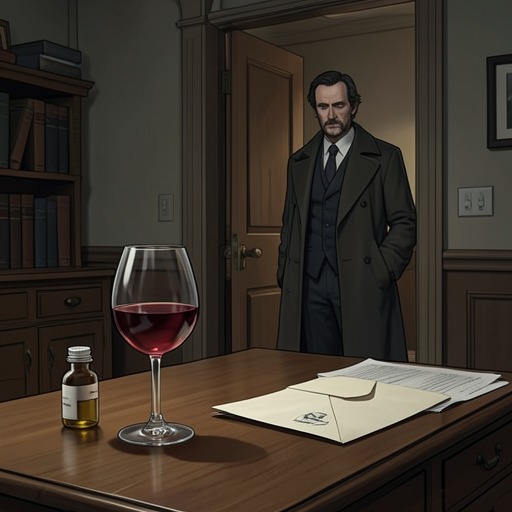
Mrs Ferrars had been taking veronal for sleeplessness. On the night of 16–17 September, she took an overdose and died. Dr. James Sheppard was summoned at eight on the morning of Friday, 17 September, but when he arrived she had already been dead for several hours. He initially described the death as an accidental excess of a medicine she had lately been using; Caroline immediately insisted that Mrs Ferrars had taken it deliberately. The disagreement establishes the central fact and its uncertainty at once: the physical cause is an overdose, but the question of intention is contested from the outset.
The circumstances behind the death emerge through Ackroyd’s account of a conversation with Mrs Ferrars the previous day. Three months earlier, he had asked her to marry him. She first refused, then accepted, but asked that the engagement remain private until her year of mourning ended. After a year and three weeks had passed since her husband’s death, Ackroyd called on her to say there was no longer an objection to making their engagement public. Instead of welcoming the announcement, she broke down and told him that she had hated her husband, had grown to love Ackroyd, and had murdered her husband by poison.
The confession changes the meaning of the proposed marriage. Ackroyd is not able to separate his love and sympathy from his understanding of civic and legal duty: the revelation horrifies him, and he recognizes that Mrs Ferrars sees his reaction. She asks him to wait twenty-four hours before acting, promising that she will contact him again, but refuses to name the person who has been blackmailing her. Ackroyd suspects that the blackmailer may be among the people in his own household, though he cannot bring himself to accept the possibility. The combination of a concealed crime, a concealed blackmailer, and a promised delay leaves both the confession and its consequences suspended when Mrs Ferrars dies.
The Death and the Letter
In the letter she leaves for Ackroyd, Mrs Ferrars frames her suicide as a response to the person who has made her life a hell for the past year. She writes, “A life calls for a life,” and describes taking the only road open to her. She says she had been unwilling to name the blackmailer in person but has now decided to do so in writing. The letter also asks Ackroyd to forgive the wrong she had meant to do him, since she could not carry it out after all. Her words bind together the poisoning of her husband, the blackmail, and her own death without making those acts morally equivalent or resolving what Ackroyd should do next.
Ackroyd reads the letter aloud to Sheppard, but stops when he reaches the point where it is about to disclose the blackmailer’s name. He asks to read the rest alone, explaining that it was intended for his eyes only. This interruption leaves the most consequential information concealed at the moment when the reader learns that it exists. Mrs Ferrars’s suicide therefore produces not a completed explanation but a new secret: her letter can identify the blackmailer, yet Ackroyd keeps that identification private.
Consequences and Significance
The suicide leaves Ackroyd with the belief that he may have helped cause it. Mrs Ferrars had asked him to wait, and he had promised; he insists that he never imagined she intended to kill herself. After her death, he tells Sheppard that she has made him an accessory after the fact to her husband’s murder and asks what he ought to do. At the same time, he argues that the dead woman’s past should not be reopened. His conflict is between a sense of duty toward the law and a wish to let a dead woman’s secret remain buried, sharpened by his own recent engagement to her and by her request that he punish her blackmailer.
For Sheppard, the death is both a medical call and the beginning of the troubles he senses ahead. His account distinguishes the settled fact of the overdose from Caroline’s immediate certainty about suicide, while his subsequent narration reveals the confession and the unanswered question of blackmail. The sequence makes the reader’s knowledge depend on what Ackroyd tells Sheppard, what he withholds by reading the letter alone, and what Sheppard chooses to recount. Mrs Ferrars’s death thus sets the novel’s investigation in motion through a chain of secrets rather than a single disclosed cause: a husband poisoned, a blackmailer unnamed, and a letter whose decisive line is kept from its first listener.