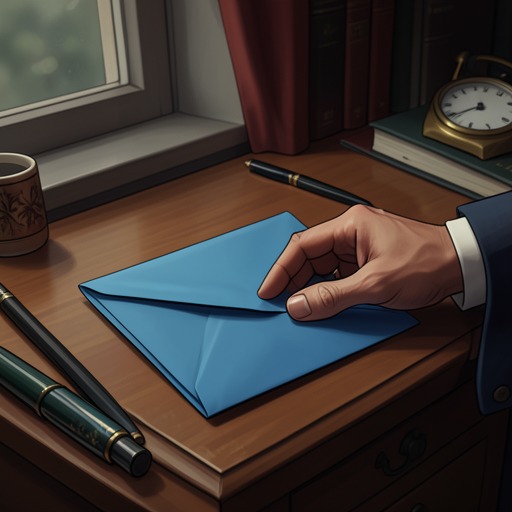
Mrs. Ferrars’s letter
The Murder of Roger AckroydMrs. Ferrars’s letter is a private confession whose concealed name becomes central to the mystery surrounding Roger Ackroyd’s murder. Read aloud only in part, it records Mrs. Ferrars’s remorse and her intention to identify the person who had made her life hell; before Ackroyd can finish reading it, the letter is left unread and later vanishes from his study. Its movement from intimate message to missing evidence makes the letter a hinge between personal guilt and the investigation.
The Confession and Its Unfinished Disclosure
The letter addresses Ackroyd as a dearly loved correspondent and frames its writer’s decision in terms of retribution: “A life calls for a life.” Mrs. Ferrars says that she recognized the need for such an accounting in Ackroyd’s face that afternoon. She describes taking the only road open to her and leaving him to punish the person who had made her life a hell on earth for the past year. The letter thus presents her death not as an isolated private act but as an appeal for Ackroyd to act against someone who has harmed her.
The disclosure is carefully divided. Mrs. Ferrars says she had not told Ackroyd the man’s name that afternoon, but now proposes to write it. She adds that she has no children or close relations who need protection from publicity. This reassurance removes one possible reason to withhold the accusation, while making the written name seem all the more consequential: the letter is intended to transfer knowledge and responsibility to Ackroyd. It also acknowledges the wrong she meant to do him, saying that when the moment came she could not do it after all. The passage binds confession, threatened harm, and remorse together without revealing the identity of the person she names.
The letter is already physically incomplete as evidence when Ackroyd reads it. He unfolds the thick sheets and reads in a low voice, but pauses with a finger on the page as if to turn it over. He then stops, explaining that the message was meant for his eyes alone. The interrupted reading leaves the central identification concealed from the other people present and from the reader at that moment.
Ackroyd Keeps the Letter Private
Ackroyd’s decision to read the letter alone turns its privacy into a decisive delay. He puts it back into its envelope and lays it on the table, saying he will read it later, when alone. Dr. James Sheppard urges him to continue, first asking him to read the man’s name, but Ackroyd refuses. The more Sheppard presses, the more firmly Ackroyd holds to his decision; Sheppard leaves with the letter still unread.
The timing is precise: the letter was brought in at twenty minutes to nine, and Sheppard leaves just before ten minutes to nine. He pauses at the door, looks back, and wonders whether anything has been left undone, but can think of nothing. This interval matters because the letter has reached Ackroyd and is within the study, yet its decisive contents have not been read aloud. The scene gives the document a tense double status: it is present and potentially revelatory, but its secrecy prevents it from resolving anything before Sheppard departs.
Sheppard encounters Parker nearby after leaving. He thinks the butler may have been listening at the door, but does not establish that he did so. The possibility reinforces the letter’s unstable privacy: Ackroyd insists that it was meant for his eyes alone, while the people around the study may still be alert to what it contains.
The Missing Blue Envelope
Later, after Ackroyd is found murdered, the letter’s physical absence becomes an immediate problem. Geoffrey Raymond is sorting papers on the desk, and Hector Blunt points out several letters lying on the floor, where Ackroyd had dropped them earlier in the evening. Among the scattered papers, however, the blue envelope containing Mrs. Ferrars’s letter is missing.
The distinction between the letters left behind and the missing envelope gives the absence particular force. The study shows no sign that drawers have been tampered with, and Raymond remarks that nothing else seems to be missing. The letter’s disappearance therefore stands out against the otherwise undisturbed room. Sheppard begins to speak when he notices it, but the sound of a bell and the arrival of the local inspector and a constable interrupt him. The letter is not merely an important document that has been read; it is a document whose whereabouts become a question at the moment the murder investigation begins.
Narrative and Investigative Significance
The letter’s role depends on a sequence of withholding. Mrs. Ferrars writes that she will name the person who has tormented her; Ackroyd refuses to read that name in company; Sheppard leaves before Ackroyd has read the letter; then the blue envelope is missing. Each step preserves the secret while increasing the importance of the document. The reader is made to attend not only to what the letter says, but to who has or has not had access to its unwritten or unread remainder.
As a piece of correspondence, the letter carries the particular authority of a private message addressed to Ackroyd. Its language is intimate and apologetic, but its purpose is also accusatory: it places a future punishment in his hands. That mixture complicates the document’s apparent simplicity. It is at once a confession, a warning about a third party, and a potential source of evidence; because its most important disclosure is withheld and the envelope disappears, its significance grows through absence as much as through the words actually read aloud.