Murder of Roger Ackroyd
The Murder of Roger AckroydThe Murder of Roger Ackroyd is the crime around which the investigation turns—and the event whose apparent timing and sealed-room circumstances conceal Dr. James Sheppard’s guilt. The first account presents a physician answering a call for help, forcing entry with the butler, and finding his friend dead; the later reconstruction shows that Sheppard had killed Roger Ackroyd before leaving the house, then arranged the evidence to make the death appear later and himself appear innocent.
Causes and Opportunity
The murder grows out of Sheppard’s fear that Ackroyd will discover his blackmail of Mrs. Ferrars. Sheppard had attended her husband, Ashley Ferrars, and therefore had particular knowledge of the poisoning that caused his death. After Mrs. Ferrars’s death, he believed she might have told Ackroyd the truth. Poirot later identifies safety—not an inheritance or some newly invented motive—as Sheppard’s purpose: exposure would ruin him, and Ackroyd would show him no mercy.
The crime was prepared in advance but, in Sheppard’s retrospective account, also shaped by the evening’s uncertainty. Ackroyd had lent him a Dictaphone two days earlier for adjustment. Sheppard took it to Fernly Park in his bag, having arranged its mechanism to speak at half past nine. He says he feared Ackroyd might know the truth, yet allowed for the possibility that the agitation concerned Ralph Paton instead. The device let him prepare for either outcome while creating a false impression of when Ackroyd was alive.
Sheppard’s choice of weapon also joined improvisation to concealment. He brought another weapon with him, but when he saw a dagger on the silver table, he decided that using a household object would be less likely to lead back to him. Poirot’s later summary narrows the opportunity: the murderer had to know Ackroyd well enough to know about the Dictaphone, be capable of adjusting it, have a chance to take the dagger before Flora Ackroyd examined the table, and possess a bag suitable for concealing the machine.
The Locked Study and the Reported Discovery
Sheppard’s first account makes the discovery appear to begin with an urgent summons. He says that Parker telephoned from Fernly Park to report that Ackroyd had been murdered. Sheppard hurried there with his medical bag, reached the house, and found Parker at the door. Inside, he passed through the small lobby towards the study, with Parker close behind. The study door was locked and there was no answer.
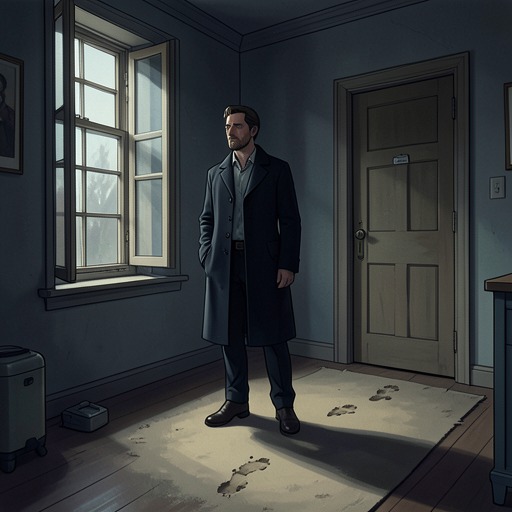
At Sheppard’s insistence, he and Parker took a heavy oak chair from the lobby and used it to break the lock. They entered to find Ackroyd in the armchair by the fire, his head fallen to one side and the dagger visible below his coat collar. Parker recognized that Ackroyd had been stabbed from behind. Sheppard says he did not disturb the body or handle the dagger, and judged that Ackroyd had been dead for some time. The locked door and apparently undisturbed scene made the room itself part of the mystery.
The discovery immediately changes the case from a private danger into a public investigation. Sheppard reports that he sent Parker to telephone the police while he remained in the study. Later, when Flora Ackroyd asks Hercule Poirot to find the murderer, she explains that she fears the police are about to make a mistake. Her appeal brings Poirot into a case whose first telling has already framed Sheppard as the doctor who found the body and assisted at the scene.
The Timing Deception
The Dictaphone supplies the false temporal anchor. Poirot explains that Ackroyd was already dead at half past nine: the voice heard then came from the machine, not from Ackroyd speaking in the room. Sheppard had placed the Dictaphone on a table by the window and set it to operate at that time. He pulled the armchair out so that it concealed the device from the doorway. The recorded voice thus made a dead man seem to be speaking later, helping sustain the impression that the murder occurred after Sheppard had left.
A discrepancy in the journey from Fernly Park provides Poirot with a way to test Sheppard’s account. Sheppard and Parker both placed Sheppard’s departure at ten minutes to nine, yet he did not pass through the lodge gates until nine. The walk should have taken about five minutes, less by the shortcut to the terrace. Poirot reasoned that the unexplained interval could accommodate the murder and the construction of the apparent locked-room exit. He also questioned whether the study window had truly been fastened: Ackroyd had asked whether Sheppard had secured it, but had not checked for himself.
Poirot’s reconstruction accounts for the extra time without requiring an intruder to enter while Ackroyd was alive. Sheppard killed Ackroyd beside the armchair before leaving through the front door. He then went to the summerhouse, took Ralph Paton’s shoes from the bag he had brought that evening, and wore them to leave misleading muddy prints at the study window. He climbed in through the window, locked the study door from inside, returned to the summerhouse, changed back into his own shoes, and continued to the gate. Poirot says he had tested a comparable sequence of actions and found that it took ten minutes, matching the disputed interval.
Poirot’s Reconstruction and Exposure
The murder’s apparent chronology depends on what Sheppard’s narration withholds. He records that the letters arrived at twenty minutes to nine and that he left Ackroyd just before ten minutes to nine, with the letter still unread. He then reflects that the account would have invited a different question had he marked the intervening blank with a row of stars. In the missing interval, he had killed Ackroyd, arranged the Dictaphone, and set the later voice in motion. What first reads as a careful report of departure becomes, once the gap is recognized, an account shaped to conceal what happened inside it.
His conduct after the body is found continues the same strategy. Sheppard writes that he did what little had to be done while avoiding movement of the body and the dagger. In fact, after sending Parker away to telephone the police, he removed the Dictaphone from the room and returned the armchair to its proper place against the wall. That repositioning erased the chair’s role in hiding the machine. Sheppard had assumed Parker would be absorbed by the body; he had not allowed for the butler’s close attention to details of the room.
At the final explanation, Poirot assembles the clues into a direct accusation. Sheppard responds with laughter and calls him mad, but Poirot points to the time discrepancy, the timed Dictaphone, the opportunity to take and use the dagger, and the carefully constructed route through the summerhouse and window. He then identifies the motive in the blackmail of Mrs. Ferrars and Sheppard’s fear that Ackroyd had learned the truth. The apparent doctor-witness is revealed as the murderer, and the account of the discovery is exposed as part of the concealment.
Narrative and Thematic Significance
The event has two distinct chronologies: first, the reader encounters Sheppard’s hurried arrival and the forced opening of the locked study; only later does Poirot reconstruct the earlier killing and the staged sequence that followed it. This gap makes the murder both a physical puzzle and a problem of narration. The clues are not simply absent: the journey time, the reported departure, the chair, the Dictaphone, and Sheppard’s actions after Parker leaves all acquire new meaning when read together.
The murder also turns the conventions of a medical witness into instruments of deception. Sheppard’s professional presence gives his handling of the scene an appearance of practical restraint, while his position as narrator lets him describe his own omissions as insignificant. The machine supplies a counterfeit voice; the locked door supplies a counterfeit impossibility; and the account supplies a counterfeit alibi. Poirot’s solution joins them by asking not only how Ackroyd died, but who controlled the evidence and the story of its discovery. The crime’s decisive revelation is therefore that the trusted narrator’s account is itself one of the murder’s instruments.