Parker
The Murder of Roger AckroydParker, the butler at Fernly Park, is a quiet but consequential witness in the inquiry into Roger Ackroyd’s murder. His duties put him in the hall and near the study at critical moments; his measured demeanor contrasts with the alarming information he brings forward, while his access to the household makes him a plausible channel for private talk and village rumor.
Position in the Household
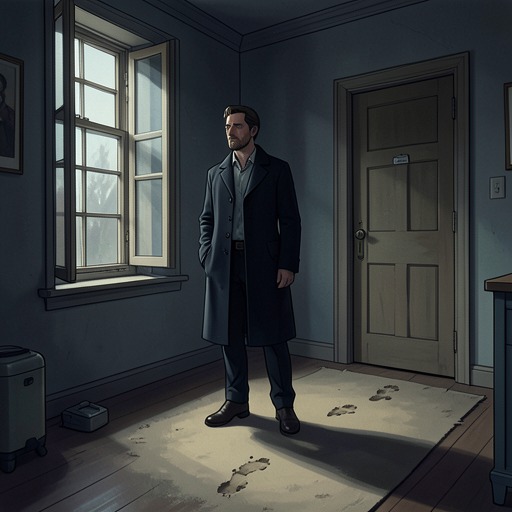
Parker serves as butler at Fernly Park, where he manages the household’s formal threshold and attends to its routines. When Dr. James Sheppard arrives for dinner shortly before half-past seven, Parker opens the front door promptly and takes his overcoat. The entrance hall also serves as a passage for Roger Ackroyd’s secretary, Geoffrey Raymond, who crosses it carrying papers on his way to Ackroyd’s study. Parker’s position places him at the intersection of domestic service and the household’s business, though the evidence does not establish what he learns from that access before the murder.
The village around Fernly Park is shaped by gossip: the narrator describes it as the inhabitants’ defining recreation. That social atmosphere gives special weight to the movement of information between a great house and the surrounding community. Parker belongs to the household’s service structure, but his later mention of blackmail shows how quickly a private suspicion can enter the investigation and become a matter of general concern.
The Murder Night
After Roger Ackroyd’s murder is reported, Dr. Sheppard hurries to Fernly Park. Parker’s face remains impassive as he opens the door; Sheppard pushes past him into the hall and demands to know where Ackroyd is. The controlled entrance contrasts with the urgency of the news and with the rapid change in Parker’s role, from attendant at the door to a person the investigators question.
Parker supplies a specific detail about the evening’s sequence. He says that at about a quarter to ten, while carrying a tray with soda and whisky, he encountered Flora Ackroyd as she came out of the study. She told him that her uncle did not wish to be disturbed. The account complicates the apparent authority of the instruction: Parker says Flora gave it to him, rather than Roger Ackroyd sending her with the message. The inspector notices this distinction and presses Parker about whether he had already been told that Ackroyd wanted to be left alone. His testimony therefore contributes a concrete point to the reconstruction of who entered or left the study and when.
Blackmail and Suspicion
Parker’s name enters the more troubling line of inquiry when Inspector Davis tells Dr. Sheppard that Parker has offered a confused account involving blackmail. Davis says he has been making inquiries into Parker’s movements because he disliked the butler’s manner; when questioned, Parker became nervous and blurted out the garbled story. The evidence presents this as Davis’s report of Parker’s behavior, not as proof that Parker participated in blackmail or understood the full secret behind it.
Sheppard responds that if Parker heard anything about blackmail, he must have been listening outside the study door with his ear against the keyhole. This is speculation framed as an explanation for how the butler might have learned something, not an established account of what Parker did. The exchange nonetheless makes Parker a point where access, suspicion, and information converge: a possible listener whose knowledge is incomplete, and whose unease causes the subject of blackmail to surface during the investigation.
Rumor and Narrative Role
The blackmail rumor continues to circulate beyond the police inquiry. Colonel Melrose tells Sheppard that he has heard the word mentioned and confidently supposes that a woman must be involved. His comment demonstrates how a fragment of information can spread through the village and acquire conjectural additions. Parker’s garbled account is part of that chain, but the evidence does not establish that he originated the Colonel’s version or that its gendered assumption is accurate.
Parker’s importance lies less in a resolved personal arc than in his position within the novel’s network of access and hearsay. He can describe Flora’s message at the study, and he appears to have encountered or repeated a confused suggestion of blackmail; yet neither detail, on its own, reveals the murderer. His impassive appearance at the door and the investigators’ scrutiny of his manner leave a useful tension between what a servant may witness and what he can reliably explain. The available evidence does not disclose a later confession or establish Parker’s ultimate knowledge of the crime.