Roger Ackroyd
The Murder of Roger AckroydRoger Ackroyd is a successful manufacturer, benefactor, and conspicuous presence in King’s Abbot whose murder gives the village’s ordinary habits of observation and gossip a deadly focus. His public standing as a genial country notable contrasts with the private crisis that precedes his death: Mrs. Ferrars confesses to poisoning her husband, and Ackroyd’s response makes clear that affection cannot erase his moral horror. Found stabbed in his study, he becomes both the victim at the center of the investigation and the person whose final evening must be reconstructed from conflicting accounts.
Identity and Place in King’s Abbot
Ackroyd owns Fernly Park, one of the only two houses in King’s Abbot considered important; the other is King’s Paddock, left to Mrs. Ferrars by her late husband. Though he resembles the traditional country squire in appearance and manner, he is not one by occupation: he is an immensely successful manufacturer of wagon wheels. Nearly fifty, red-faced and genial, he has the profile of a familiar village notable but the wealth of a businessman.
His influence extends beyond Fernly Park. He is close to the vicar, contributes generously to parish funds, encourages cricket matches, Ladies’ Clubs, and Disabled Soldiers’ Institutes, and is described as the life and soul of the village. This public generosity sits beside a local rumor that he is extremely mean in his personal spending. The contrast gives his reputation a double aspect: he sustains communal life, yet his habits are also watched and discussed in a village where gossip is a principal recreation.
Engagement and Mrs. Ferrars’s Confession
Ackroyd asks Mrs. Ferrars to marry him three months before the events he relates. She initially refuses, then agrees, but will not let him make the engagement public until her year of mourning has ended. When he visits her the following day after a year and three weeks have passed since her husband’s death, he argues that there is no longer a reason to keep their engagement private.
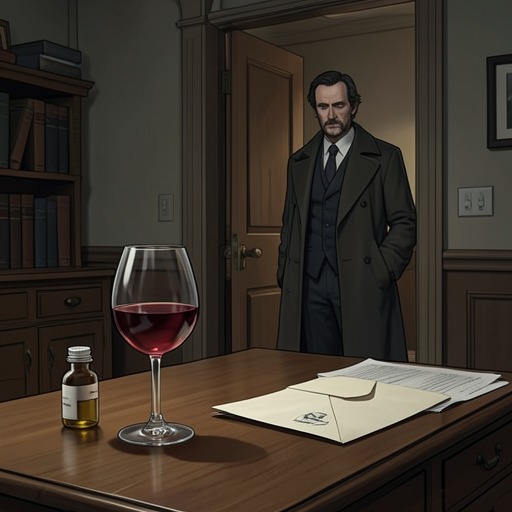
Mrs. Ferrars has seemed strange for several days, and then breaks down and tells him the truth. She describes her hatred of her husband, her growing love for Ackroyd, and the means by which she killed him: poison. Ackroyd recognizes the act as murder, and his horror is visible to the physician he later confides in. The account presents him not as a lover willing to excuse anything, but as a fundamentally law-abiding man whose affection is confronted by the gravity of her confession. The revelation turns their prospective marriage into a moral crisis: the private future they had agreed to is overshadowed by a crime he cannot regard as a mere secret between them.
Murder and the Locked Study
After Ackroyd’s death, the study is forced open. The physician and Parker take a heavy oak chair from the lobby and hurl it against the locked door three times; at the third blow the lock gives way. Ackroyd is still seated in the armchair by the fire, his head fallen sideways. A shining piece of twisted metal is visible just below his collar, and Parker identifies the wound as a stab from behind. The room’s closed door and the body’s position establish the stark scene from which the investigation proceeds.
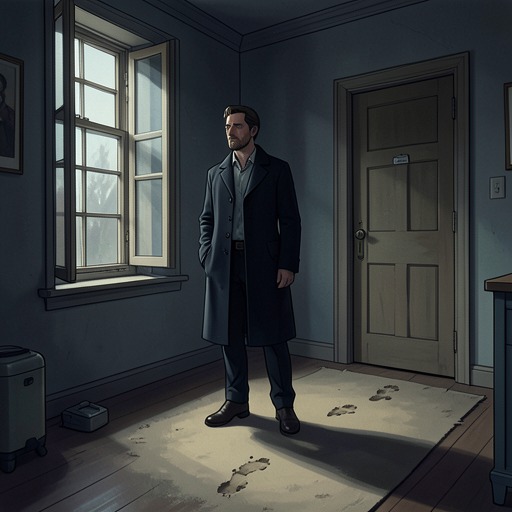
The circumstances of the evening make the murder a question of both access and timing. Ackroyd was heard speaking to someone at half-past nine. Ralph Paton must, according to the shoe prints, have entered through the window at some point, while Ackroyd’s nervousness suggests that he would admit someone he knew. These facts form an initial framework for the case, but they do not by themselves establish who killed him or when. The apparent clues and the locked room must be read against testimony that later proves unreliable.
Investigation and the Problem of Time
Hercule Poirot’s reconstruction begins with details gathered at Fernly Park. Along the terrace he is shown footprints on a windowsill; on the path toward the drive, a small summerhouse catches his attention. A search there turns up a scrap of starched cambric and an empty goose quill. The cloth suggests a maid’s apron, while the quill points toward a drug user. Because Ursula Bourne, the parlour maid, has no firm alibi for the period she says she spent in her bedroom, Poirot considers whether she went to meet someone in the summerhouse.
The timing prevents that explanation from settling the matter. The stranger encountered near the gate must have reached the summerhouse shortly after nine, whereas Ursula could not have gone there before half-past nine. Poirot therefore considers the possibility of two separate meetings. He connects the quill and the stranger’s American accent with a visitor seeking drugs, then considers the housekeeper’s recent interest in cures for drug addiction as evidence that the stranger may have come to meet her rather than Ursula. The summerhouse clues thus open a chain of questions instead of supplying a simple answer: who met whom, and when?
The decisive discrepancy concerns the journey from the lodge to the house. The walk takes five minutes, or less by the shortcut to the terrace, but the physician says he left the house at ten minutes to nine and passed through the lodge gates at nine. Poirot asks what accounts for the extra five minutes on a chilly evening, when there was little reason to dawdle. He also observes that the study window’s having been fastened rests only on the physician’s statement; Ackroyd had asked whether it was shut, but had not checked it himself. The gap in the timeline and the unverified window become the basis for testing whether the stated movements could conceal a return to the house.
Narrative Significance
Ackroyd’s position in the village makes his death more than an isolated crime. As owner of Fernly Park and supporter of local institutions, he is a visible center of communal life; as the suitor to a woman who confesses to murder, he is also drawn into a private history that the village’s public image cannot contain. The investigation moves between those registers, using social knowledge, physical traces, and exact intervals of time to challenge what characters say about themselves.
His murder also gives the novel’s narration its central structural tension. Early in the case, a list of points about the half-past-nine conversation, the window footprints, and Ackroyd’s nervousness appears to make the evidence orderly. Yet the eventual importance of the physician’s unaccounted-for minutes shows that a neat account can conceal as much as it explains. Ackroyd’s death is therefore not only the puzzle’s subject; it is the event through which the reader must learn to distinguish what was observed from what was merely reported.