Secrets and concealment
The Murder of Roger AckroydSecrets and concealment are not merely obstacles in the investigation of Roger Ackroyd’s murder; they shape the investigation’s evidence, the relationships among its participants, and the form of Dr. James Sheppard’s account. Hercule Poirot’s suspicion that everyone has something to hide proves broadly right, but the most consequential concealment belongs to the narrator himself: his manuscript is accurate in its individual statements while omitting the action that makes them deceptive.
Concealment as a shared condition
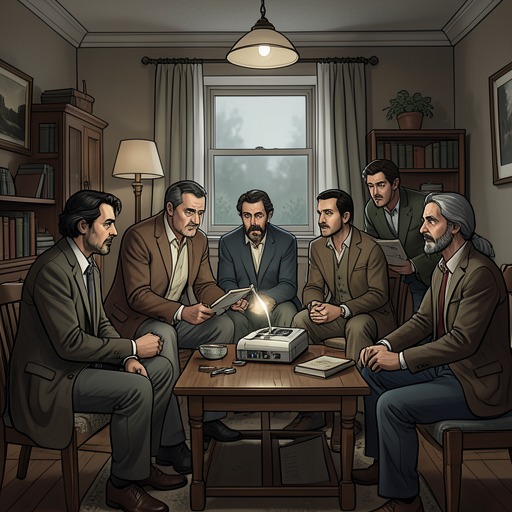
At a gathering with the people involved in the case, Poirot declares, “Every one of you in this room is concealing something from me.” He allows that a secret may be trivial or seem unrelated to the murder, but insists that everyone has something to hide. His challenge sweeps around the table; the company protests faintly, then looks down, including Sheppard. When Poirot appeals for the whole truth and no one speaks, silence itself becomes part of the evidence. Concealment is thus presented first not as proof of murder, but as a general social condition that makes the case difficult to read.
The distinction between having a secret and being the murderer matters. Poirot’s accusation catches several people in private deceptions, yet those secrets vary in importance and motive. After speaking with Mrs. Ackroyd, Sheppard recognizes that her anxiety is genuine and that she, at least, has something to hide. He urges her to make a clean breast of it; her startled response confirms his suspicion that a disclosure is pressing. The scene illustrates how Poirot’s broad premise can guide inquiry without making every secret equally incriminating.
Poirot’s method and the partial record
The inquiry itself is divided between what Sheppard sees and what Poirot understands. Sheppard recounts the circumstances to Poirot, who listens closely, occasionally asks a question, and otherwise remains silent. In retrospect, Sheppard describes himself as being at Poirot’s elbow and seeing what the detective saw, while admitting that he failed to read Poirot’s mind. Poirot shows him discoveries, including the gold wedding-ring, but keeps back the vital impressions he has formed. His hints and suggestions offer only part of his reasoning, so even the narrator who accompanies the detective cannot give the reader full access to the investigation as it unfolds.
That withholding has a deliberate counterpoint in Sheppard’s own narration. He presents the early investigation as a straightforward account, then says that after Monday evening his path and Poirot’s diverged: Poirot worked on his own, while Sheppard heard about events through the gossip network of King’s Abbot rather than being taken into the detective’s confidence. The account openly acknowledges that knowledge is piecemeal. Everyone contributes some fact or discovery, but Poirot alone fits the pieces into their proper places. This description is true as far as it goes, yet it also directs attention away from what Sheppard himself has not told.
The narrator’s omissions
The deception is planted in the apparently precise account of Sheppard’s departure from Ackroyd’s study. The letters were brought in at twenty minutes to nine; Sheppard left just before nine, with the letter still unread. He describes pausing at the door, wondering whether anything had been left undone, then shaking his head, leaving, and closing the door. Parker is nearby and looks embarrassed; Sheppard wonders whether the butler has been listening. The careful times and vivid threshold detail make the passage seem complete, while the essential action is absent.
At the end of his manuscript, Sheppard explains the mechanism of that omission. He reproduces the passage and points out that every sentence is true. But a row of stars after the first sentence would have marked a blank interval of ten minutes and prompted the reader to ask what happened there. The gap conceals his return to the study and the murder of Roger Ackroyd. The trick depends not on a false statement but on selective truth: precise details encourage confidence, while an unmarked ellipsis hides the crime.
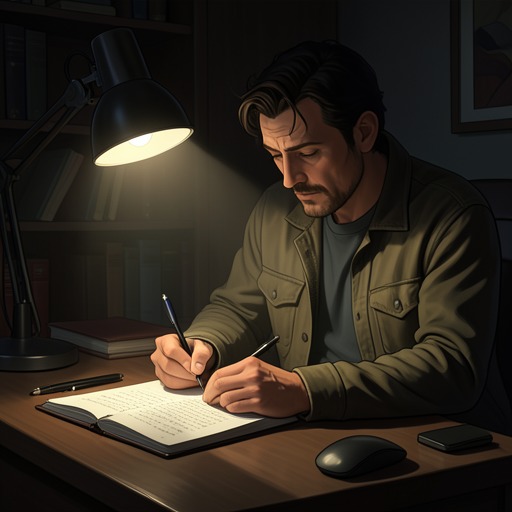
The manuscript’s closing pages expose how that strategy also shapes its purpose. At five in the morning, Sheppard records that he is exhausted, his arm aching from writing, and that he has finished his task. He had intended the manuscript to be published as the history of one of Poirot’s failures. The intended account would therefore have concealed not only the murder but the fact that its author had engineered a false appearance of failure. His retrospective confession turns the case record into evidence against its writer.
Exposure and the cost of secrecy
Poirot’s earlier accusation returns at the final gathering. He recalls that four of the five other people at the table eventually gave up their secrets, while Sheppard did not. But Poirot had suspected him: Sheppard went to the Three Boars hoping to find Ralph Paton and might have encountered him on the way home. Poirot reasons that Sheppard, a friend of Ralph’s and fresh from the crime scene, would know how grave the suspicion against him was. The question is no longer whether Sheppard has concealed something, but what his concealment protected and why.
Sheppard then admits that he had visited Ralph earlier and learned of Ralph’s marriage and desperate circumstances. After the murder, he recognized that suspicion would fall on Ralph or on the woman Ralph loved, and that the prospect of giving evidence against his wife might lead Ralph to avoid facing the authorities. Sheppard’s account reveals the personal secret he had withheld from the investigation and explains his involvement in Ralph’s concealment. Ralph, in turn, says that Sheppard stood by him but had not chosen the best course: he should have come forward and faced the consequences. Because Ralph had been kept from newspapers, he did not know what was happening outside.
The deepest concealed fact is not cleared up by that confession alone. Poirot identifies the patient Sheppard brought from the home as Ralph, though under another name, and explains that Sheppard’s manuscript was strictly truthful only within the limits of what it disclosed. The final exposure makes the relation between silence and evidence unmistakable: Sheppard’s loyalty to Ralph is real, but it does not account for the more important omission in his account. His carefully restricted truth conceals his own criminality until Poirot reconstructs what the manuscript leaves out.
Narrative significance
The novel makes concealment operate on two connected levels. Within the case, the suspects’ private secrets complicate the meaning of evidence and explain why Poirot asks for complete honesty even when a hidden matter appears trivial. In the telling, Sheppard’s first-person account gives the reader the same limited record Poirot must scrutinize, but the narrator has a reason to control what that record includes. His confidence as witness and companion to the detective is therefore structurally misleading: he can report accurately, observe closely, and still conceal the fact that would change the whole meaning of his story.
The final confession transforms earlier precision into a warning. Times, gestures, and truthful clauses are not guarantees of completeness; an account can be meticulously correct and fundamentally deceptive. Poirot’s insistence that concealment will be discovered is borne out, but the exposure depends on reading the narrator’s absences as carefully as his statements. Secrets and concealment thus name both the social puzzle of the suspects and the narrative device that makes the murderer’s own account the last secret to be solved.