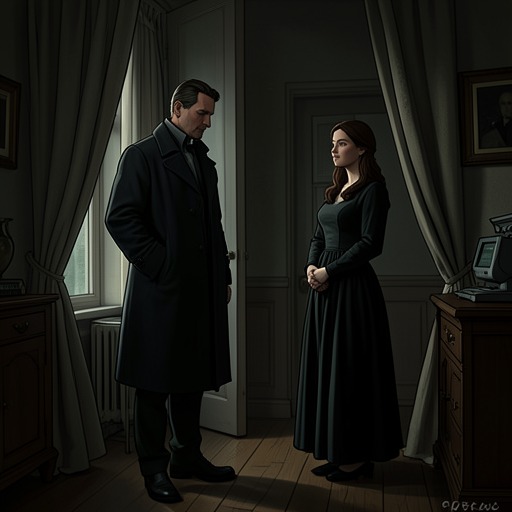
Strain of weakness
The Murder of Roger Ackroyd“Strain of weakness” is Hercule Poirot’s expression for a latent moral vulnerability that can turn an ordinary, respected person into a criminal. In his explanation, the weakness begins with silence chosen for money, deepens through greed and blackmail, and ultimately makes murder possible; the phrase returns at the close as Dr. James Sheppard recognizes that Caroline’s earlier words may have come close to identifying him.
Poirot’s explanation of moral decline
Poirot introduces the phrase while speaking in a quiet, uncharacteristic manner. He asks his listeners to consider an ordinary man with no prior intention of murder, whose hidden vulnerability has never been tested. Such a person might otherwise live and die respected. A sudden opportunity changes the conditions: he discovers a secret involving life or death and initially wants to tell the truth and do his duty. But the prospect of substantial money tempts him to remain silent. Silence appears effortless and profitable, and the desire for money grows as the secret becomes a source of continuing gain.
Poirot’s account makes criminality a process rather than an inborn identity. The man is not initially imagined as a murderer; his first breach is the decision not to disclose what he knows. Greed then changes the scale of that compromise: the person who once kept silent for money becomes someone who needs more, and whose judgment is shaped by the prospect of losing what the secret has brought him. The weakness matters because it is latent, but the choices that activate and strengthen it are concrete.
Exposure and the turn to murder
The process reaches a crisis when the person whose secret is being exploited is pressed too far and chooses to tell the truth. Poirot describes this as the destruction of the source of the blackmailer’s profit: the “death of the goose that laid the golden eggs.” The exposure does not restore the blackmailer’s earlier character. By then, Poirot argues, the man’s moral judgment has been blunted, and the threat of ruin leaves him desperate and willing to use whatever means remain. The murder follows from that threatened exposure in Poirot’s account.
Poirot adds that the criminal can appear normal and kind again after the immediate danger has passed. That return to ordinary behavior does not mean the danger is gone: if the need arises again, he may strike again. The contrast between normality and repeated violence gives the expression its unsettling force. The weakness is not presented as a single lapse that ends once its immediate crisis passes, but as a capacity that can be reactivated when the person feels threatened.
From general theory to suspicion
As Poirot’s analysis hangs over the room, its listener Dr. James Sheppard records the fear it provokes. Caroline responds by naming Ralph Paton as the man Poirot appears to describe, while also insisting that no one should condemn a man without hearing him. Her intervention makes the phrase part of the case’s misdirection: the discussion supplies a psychological account of the murderer, but its apparent application to Ralph is not proof of his guilt.
The expression’s meaning changes decisively in Dr. Sheppard’s final reflections. He recalls that Caroline once spoke of his “strain of weakness” and admits that his greatest fear throughout the case has been that she might guess. The phrase that Poirot had used to describe a hypothetical man who begins with silence and descends into murder thus returns as a private recognition of the narrator’s own concealed criminality. The parallel connects the expression’s stages—secrecy, escalating wrongdoing, and threatened exposure—to the truth Dr. Sheppard has kept from Caroline.
Recurrence and narrative significance
The expression works both as a theory of conduct and as a recurring verbal clue. Poirot presents it as a general account, allowing those listening to associate it with Ralph Paton; at the end, Dr. Sheppard’s recollection turns the same language back toward its actual significance. The narrative’s movement from an apparently abstract example to the narrator’s personal fear gives the phrase retrospective force without making Caroline’s earlier remark a full disclosure of what she knows.
The ending preserves that tension rather than resolving it through a conversation between brother and sister. Dr. Sheppard believes Caroline will never learn the truth and considers his death a way to spare her knowledge of it; he also trusts Poirot and Inspector Raglan to manage what follows. His fear that Caroline may have guessed nevertheless remains the final echo of the phrase. “Strain of weakness” therefore names more than the first small compromise in Poirot’s theory: it is the language through which Dr. Sheppard’s concealed guilt becomes legible to himself, even as he hopes to prevent Caroline from recognizing it.