The Three Boars
The Murder of Roger AckroydThe Three Boars is the local inn at the center of the search for Ralph Paton after his whereabouts become uncertain. It is where Dr. James Sheppard finds Ralph, where information about Ralph’s movements and belongings circulates through servants and staff, and where Hercule Poirot later places Sheppard’s failed attempt to locate his friend on the night of the murder. The inn’s significance lies less in any special physical description than in its function as a crossroads: people go there seeking Ralph, while details associated with the place expose the distance between what is known and what has been concealed.
Identity and Place in the Investigation
The Three Boars is a local inn in King’s Abbot. Its importance begins when Caroline tells Sheppard that Ralph is staying there instead of at Fernly Park. Sheppard accepts her statement without questioning it, because Caroline’s word is sufficient for him; he then says that Roger Ackroyd had told him Ralph was in London. The contrast immediately makes the inn a test of competing information. Ralph’s supposed presence is not merely a matter of lodging: it unsettles the account Sheppard had received from Roger and reveals how little he has verified for himself.
The inn also supplies a public, practical setting for the search. It is not a sealed or private space in the way Fernly Park’s murder scene is. People can ask after Ralph, learn when he was last seen, and pass along details through the local network. That openness makes the place useful to the investigation, but it does not make its information complete: Ralph’s presence at the inn does not mean that anyone can establish where he went afterward.
Sheppard’s Visit to Ralph
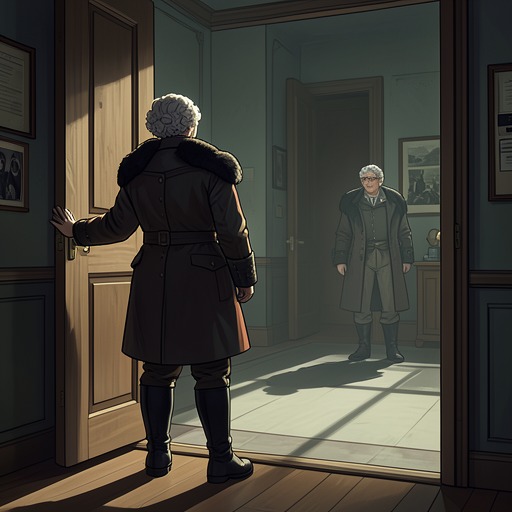
Sheppard goes to the Three Boars to see Ralph after learning that he may be there. Ralph has only just come in when Sheppard asks for him, and Sheppard goes up to his room and enters without announcement. The directness of this visit reflects their existing friendship: although Sheppard briefly doubts how Ralph will receive him, he has no reason to fear a hostile welcome. Ralph greets him warmly, and the encounter gives Sheppard an opportunity to try to influence the young man, whom he thinks he may be able to help.
The scene adds a human dimension to the inn’s role in the plot. Ralph is not simply a name attached to an uncertain whereabouts; he is a familiar friend whom Sheppard approaches in person. Yet this access does not mean that Ralph immediately confides in him. When Sheppard later recounts their meeting, he says Ralph initially refused to take him into his confidence, only later telling him about his marriage and his financial difficulties. The inn therefore marks the beginning of an encounter whose important disclosures emerge gradually rather than all at once.
Search, Departure, and Material Clues
Flora explains that she went to the inn after hearing from the servants that Ralph was staying there. She had not known he was in King’s Abbot and was astounded to discover it. At the inn she was told that he had gone out at about nine the previous evening and had not returned. When Sheppard points out that Ralph left his luggage behind, Flora tries to imagine that he might have gone anywhere, perhaps back to London. The abandoned luggage makes that explanation difficult: his disappearance is not a straightforward departure from the inn with his belongings.
The inn’s staff and their connections also make it a source of investigative leads. Caroline works out that Annie’s close friend Clara is Miss Gannett’s maid, and that Clara is walking out with the Boots at the Three Boars. With Miss Gannett’s cooperation, Clara is given leave so that Caroline’s inquiry can be made quickly. A casual social connection thus becomes a channel for obtaining a specific detail about Ralph’s belongings. The evidence does not make the inn’s workers responsible for the mystery; rather, their everyday relationships show how information in King’s Abbot travels beyond formal police questioning.
That detail concerns Ralph’s boots. Sheppard passes on Caroline’s message to Poirot: Ralph’s boots were black, not brown. Sheppard watches Poirot as he says it and thinks he detects a momentary flicker of discomposure, though it quickly passes. The correction matters because the investigation has attached significance to the boots and their color. The inn is not itself the place where the boots are found or explained, but its staff provide the human route by which a concrete fact reaches the investigators and challenges an assumption.
Poirot’s Reconstruction and Narrative Significance
At the final disclosure, Poirot returns to the Three Boars to reconstruct Sheppard’s movements. He recalls that Sheppard went there on the night of the murder hoping to find Ralph but did not find him at the inn. Poirot then considers the possibility that Sheppard met Ralph in the street on his way home. He connects the visit to Sheppard’s friendship with Ralph, Sheppard’s immediate knowledge of the crime scene, and the fact that the evidence seemed to place Ralph in serious danger. The inn becomes a fixed point in Poirot’s account, while the possible meeting outside it supplies the missing link between Sheppard and Ralph.
Sheppard confirms that he had visited Ralph earlier that afternoon and eventually learned about Ralph’s marriage and financial predicament. He also says that, after the murder was discovered, he realized suspicion might fall on Ralph or on the woman Ralph loved; he put the situation plainly before Ralph that night. Poirot’s account and Sheppard’s admission transform the inn from a stop in an ordinary search into part of the concealed history surrounding the case. The location’s recurring function is to expose the limits of appearances: Ralph can be reported as lodging there, sought there, absent from it, and still connected to an encounter that Poirot reconstructs only at the end.