Truth
The Murder of Roger AckroydTruth in the investigation of Roger Ackroyd’s murder is not simply the answer to a puzzle; it is Hercule Poirot’s declared objective and the standard against which the gathered suspects’ silences are measured. He insists that he will reach it despite his age, his possible loss of former powers, and the resistance of everyone in the room. Yet truth does not arrive through a single willing confession: Poirot must distinguish what people conceal, protect the innocent from suspicion, and confront the murderer with the knowledge that the secret is no longer secure.
Poirot’s declared pursuit
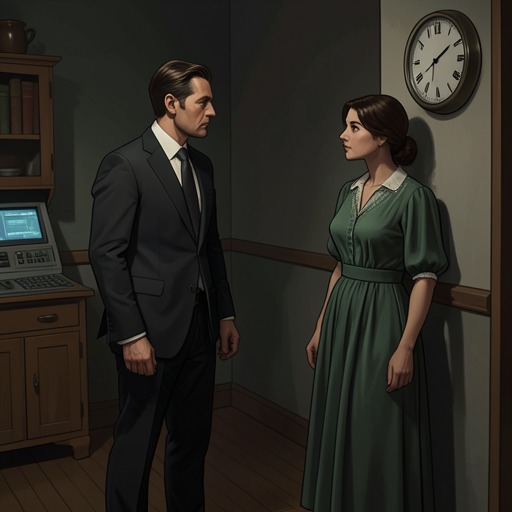
At the gathering, Poirot presents the search for truth as both a personal commitment and a test of his professional resolve. He acknowledges that he is much aged and that his powers may have diminished, but he refuses to let those doubts define the outcome. He says that this may be the last case he investigates and declares that he will not end his career with failure. His certainty is emphatic: he means to know, even if those present oppose him.
Poirot also gives his pursuit an explicitly intellectual and moral value. He describes truth, however ugly, as curious and beautiful to the person seeking it. That formulation does not make painful revelations harmless; rather, it explains why discomfort cannot be a reason to abandon the inquiry. Truth matters because the investigator seeks it for its own sake, not because it promises an easy or reassuring conclusion.
Concealment and the silent room
Poirot’s claim that everyone present is concealing something turns the investigation from a search for one hidden criminal into an examination of a whole company of guarded people. He allows that some secrets may be trivial and seem unrelated to the case, but insists that concealment is nevertheless present throughout the room. His accusation produces a murmur of protest, yet when he challenges the gathering, every pair of eyes drops—including the narrator’s. The response supplies no confession, but the silence confirms the atmosphere of evasion that Poirot has named.
He appeals for the whole truth, receives no answer, and leaves after a repeated short laugh. The scene makes the difficulty of truth-seeking concrete: Poirot can demand candour, but he cannot make the assembled people provide it. The gap between what he knows and what they will admit becomes part of the case’s tension, while the narrator’s lowered eyes place the narration itself inside the field of concealment rather than outside it.
Truth, patience, and protection
Poirot’s pursuit is not equivalent to indiscriminately exposing every secret at once. When Miss Russell asks whether she ought to tell Inspector Raglan her account, Poirot advises proceeding slowly and in due order and method. Charles Kent has not been formally charged with murder, he explains, and circumstances may make her story unnecessary. The advice recognizes that a truthful account must be assessed in context: disclosure can affect a person under suspicion, and haste may make a statement seem necessary before the case has established that need.
Miss Russell seeks reassurance that her son had nothing to do with the murder. Poirot answers with a specific point about the timeline: the man speaking with Roger Ackroyd in the library at nine-thirty could not have been Charles. His response gives her grounds for hope without asking her to accept an unsupported general promise. The exchange shows truth operating in two ways at once: as a route toward identifying the murderer and as a means of correcting suspicion directed at someone who, on the evidence Poirot cites, could not have occupied the relevant place at the relevant time.
The murderer confronted
At the final gathering, Poirot’s confidence takes on a more direct and controlled force. He explains that Inspector Raglan was not invited because he does not want to disclose everything he knows that night. Then he addresses the murderer, stating that the killer of Roger Ackroyd is in the room and that the truth will go to Inspector Raglan the next day. The declaration changes the terms of secrecy: Poirot has not yet delivered all his knowledge to the police, but he makes clear that he has identified the truth and set a limit on how long it will remain withheld.
That delayed disclosure is consistent with his earlier insistence on order and method, not a retreat from the truth he promised to pursue. The threat of tomorrow’s report makes the hidden fact imminent while leaving the gathering suspended in tense silence. Across both scenes, truth is something Poirot claims he can reach, but also something whose revelation he times: he refuses to be diverted by universal concealment, yet distinguishes between knowing, disclosing, and establishing what another person needs to know.
Narrative significance
The novel’s treatment of truth is sharpened by the narrator’s presence in the room where Poirot’s accusation is made. The narrator’s eyes drop with everyone else’s, so the scene does not place the act of concealment solely among other suspects. Poirot’s challenge instead makes the reader’s understanding depend on the difference between a confident demand for truth and the information the narration has actually disclosed. Truth is therefore both the detective’s object and a question of how knowledge is presented.
The evidence also complicates any simple equation between truth and immediate confession. The assembled people do not answer Poirot’s appeal; Miss Russell asks whether she should speak to the police; and Poirot postpones telling Inspector Raglan what he knows until the following day. These moments distinguish the existence of a fact from its admission, investigation, and public revelation. The concept gathers the novel’s central pressure into one problem: a truth may be ugly, concealed, or delayed, but Poirot’s method treats none of those conditions as a reason to stop seeking it.