silver display table
The Murder of Roger AckroydThe silver display table is a glass-topped cabinet in the drawing room, but in the investigation of Roger Ackroyd’s murder it becomes more than a piece of furniture: the sound of its lid offers Dr. James Sheppard a precise sensory recollection of the previous evening, and the cabinet’s association with the missing weapon draws Hercule Poirot to examine it directly. Ordinary, decorative, and initially easy to overlook, it helps turn a remembered noise into evidence.
Form and Contents
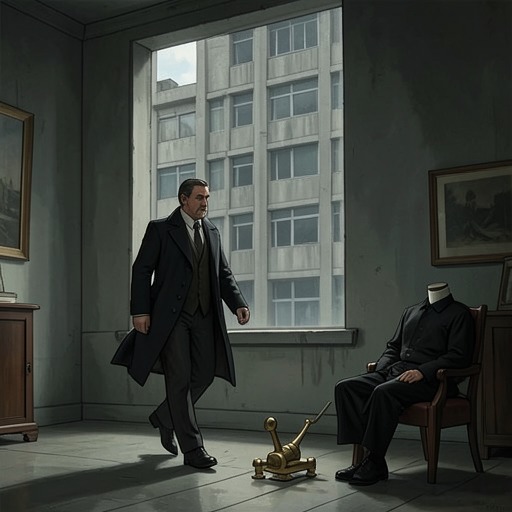
The table has a lid that lifts, with glass through which its contents can be seen. Inside are one or two pieces of old silver, a baby shoe belonging to King Charles the First, Chinese jade figures, and numerous African implements and curios. The room’s assortment invites casual looking, but the cabinet’s contents also include a curio later discussed in connection with the weapon taken from the house.
The lid’s physical action is particularly important: it can fall shut with a sound that is gentle rather than violent. That ordinary mechanism gives the table a recognisable acoustic signature. The clue is not a dramatic crash or an unexplained disturbance, but the small, repeatable noise of a lid settling into place.
The Recalled Sound
On arriving for dinner the night of the murder, Sheppard hears the silver table’s lid being shut in the drawing room. Later, while alone with the cabinet, he tries to work out what could have made the sound. He rejects the possibilities of coals on the fire and a bureau drawer, then notices the glass-topped table and approaches it to inspect the display.
Wanting a closer look at one of the jade figures, Sheppard lifts the lid. It slips through his fingers and falls; at once he recognises the sound he had heard the previous night. He repeats the movement once or twice to satisfy himself, then lifts the lid again to examine the contents. Still bent over the open table, he is there when Flora Ackroyd enters the room. The episode makes the memory concrete through repetition: the table does not explain who closed it on the murder night, but it establishes what Sheppard’s remembered sound was.
A Clue in the Inquiry
When asked where the curio was usually kept, the secretary identifies the silver table in the drawing room. Sheppard reacts with an exclamation, then explains that the detail seems trivial: when he arrived the previous night for dinner, he heard the lid being shut there. His identification is specific enough to attract attention, but not enough by itself to settle who was at the cabinet or what they did.
The inspector’s response underscores that uncertainty. He regards Sheppard with scepticism and a trace of suspicion, then asks how Sheppard knew the sound came from the silver table. The remembered noise therefore functions in two directions: it offers the investigation a location-specific detail, while its unexplained precision also makes Sheppard’s knowledge something to scrutinise.
Access, Weapon, and Reconstruction
Miss Russell supplies a separate account of the cabinet’s state. She initially says she does not think she went near it while checking that the flowers were fresh, then recalls that it had been left open when it should not have been. She says she shut the lid as she passed. The sequence places her at the table and establishes that it was open at a point in the evening, but it does not, on its own, resolve when the weapon was removed or who handled it.
Later, Hercule Poirot asks to see the silver table from which the weapon was taken. Sheppard leads him to the drawing room. Poirot raises and drops the lid once or twice, testing the same simple movement that had fixed the sound in Sheppard’s memory; he then pushes open the window and steps onto the terrace, with Sheppard following. The examination links the cabinet’s mechanism, its contents, and the room’s adjoining space without making the table alone a complete solution.
Narrative Significance
The cabinet matters because it transforms an incidental sound into a material point of reference. Sheppard’s effort to identify it begins as private distraction, prompted by painful thoughts; the repeated opening and falling shut then gives his memory a reproducible form. When the table is later named in the inquiry, what seemed trivial becomes relevant, though its meaning remains open to testing against other accounts and physical circumstances.
Its narrative force lies in the gap between what it can establish and what it cannot. The lid can account for a sound; Miss Russell’s recollection can establish that the table was open and that she shut it; Poirot’s inspection confirms the object’s connection to the weapon and the room. None of those facts alone identifies the person responsible. The silver display table thus serves as a modest but exact instrument of reconstruction: a domestic object whose familiar motion helps the investigation distinguish a remembered noise from a guess, while leaving the larger mystery to be resolved through the evidence as a whole.