the murder dagger
The Murder of Roger AckroydThe murder dagger is the weapon Dr. James Sheppard uses to kill Roger Ackroyd, and a conspicuous object in Poirot’s reconstruction of the crime. Its disappearance from the silver display table and Sheppard’s later admission that he chose it as an untraceable substitute turn it from household furnishing into a clue about access, preparation, and the killer’s effort to conceal his identity.
From Household Object to Evidence
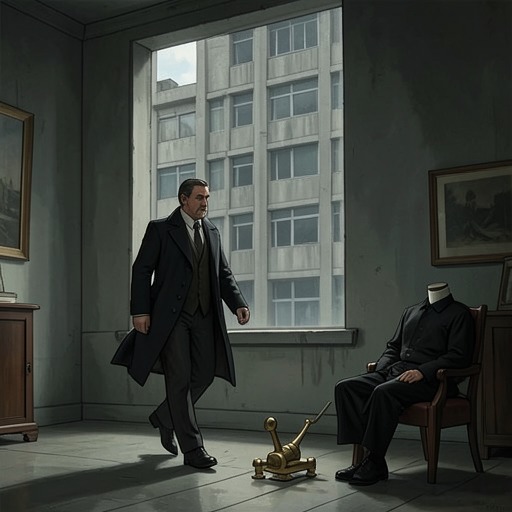
The dagger is initially part of the silver display on a table in Roger Ackroyd’s house. The police theory has Ralph Paton enter through a window, take the dagger, and return to the study; that reconstruction makes the weapon appear to support the case against an already suspected man. But the object’s location before the murder matters as much as its use. Flora Ackroyd was certain the dagger was no longer on the table when she examined it, giving Poirot a basis for asking who could have removed it before she arrived.
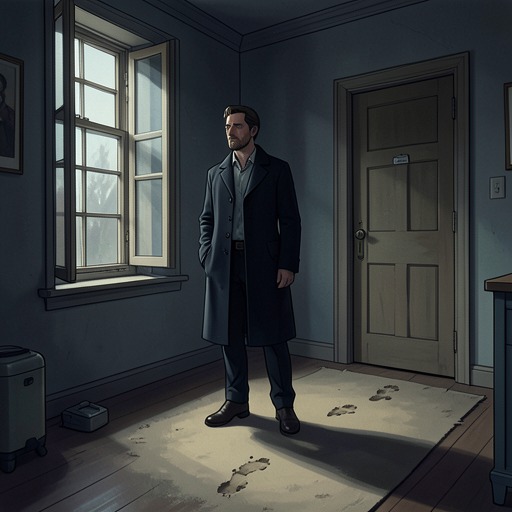
The dagger therefore provides a distinct line of inquiry from the footprints at the study window. Those marks could be read as evidence that Ralph had entered the room, but Poirot’s reconstruction also requires the killer to have had an opportunity to take the weapon from the silver display table before Flora’s inspection. The clue does not simply identify a weapon; it narrows the sequence of access to it.
The Police Reconstruction and Its Limits
Inspector Raglan’s account places the dagger within a persuasive imagined timeline. After the suspected exchange over money, Ralph is supposed to leave by the study window, enter the empty drawing room, take the dagger from the silver table, and return to the study. The explanation connects the alleged visit, the window, and the weapon into a continuous story, but it remains a theory built around the assumption that Ralph was the intruder and killer.
Poirot’s approach separates what the evidence establishes from what the police have inferred. The dagger was used, and Flora’s inspection suggests it had already been taken before she checked the table; neither fact proves that Ralph took it. Poirot treats the opportunity to remove it as one condition in a broader description of the murderer, alongside presence at the Three Boars, knowledge of Ackroyd’s Dictaphone, mechanical ability, and access to a suitable bag. The weapon is thus one component in a cumulative case rather than a stand-alone identification.
Sheppard’s Admission and the Substitution
In his confession, Sheppard explains that he had brought a small weapon of his own but changed his plan when he saw the dagger on the silver table. He chose the household weapon because it could not be traced to him. That decision gives the dagger its decisive significance: its apparent connection to Ralph was not proof of Ralph’s guilt but part of the concealment surrounding Sheppard’s crime.
Sheppard’s account also clarifies why the dagger was an afterthought, not the instrument around which his initial preparation had been built. He had already taken precautions involving Ackroyd’s Dictaphone, which Ackroyd had given him to adjust, and brought the device to the house in his bag. The switch of weapons belongs to the same effort to manage the evidence, but the dagger itself was selected only when Sheppard saw an opportunity to use an object whose ownership would not lead back to him.
Narrative and Evidentiary Significance
The dagger’s changing meaning exposes the gap between a clue and the story told about it. In the police reconstruction, it helps make Ralph’s supposed movements seem coherent; in Poirot’s analysis, its removal raises a question of prior access; in Sheppard’s confession, it becomes evidence of an opportunistic substitution intended to misdirect suspicion. Each stage reinterprets the same object without changing the basic facts of its location and use.
Its role also fits the novel’s larger problem of selective narration. Sheppard can describe the dagger as a practical choice only after Poirot has assembled the conditions that point toward him. The weapon that seemed to implicate the missing Ralph instead helps reveal the narrator’s own concealed agency. In that reversal, the dagger is both murder weapon and a material trace of the difference between the apparent solution and the truth.