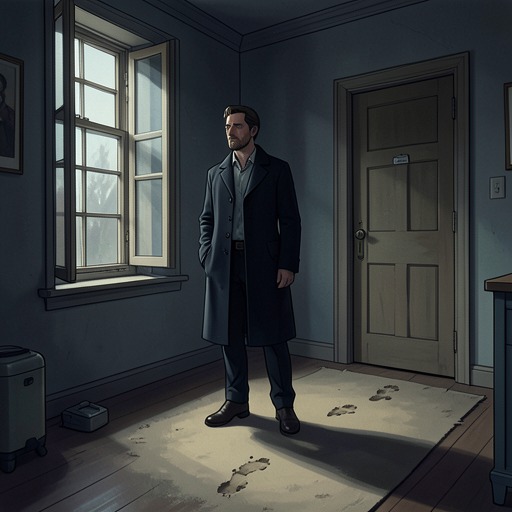
the summerhouse
The Murder of Roger AckroydThe summerhouse at Fernly Park is not merely a secluded garden building but the place where two secret meetings converge on the night Roger Ackroyd is murdered. Poirot’s examination of its small physical traces helps him distinguish the visitors, reconstruct their separate purposes, and test the timing of the case; the summerhouse becomes a compact map of the secrets the household has tried to keep apart.
Setting and Physical Clues
The summerhouse stands beside a path leading toward the drive. Inspector Raglan initially treats the path as a shortcut to the house, but Poirot sees that someone visiting a rendezvous could use it for the same reason. The distinction matters: the stranger whom Dr. James Sheppard encountered did not appear to have entered by either the front or back door, so the garden building offered a plausible meeting place outside the household’s ordinary entrances.
Poirot searches the summerhouse hoping to find evidence and discovers two clues: a scrap of starched cambric and an empty goose quill. The cambric suggests a maid’s apron, while the quill points toward someone who uses drugs. Neither object identifies a visitor by itself; together with the path, the house’s list of occupants, and the visitors’ timings, they make the apparently simple rendezvous more complicated. In the final account, Poirot explains that the quill initially suggested a drug user from across the Atlantic, a deduction consistent with the American accent Dr. Sheppard had heard.
Two Meetings, Not One
The first apparent explanation is that the stranger came to meet Ursula Bourne, the parlour maid, whose account placed her in her bedroom from half past nine until ten. Poirot recognizes that the timings resist this theory: the stranger must have reached the summerhouse shortly after nine, whereas Ursula could not have gone there before half past nine. Rather than force the two accounts together, he considers that two separate meetings took place in the same building that evening.
The earlier visitor was Charles Kent, who came to see his mother, Miss Russell, the housekeeper. She had already shown interest in remedies for drug addiction when she visited Dr. Sheppard that morning, a detail that, combined with the goose quill, helped Poirot infer the purpose of the stranger’s visit. During questioning, Miss Russell admits that Kent came to see her and that she went out to meet him in the summerhouse. She had heard from him, wrote to the address he supplied, and arranged to meet him there because she dared not have him come to the house.
Miss Russell also describes the practical measures by which she concealed the encounter. Fearing Kent might not wait, she ran out and left a paper message saying she would be there at about ten minutes past nine. She slipped out through the drawing-room window to avoid being seen by the servants. On her return, she met Dr. Sheppard and noticed that he might find her presence strange; she was out of breath from running, and she had not known he was expected to dinner. These details place her encounter in the earlier part of the evening and explain why the stranger’s visit must not be conflated with Ursula’s later meeting.
Ursula and Ralph’s Rendezvous
A second chain of clues identifies Ursula’s visitor as Ralph Paton. Poirot finds a wedding ring engraved with the words “From R.” and a date inside it; he also learns that Ralph was seen approaching the path to the summerhouse at twenty-five minutes past nine. Those details join the secret marriage, the engagement announced on the day of the tragedy, and a stormy conversation between Ralph and an unidentified young woman in the wood. The summerhouse is thus not an isolated clue but the setting that brings those previously scattered pieces into a coherent sequence.
Ursula later confirms the meeting. She and Ralph had arranged to see one another that evening, and she stole out through the side door to meet him in the small summerhouse. Their interview was bitter: Ralph accused her of ruining his prospects by revealing the marriage at the wrong moment, while Ursula reproached him for his duplicity. They parted, and a little over half an hour later Roger Ackroyd’s body was discovered. Ursula had neither seen nor heard from Ralph since that night.
The precise timing of the rendezvous matters because it bears on the murder’s chronology. Ursula says she went out at half past nine. With Hector Blunt walking up and down the terrace, she had to go around through the bushes to avoid him; she reached the summerhouse at about twenty-seven minutes to ten. Ralph was waiting, and she stayed with him for ten minutes, returning to the house at a quarter to ten. The interval establishes that Ralph and Ursula were together at the summerhouse then, and it helps Poirot reject the suggestion that Ralph could have been with Ackroyd in the study at half past nine.
Evidence and Narrative Significance
The summerhouse’s importance depends on the way its evidence is read in combination. The cambric connects the place to a maid, the quill suggests a drug user, the ring points toward a secret marriage, and the reported movements of Kent and Ralph supply distinct visitors and times. What first looks like one mysterious stranger’s visit resolves into two separate encounters: Kent with Miss Russell earlier, and Ralph with Ursula later. The setting makes the overlap possible, but the chronology prevents it from being mistaken for a single meeting.
Its clues also reveal the limits of inference. The path alone does not establish who used it, and the quill’s implication does not by itself identify the person who left it. Poirot’s method is to compare material traces with alibis, relationships, and times rather than accept the inspector’s shortcut explanation or settle for an apparently tidy account. In retrospect, the summerhouse is a meeting place whose evidence both uncovers private relationships and protects the distinction between them—a small, secluded space on which the larger reconstruction of the murder depends.