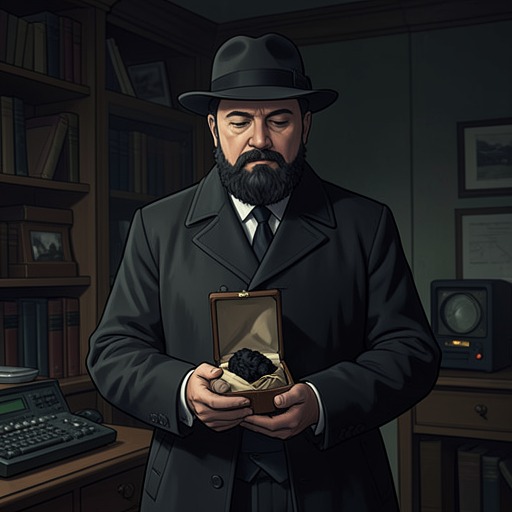
Albert Mace
The Mysterious Affair at StylesAlbert Mace, a qualified pharmacist’s assistant newly employed at a village chemist’s shop, becomes a pivotal witness when he identifies Alfred Inglethorp as the purchaser of strychnine. His testimony appears to make the poison’s route into the case plain, but the investigation ultimately shows why a seemingly direct clue must be read alongside the timing, handling, and testing of other medicines and household substances.
Identity and introduction
Mace has only recently joined the chemist’s shop: the assistant previously employed there had been called up for the army. The inquest presents him as a young man with a pale face, visibly agitated when summoned to give evidence. His qualifications matter to the scene: he is a trained pharmacist, but a new arrival at this particular shop, a distinction that helps establish what he can testify to and why the Coroner asks him about a sale.
Inquest testimony and suspicion
Mace’s appearance before the Coroner is described as the sensation of the day. When asked whom he had sold the strychnine to, he answers that it was Mr. Inglethorp. The courtroom’s attention turns to Alfred, who remains seated and impassive, though he starts slightly at the accusation. Mace’s identification supplies a concrete link between the household’s principal suspect and the poison, and places the purchase in the public record of the inquiry.
The evidence does not, by itself, establish how the poison reached Emily or when she took it. The post-mortem finds that she died from strychnine poisoning, with the recovered quantity indicating that she had taken at least three-quarters of a grain and probably about a grain or somewhat more. Medical testimony notes that strychnine’s symptoms usually appear one to two hours after ingestion. Since Emily had her after-dinner coffee at about eight, but became ill in the early hours, the timing points toward a later dose; a sample of her bedtime cocoa, tested by the doctor, contains no strychnine. Mace’s sale is therefore a troubling clue, but not a complete account of the fatal administration.
The clue reconsidered
As the inquiry proceeds, Poirot remarks that strychnine has surfaced too often: in Emily’s tonic, in the purchase Mace describes, and again in material handled within the household. The repetition produces confusion rather than a straightforward solution. Mace’s testimony helps direct suspicion toward Alfred, yet the novel’s later explanation distinguishes the purchase from the method that actually caused Emily’s death.
Poirot explains that the fatal dose was concentrated in the last portion of Emily’s medicine. A pharmaceutical reference describes how a mixture can cause strychnine salt to settle as an insoluble bromide; if the bottle is not shaken, much of the poison can remain in the sediment and be swallowed together in the final dose. The delayed taking of that dose, after Emily missed her medicine on the intended evening and was away at lunch the next day, also explains why the decisive evidence emerged later than the plotters had anticipated. The investigation further separates tests that answer different questions: the cocoa had been tested for strychnine, while Poirot’s analyst was asked to test it for a narcotic as well.
Narrative role
Mace is a consequential but limited witness. His identification gives the prosecution of suspicion its most dramatic public moment, while the later accounting of the poison’s preparation and timing prevents that moment from serving as the case’s final explanation. The contrast between an apparently damning sale and the more intricate evidence about Emily’s medicine reflects the novel’s central investigative discipline: an isolated fact may be accurate and still mislead when its relation to the other facts has not been established.