Arthur Hastings
The Mysterious Affair at StylesArthur Hastings is both a participant in the Styles affair and the first-person narrator who records it, so the reader encounters the mystery through a perspective that is personally involved yet repeatedly left incomplete. A former soldier invalided home from the Front, he goes to Styles on sick leave after renewing his acquaintance with John Cavendish. His reunion with Hercule Poirot turns the visit into an investigation, while his observations and misunderstandings make the process of learning the truth part of the story itself.
Identity and Return to Styles
Hastings has been invalided home from the Front and spent several months in a convalescent home before receiving a month’s sick leave. With no close relations or friends to visit, he is uncertain how to spend it when he runs into John, whom he has seen little over the preceding years. John is about fifteen years his senior, but Hastings recalls having stayed at Styles as a boy, when the house belonged to John’s mother. Their conversation about old times ends with John inviting him to spend his leave there, and the prospect of seeing the family again gives the visit its personal, rather than investigative, beginning.
The book presents Hastings’s account retrospectively: after the intense public interest in the Styles Case has subsided, he explains that Hercule Poirot and the family have asked him to set down the whole story. He says the account is intended to quiet sensational rumors that continue to circulate. The frame makes his narration an attempt to order and clarify events after the fact, even as his limited understanding at particular moments remains visible within the account.
Reunion with Hercule Poirot
While driving through the village with John and Lawrence Cavendish, Hastings remembers that he needs stamps, and the party stops at the post office. On his way out, he collides with a little man entering the building. The stranger embraces and kisses him warmly, and Hastings recognizes his old friend Poirot. Their reunion brings their friendship back into the narrative at the moment when Hastings is staying at Styles, linking the household’s private crisis with Poirot’s investigative presence.
Hastings tells John that Poirot is a Belgian who has been a famous detective, then asks permission to call him in to investigate the matter. This is a direct and consequential intervention: Hastings is not himself the person conducting the formal inquiry, but he helps bring the detective into the case. The request also shows how his personal acquaintance with Poirot becomes a practical resource for the household as suspicion and uncertainty grow.
A Witness Who Does Not Know Everything
Hastings’s account records not only what he sees but also the gaps in his understanding. At one point he tells Poirot that he and Evelyn Howard seem to know what they are talking about while he remains in the dark, and asks to be enlightened. The remark captures a recurring tension in his role: he is close enough to the people and events to report their exchanges, but he does not possess the interpretive framework that would make their significance clear. The mystery is thus narrated through a witness whose candid admission of confusion keeps the reader beside him rather than above him.
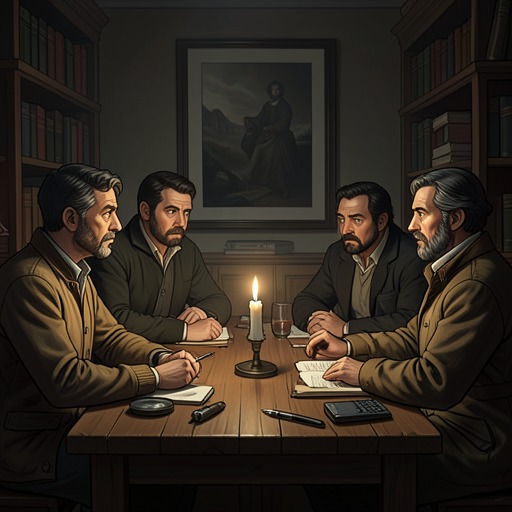
During John Cavendish’s trial, Hastings is also confronted with how evidence can be arranged into a persuasive but mistaken accusation. The prosecution describes John as a stepson who had been supported and treated generously by Emily Inglethorp, then connects financial pressure and an alleged intrigue with Mrs. Raikes to the quarrel before her death. It argues that John bought strychnine in disguise to implicate Alfred Inglethorp. The account of the prosecution’s case places Hastings near the public and legal consequences of the investigation, while making clear that an apparently coherent theory can still misrepresent the facts.
The defence supplies a competing explanation. John says that he understood the quarrel he had been told about as one between Emily and Alfred, rather than realizing his own voice might have been mistaken for Alfred’s. It also says that on July 16 he was at Marston’s Spinney after receiving an anonymous, blackmailing note, and that he waited there without meeting anyone able to confirm his journey. The defence further argues that, as a former barrister, John knew his stepmother’s earlier will in Alfred’s favour had been automatically revoked by her remarriage. These claims complicate the prosecution’s picture and show how Hastings’s narrated trial brings disputed events and legal knowledge into the account without making him their final judge.
Family Evidence and the Will
Hastings’s presence at Styles also places him among the disclosures about Emily’s fortune and her household. Her last will, dated the previous August, left her entire fortune to John after minor legacies to servants. John regarded that distribution as fair because his father’s will had already provided Lawrence with a considerable sum on Emily’s death, while John would be responsible for maintaining Styles. Poirot points out that English law automatically revoked the earlier will when Emily remarried, and Mr. Wells confirms that it was null and void. The legal rule changes the apparent meaning of the inheritance arrangement: what seems to be a settled division of property cannot simply be read apart from the later marriage.
The servants’ account of a later document adds another piece to the chronology. Emily had them come in and sign their names beneath her signature on a long paper, while blotting paper covered the text above it. They therefore confirm that they signed something without knowing what the document said. At trial, the prosecution presents the new will made after the July 17 quarrel as having been destroyed in the bedroom grate the next morning and as having been drawn up in favour of Alfred. The defence, by contrast, says John knew the earlier will was already revoked and would call evidence about who destroyed the later one. In Hastings’s record, the wills are not merely financial documents: their dates, legal status, concealment, and destruction become competing grounds for interpreting motive and responsibility.
Clues, Friendship, and the Ending
Hastings’s most important contribution to the solution is inadvertent. Poirot later tells him that he discovered his “last link” in the spill vase in Emily’s bedroom, and that he owes the fortunate discovery to Hastings. Hastings asks how the discovery can be due to him; Poirot connects it to Hastings’s earlier remark that Poirot’s hand shook while he was straightening ornaments on the mantelpiece. A casual observation, apparently detached from the central mystery, has helped direct attention toward the decisive clue. The episode gives practical force to the idea that small details matter, while preserving the distinction between noticing something and understanding what it means.
At the close, Hastings speaks sadly of two delightful women, and Poirot points out that neither is for him. Poirot then consoles him with the possibility that they may hunt together again. The exchange returns their friendship to the foreground after the case’s legal and investigative complications: Hastings may not have solved the mystery, but he has served as Poirot’s companion, witness, and occasional source of the observation that completes the chain. His account ends not with a claim to mastery, but with the prospect of another investigation shared between the two friends.