Exposure and arrest of Alfred Inglethorp and Evelyn Howard
The Mysterious Affair at StylesThe exposure of Alfred Inglethorp and Evelyn Howard is the decisive unmasking in the Styles case: Poirot links the poison’s delayed delivery to a letter in the murderer’s handwriting, turning a reconstructed method into proof of a shared plot. The revelation culminates in Alfred’s failed attempt to recover the letter and Poirot’s public identification of him as the murderer; the next scene confirms that Alfred and Evelyn are both in custody.
Causes and the delayed poisoning
Poirot explains that Dr. Wilkins’ prescription contained no bromide, but that an empty box of bromide powders had been found earlier in the investigation. One or two such powders put into the full medicine bottle would, as the book describes, precipitate the strychnine. The poison would then remain in the sediment and be taken in the last dose. This mechanism gives significance to the way the medicine was ordinarily poured: the person who served it was careful not to shake the bottle, leaving the sediment undisturbed until the fatal dose.
The plan had been timed for Monday evening. Emily’s bell wire was neatly cut that day, and Cynthia was to spend the night with friends, leaving Emily alone in the right wing, isolated from help. But Emily forgot her medicine while hurrying to a village entertainment, then lunched away from home the following day. The final dose was therefore taken twenty-four hours later than the murderer anticipated. In Poirot’s account, the delay is more than a failed calculation: it is what allows him to obtain the last proof.
The letter as proof
At the revelation, Poirot holds out three thin strips of paper. He says they form a letter in the murderer’s own handwriting and suggests that, had its meaning been clearer, Emily might have escaped. She had recognized that she was in danger, but not how the danger would be carried out.
In the assembled letter, the writer tells Evelyn that the plan will happen that night rather than the previous night, refers to a future made possible once “the old woman is dead and out of the way,” and claims that no one can connect the crime to him. The writer also credits Evelyn’s idea about the bromides. The unfinished final words indicate that the letter breaks off, but Poirot maintains that the handwriting is recognizable. Its details join the poisoning method, its altered timing, and Evelyn’s role in a single piece of evidence.
Exposure and arrest
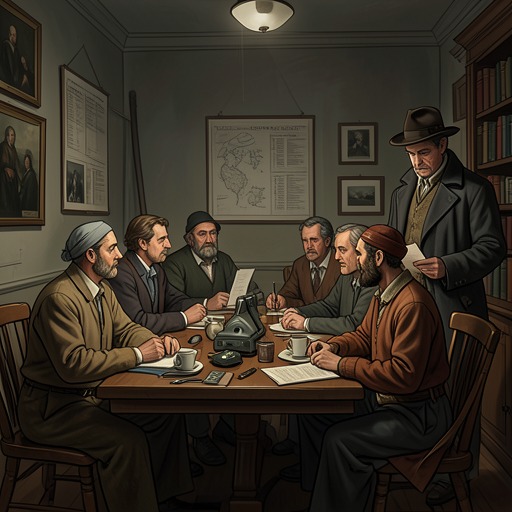
The identification provokes an immediate reaction: Alfred cries out, overturns a chair, and attempts to get the letter. Poirot moves aside and brings the confrontation to an end by stopping his assailant. He then presents Alfred to those gathered as the murderer. The scene makes the revelation public: the incriminating letter is not merely a clue privately interpreted by Poirot but the evidence that triggers Alfred’s direct attempt to interfere with it.
The account then shifts to the library, after several hectic days have passed. Arthur Hastings has Poirot to himself and challenges him over what he considers deception; Poirot replies that he had, at most, allowed Hastings to deceive himself. In the room below, John and Mary are together again, while Alfred and Evelyn are in custody. The arrest of both conspirators confirms the practical consequence of the exposure, while the ensuing private explanation marks a transition from the public accusation to Poirot’s account of how he reached it.
Narrative function
The solution works through a chain of linked circumstances rather than a single clue: the empty bromide box supplies a means, the undisturbed sediment explains the medicine’s delayed effect, Emily’s changed routine disrupts the intended schedule, and that delay leads to the surviving letter. The final piece of evidence retrospectively clarifies the planned isolation of Emily and the conspirators’ confidence that the crime could not be traced to them.
The letter’s fragmentary form preserves a brief interval of uncertainty at the moment of disclosure. Its writer is not named in the surviving lines, and it ends before the thought is completed; Poirot’s recognition of the handwriting supplies the identification. Alfred’s attempt to take the paper then turns that evidential conclusion into visible action. The episode closes the central mystery by connecting method, opportunity, conspiracy, and arrest, before moving into a separate explanation of Poirot’s investigative conduct.