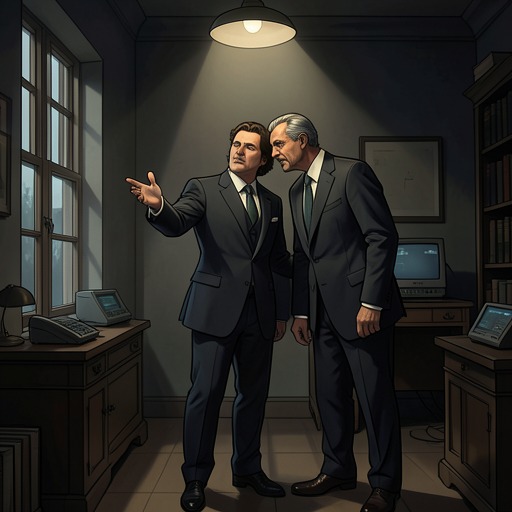
Inquest into Emily Inglethorp’s death
The Mysterious Affair at StylesThe inquest into Emily Inglethorp’s death turns a household death into a public question of cause and responsibility. Held at the Stylites Arms in the village, it establishes strychnine poisoning as the cause of death and produces a dramatic accusation against Alfred Inglethorp, yet ends with a verdict against an unknown person. Its central significance lies in the gap between identifying the poison and proving who administered it: evidence that seems conclusive at the inquest is later shown to have been manufactured, while the true route of poisoning emerges only through Hercule Poirot’s reconstruction.
Setting and Medical Finding
The proceedings take place on Friday at the Stylites Arms. Hercule Poirot and Arthur Hastings attend but are not required to give evidence. After the jury views the body, John Cavendish identifies it and recounts his awakening in the early hours and the circumstances of his mother’s death. The inquest thus begins with a family member’s account before turning to the specialist evidence needed to determine how she died.
A celebrated London toxicologist gives the post-mortem findings. In plain terms, Emily died of strychnine poisoning; the amount recovered indicated that she had taken at least three-quarters of a grain, and probably one grain or slightly more. The coroner asks whether the poison might have been swallowed accidentally. The specialist considers that very unlikely, noting that strychnine is not a domestic poison and that its sale is restricted. The finding establishes deliberate poisoning as the governing possibility, but it does not identify the person responsible.
Timing and Possible Means
The medical evidence also complicates the first suspicion about the delivery of the poison. Alfred had taken Emily’s after-dinner coffee to her, making it an obvious candidate. But strychnine ordinarily produces symptoms within one to two hours, whereas Emily’s symptoms appeared in the early hours of the morning; the specialist therefore considers the interval inconsistent with the coffee, reportedly taken at about eight, unless unusual delaying conditions were present. He says none appeared to apply.
Emily’s habit of drinking cocoa in the middle of the night supplies another possible route. The specialist rules it out as a source of strychnine: he personally took a sample of the cocoa remaining in the saucepan, and it tested negative. These distinctions matter to the investigation beyond the hearing. The coffee and cocoa are plausible but misleading paths; neither explains how the poison reached Emily in the fatal quantity.
Hercule Poirot has already framed the inquiry around the timing of the coffee and whether Emily had eaten well the previous evening, reasoning from the proposition that strychnine had presumably been given in the coffee. At the hearing, however, the poison’s delayed effects and the negative cocoa test unsettle that initial hypothesis. Later, Poirot identifies the medicine as the third medium: the strychnine was already present in Emily’s tonic, prescribed by Dr. Wilkins. A dispensing text explains that a mixture could deposit most of its strychnine as insoluble crystals; added bromide powders could cause the poison to settle, concentrating it in the final dose. The person pouring the medicine was careful not to shake the bottle, leaving the sediment undisturbed. The explanation turns the apparent puzzle of timing into a sequence of dose, settling, and final administration.
The Accusation Against Alfred
The inquest’s most sensational moment comes when Albert Mace, a qualified pharmacist recently arrived at the village shop, is called. Asked whether he had sold strychnine to an unauthorized person, he answers yes. When asked to identify the buyer, he names Alfred Inglethorp. The accusation makes the poison’s restricted sale appear to connect Alfred directly to the death; the assembled attention fixes on him, and he reacts with a slight start before remaining seated.
But the identification rests on a critical weakness. At the later proceedings, Mace identifies the phial as the one he sold to the man he called Alfred, yet admits that he knew Alfred only by sight and had never spoken to him. Alfred denies purchasing the poison and denies having quarrelled with Emily; witnesses support those denials. The accusation’s apparent certainty is therefore not the same as a secure identification. Poirot judges the evidence against Alfred too conclusive to be natural, and says it has been cleverly manufactured: by tightening the net so dramatically, the criminal has created a weakness that can free Alfred.
The inquest’s medical and testimonial evidence is consequently double-edged. It gives the inquiry a firm cause of death and a plausible suspect, but the very prominence of the purchase testimony risks mistaking a constructed case for proof. Poirot’s later observation that the investigation encounters strychnine repeatedly—in Emily’s tonic, in the shop sale attributed to Mace, and in another substance handled within the household—expresses his suspicion that the abundance of poison evidence is confusing rather than clarifying.
Verdict and Later Reassessment
The inquest concludes with the jury’s verdict: wilful murder by some person or persons unknown. That finding recognizes that Emily was deliberately killed without resolving the killer’s identity. It is a consequential distinction: the legal conclusion confirms murder, while the central accusation remains unproved. James Japp of Scotland Yard and another detective are present, a sign that the investigation is moving beyond the inquest, but the verdict itself does not authorize a conclusion against Alfred.
Subsequent evidence makes the inquest’s uncertainty more significant. Detectives later find a long, nearly new piece of blotting paper in Emily’s cheque book; reversed in a mirror, it reveals words showing that a destroyed will had left her property to Alfred. Japp also produces a charred fragment from the grate, and evidence about a beard completes the case then being presented against Alfred. These exhibits strengthen the appearance of a coherent accusation, but the plot ultimately discloses that the apparent case was a frame. The will evidence, poison purchase, and disguise must be assessed not as separate certainties but as parts of an arrangement intended to misdirect.
Poirot’s eventual account supplies the missing causal chain. Emily did not drink the coffee, and her cocoa contained no strychnine; the fatal substance was in her medicine, where the drug precipitated and accumulated in the final dose. The planned timing was also disrupted: Emily forgot to take the medicine on Monday, then spent the next day away at lunch, so the fatal dose came twenty-four hours later than anticipated. That delay left the last piece of proof available to Poirot. The inquest therefore stands as both an answer and an open question: it settles the manner of death, but its verdict preserves the identity of the murderer for the later investigation to establish.