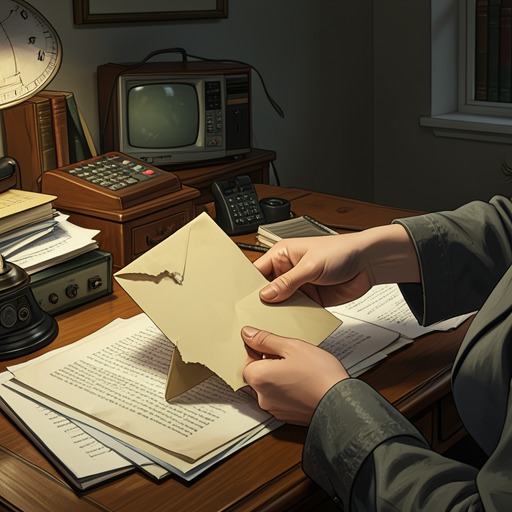
Law Evidence and Private Belief
The Mysterious Affair at StylesLegal proof versus private certainty is the tension between what Hercule Poirot believes he knows and what a court can establish through evidence. The novel repeatedly shows that a compelling accusation is not necessarily a sound case: evidence must be tested for how it was obtained, what it actually proves, and whether an innocent or deceptive explanation remains possible. The distinction ultimately shapes Poirot’s conduct as well as the fate of John Cavendish.
From cause of death to accusation
At the inquest at the Stylites Arms, a medical specialist concludes that Emily Inglethorp died of strychnine poisoning. The estimated quantity—at least three-quarters of a grain, probably a grain or slightly more—establishes the medical cause of death, but does not by itself establish who administered the poison. The Coroner’s questions about accidental ingestion and restricted access to strychnine begin to turn a finding about cause into an inquiry about responsibility.
That inquiry produces a startling identification: the pharmacist’s assistant says he sold strychnine to Alfred Inglethorp. The testimony seems to connect a suspect directly with the poison, and Alfred’s visible reaction intensifies its apparent force. Yet Poirot warns against confusing an arresting detail with reliable proof. The witness knew Alfred only by sight and had never spoken to him; at trial, that limited basis for identification matters. Evidence may be true in its narrowest form—the assistant did sell poison to someone he took for Alfred—without proving that Alfred was the purchaser.
Poirot also questions the apparently suspicious circumstances of Alfred’s absence on the night of the death. If Alfred knew a poisoning would occur, Poirot reasons, he would have arranged to be away; the supposedly fabricated excuse therefore permits competing explanations rather than settling guilt. The evidence can support suspicion without uniquely identifying motive or responsibility.
How apparent certainty is dismantled
The prosecution’s case against Alfred acquires the appearance of completeness through a cluster of details: the chemist’s identification, objects found in a room, and traces associated with Emily’s destroyed will. Poirot calls such a case too conclusive. In his view, evidence that is vague and difficult to disprove has been arranged with such precision that one successful challenge can release the accused. The neatness of a case becomes a reason to examine its construction, not a substitute for doing so.
The trial supplies that challenge. Detectives say they found Alfred-like pince-nez and a phial of strychnine hidden beneath clothing in an unlocked drawer. Cross-examination exposes the weakness in treating their presence as proof: a drawer open to others is an uncertain chain of possession, and a week had passed since the crime. The objects establish that incriminating items were there when found; they do not, without more, establish who put them there or when.
Other evidence likewise changes meaning under scrutiny. Blotting-paper recovered from Emily’s cheque book reveals words indicating that a destroyed will favored her husband, while a charred fragment and a beard found in the attic appear to support the prosecution’s account. But a clue to the existence and beneficiary of a will is not proof of who destroyed it or committed the murder. The prosecution’s collection of suggestive facts cannot make up for the missing links between them.
Handwriting experts testify that the signature entered in the poison register is not Alfred’s. They consider that it might be John’s disguised writing, but acknowledge that it might instead be Alfred’s writing cleverly counterfeited. The testimony therefore does not resolve authorship: its alternatives preserve uncertainty even while making the register look incriminating. The courtroom’s task is not merely to accumulate evidence, but to determine how much each item can actually bear.
Poirot’s missing link
Poirot states the central distinction plainly: knowing that a man is guilty and proving him guilty are different things. He believes John is guilty, yet admits that the case contains terribly little evidence and that he lacks the last link in his chain. His confidence is personal, provisional in its practical consequences, and insufficient to replace a demonstrable connection before the law.
That gap governs Poirot’s strategy. He expects the prosecution to present its case at the police-court proceedings and anticipates that John’s solicitors may reserve the defence for the trial. Until the missing link is found, Poirot insists that he must remain behind the scenes; Mary must believe he is working for her husband rather than against him. His secrecy reflects the difference between an investigator’s developing judgment and a case ready to be proved. A private conviction cannot safely be treated as a public verdict, especially when revealing his position might compromise the inquiry.
The episode also sharpens the contrast between evidence and interpretation. The discovery of a phial, the identification by a witness, or a plausible motive can each seem decisive when isolated from questions of access, reliability, and alternative explanations. Poirot’s method is to sift rather than simply count: the force of evidence depends on what it discriminates between, not on how dramatic it appears.
Judgment, loyalty, and consequence
Poirot’s restraint has a personal cost. He later explains that, when John was arrested, he was deciding whether to clear him at once. He could have done so, but feared that an immediate intervention might prevent the real criminals from being convicted. The choice sets the possible rescue of an individual against the larger aim of bringing the guilty to justice; it also means allowing John’s jeopardy to continue while the necessary proof remains unavailable.
The case therefore refuses to equate private certainty with legal authority. Poirot’s belief does not itself acquit John, just as the prosecution’s confidence does not make its circumstantial evidence conclusive. The trial’s questioning reveals how identification can be mistaken, physical objects can be planted or left accessible, and expert opinion can preserve more than one possibility. Legal proof emerges not from certainty of tone but from evidence that survives examination.
In the end, Poirot’s concealed position and delayed intervention connect evidentiary discipline to the human outcome he values. He says he ultimately chose in favor of a woman’s happiness: the danger through which John and Mary passed brings the estranged pair together again. The resolution does not erase the difference between what Poirot privately knows and what a court can prove. Instead, it makes that difference the source of his dilemma: he must seek a defensible link, protect the prospect of justice, and decide when his knowledge should become action.