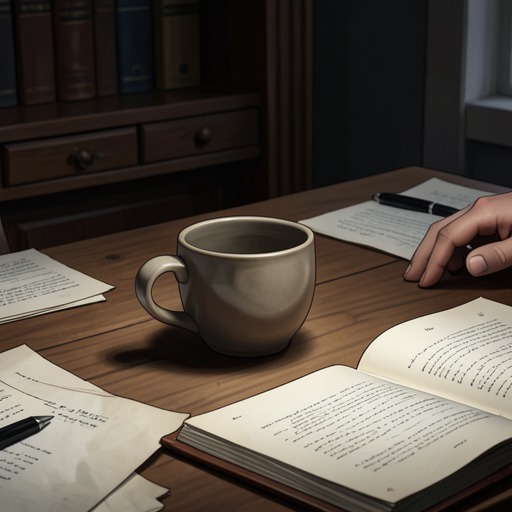
Shattered coffee cup
The Mysterious Affair at StylesThe smashed coffee-cup is a small but decisive object in the investigation of Emily Inglethorp’s death. Found among the scattered contents of her bedroom, it appears at first to be a possible vessel for the strychnine suspected of killing her. Its powder-like destruction makes that possibility impossible to test; later, the cup’s relationship to the room’s unstable table helps reveal that the coffee was spilled rather than consumed. The cup thus shifts from apparent evidence of poisoning to a material clue that overturns the initial account of how the poison was administered.
Discovery in the Bedroom
When Hercule Poirot examines the debris beside Emily’s bed, he finds a reading-lamp, books, matches, keys, and the crushed remains of a coffee-cup. The lamp’s chimney is broken in two places, but the cup has been smashed to powder. The contrast makes the cup’s condition stand out: the room contains other objects disturbed or damaged in the same episode, yet the cup has been reduced to fragments too small to offer a usable sample.
Arthur Hastings proposes that someone may simply have stepped on it. Poirot confirms that someone did, but insists that the act matters. The cup, he reasons, may have been crushed because it contained strychnine—or, more seriously, because it did not. The destruction therefore creates two competing interpretations rather than resolving the question. It is suspicious precisely because it removes the means of checking what the cup held.
Poisoning Hypothesis and the Missing Test
At the inquest, medical evidence establishes that Emily died from strychnine poisoning. The amount recovered from her body was estimated at no less than three-quarters of a grain, and probably one grain or slightly more. The inquiry considers whether the poison might have been delivered in her after-dinner coffee, which Alfred had taken to her. Because coffee’s own bitterness could cover the taste of strychnine, that explanation remains plausible even though the symptoms appeared much later than the expected one-to-two-hour interval after ingestion.
The cup’s destruction makes the uncertainty consequential: its contents cannot be analyzed. Dr. Bauerstein tells the inquest that, with the cup completely smashed, there is no possibility of testing what it contained. The medical evidence also excludes Emily’s usual middle-of-the-night cocoa as the source: a sample from the remaining cocoa had been analyzed and contained no strychnine. With the cup unavailable for examination, the coffee hypothesis remains possible but unconfirmed, and the broken object helps preserve the misleading appearance that the poison was administered in that drink.
From Suspicious Evidence to a False Lead
The coffee theory initially sits alongside other apparently incriminating evidence against Alfred. A young chemist identifies him as the person who bought strychnine, and Poirot observes that Alfred’s excuse for being away from the house was plainly invented. Yet Poirot warns that the case is too conclusive: evidence can be manufactured so neatly that its apparent force becomes a reason to examine it more carefully. The cup’s unreadable contents belong to this pattern of uncertainty. It cannot prove that Alfred’s coffee carried the poison, and its destruction leaves the central material question open.
The investigation’s later reconstruction changes the meaning of the cup. Poirot notices a damp stain on the carpet in Emily’s room, smelling of coffee and containing small china splinters. He connects it to the table near the window, which tips when weight is placed on it. He concludes that Emily set down her coffee-cup when she entered the room; the unstable table tilted, and the cup fell and broke on the carpet. On this account, the fragments found near the bed were not evidence that she had drunk the coffee, but the remains of a spill.
The Cup’s Place in the Final Reconstruction
Poirot’s reconstruction separates three questions that had become entangled: whether the cocoa contained poison, whether Emily drank the coffee, and where the fatal strychnine came from. The cocoa sample was negative, and the coffee had been spilled rather than drunk. Poirot consequently identifies Emily’s medicine as the third possible medium. In his account, the strychnine was already present in the mixture, and the final dose of her medicine carried the poison that killed her.
The cup’s destruction has a double effect on the mystery. It blocks a direct chemical answer about the coffee, allowing suspicion to gather around a plausible but mistaken route of administration. At the same time, its fragments survive as part of the physical evidence that ultimately corrects that route: the china in the carpet stain, the coffee odor, and the treacherous table establish what happened to the drink. The cup is therefore not simply a ruined container. Its broken state first frustrates analysis and then, through the traces it leaves behind, helps distinguish the apparent explanation from the actual one.