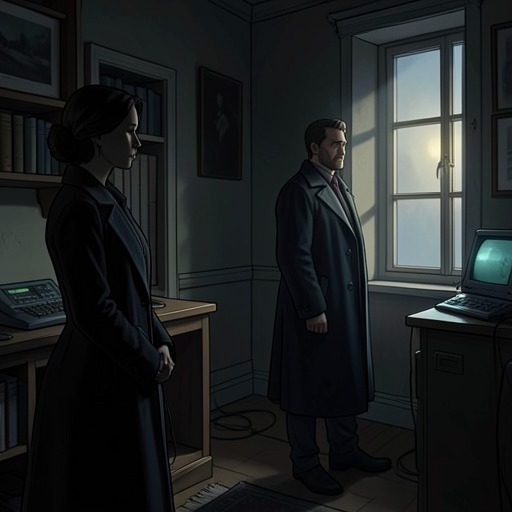
Trial of John Cavendish
The Mysterious Affair at StylesJohn Cavendish’s murder trial at the Old Bailey brings the investigation of Emily Inglethorp’s death into a courtroom, where family history, inheritance, medical findings, and circumstantial evidence are marshalled into competing accounts of murder. The prosecution presents John as a beneficiary who betrayed his stepmother; the defense argues that the case against him has been manufactured. The proceeding reaches its decisive turn when Hercule Poirot names Alfred Inglethorp as the murderer, exposing the apparent case against John as part of a larger deception.
Background and Stakes
The trial takes place after a village inquest has established that Emily died of strychnine poisoning. A toxicologist estimates that she must have taken at least three-quarters of a grain, probably one grain or slightly more. Hercule Poirot has challenged the assumption that the poison was administered in her coffee, but the prosecution’s case at the Old Bailey draws on the poisoning, the household’s disputes, and the circumstances of the damaged wills to argue that John had both motive and opportunity.
Inheritance supplies the prosecution with a pointed account of John’s financial interest. Emily’s will of the previous August left her entire fortune, after smaller legacies to servants, to John. Her earlier arrangement had appeared equitable within the family: John inherited the property under his father’s will, while Lawrence Cavendish was to receive a substantial sum when Emily died. But Hercule Poirot’s inquiry has established that Emily’s remarriage automatically revoked that earlier will. The existence and destruction of a later will therefore matter greatly: witnesses recalled that Emily called two servants in to sign a long paper beneath her signature, while blotting paper concealed its contents.
The Prosecution’s Case
On September 15, John appears in the dock charged with the wilful murder of Emily Agnes Inglethorp and pleads not guilty. Mr. Philips, appearing for the Crown, characterizes the killing as a deliberate poisoning by a stepson against a woman who had supported him since boyhood and provided generously for him and his wife at Styles Court. The argument makes betrayal as important as money: the alleged victim is presented as a trusting benefactress, and the accused as the family member most conspicuously positioned to benefit from her death.
The Crown proposes to support that account with claims about John’s finances and conduct. It alleges that he was a spendthrift at the end of his financial resources, that Emily confronted him about an intrigue with Mrs. Raikes on the afternoon before her death, and that their quarrel was overheard. It further asserts that on July 16 John bought strychnine at the village chemist’s shop while disguised as Alfred, hoping to shift suspicion onto Emily’s husband. According to the prosecution, Alfred’s alibi explains why that apparent trail leads away from him and back toward John.
The will supplies another strand of the Crown’s theory. It argues that after the quarrel on July 17, Emily made a new will in Alfred’s favour, which was found destroyed in her bedroom grate the following morning. The prosecution suggests that John, who supposedly did not know that his own earlier will had already been revoked by Emily’s remarriage, later entered her room and destroyed the document because he believed doing so would restore the earlier disposition in his favour. It also emphasizes the claim that John handed Emily her coffee on the fatal night, linking the proposed motive to an opportunity to administer poison.
The Defense and the Evidence
Sir Ernest Heavywether answers that the charge rests on circumstantial evidence, much of it unproved. Strychnine was found in a drawer in John’s room, but the drawer was unlocked, and the defense argues that no evidence establishes that John hid the poison there. The Crown, it says, has not proved that he ordered a black beard from Parkson’s, an item associated with the supposed disguise. The quarrel and John’s financial difficulties are acknowledged, but Heavywether says both have been exaggerated and do not establish murder.
The defense also disputes the prosecution’s interpretation of the quarrel. John, it says, had been told there was a violent disagreement between Emily and Alfred and naturally thought that account referred to a separate incident; he did not realize that anyone could mistake his voice for Alfred’s. On the alleged chemist’s visit, the defense offers an alternative account: John had gone to Marston’s Spinney after receiving an anonymous, blackmailing note that threatened to reveal matters to his wife unless he complied with its demands. He waited there half an hour and returned without meeting anyone who could corroborate his movements, but the note itself was preserved and produced for the jury.
On the destruction of the will, Heavywether directly contests the Crown’s premise about John’s knowledge. John had formerly practiced at the Bar and, the defense says, knew that Emily’s remarriage automatically revoked her earlier will. The defense promises evidence identifying who actually destroyed the later document, suggesting that this issue may open a different view of the case. It also points out that the evidence against Lawrence is at least as strong as that against John, widening the field of possible explanations rather than allowing suspicion to settle on the accused alone.
Reversal and Significance
The trial’s competing interpretations echo Hercule Poirot’s earlier judgment that the evidence against Alfred had been made too conclusive. In his view, a criminal had manufactured an exceptionally tight case, only for that overprecision to make it vulnerable: one cut could free Alfred. The courtroom contest consequently concerns not only what each clue appears to show, but who could have arranged the clues and whether their apparent coherence is genuine proof or a designed trap.
The proceeding’s decisive reversal comes when Hercule Poirot, addressing the gathering, introduces Alfred as the murderer. His revelation overturns the prosecution’s account of John as the poisoner and reframes the suspicious evidence against Alfred as an attempt to implicate him. The trial thus serves as the public culmination of the novel’s investigation: the inheritance and will questions that seemed to supply a motive, and the poison evidence that seemed to identify a culprit, do not by themselves establish John’s guilt. Instead, Poirot’s intervention exposes the difference between a persuasive accusation and an explanation capable of accounting for the evidence as a whole.