Kovalyov Discovers His Nose Is Missing
The NoseKovalyov’s discovery that his nose has vanished is the decisive rupture that converts a private bodily loss into a public and bureaucratic absurdity. He wakes to find a smooth vacancy where the nose should be; before long, he sees the missing feature moving through the city in the uniform and rank of a state councillor. His attempts to treat the loss as an urgent practical matter expose how thoroughly his sense of self depends on appearance, title, and social access—and how poorly ordinary institutions can respond to what has happened.
The Morning Discovery
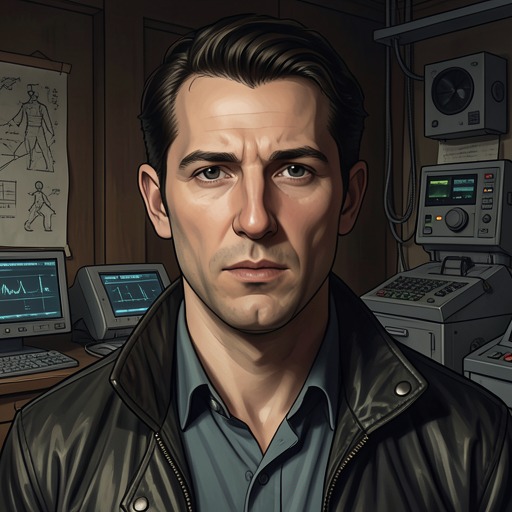
Kovalyov wakes fairly early and makes his habitual droning sound through his lips before asking his valet for the small mirror on the table. He intends to inspect a heat-boil that had appeared on his nose the previous evening. Instead, the mirror shows a perfectly smooth blank. He rubs his eyes with a towel, but the absence remains; he springs from bed, shakes himself, dresses, and goes directly to seek help from the police superintendent.
The loss is more than the disappearance of a feature: it overturns the bodily appearance on which Kovalyov’s public confidence rests. He had expected to see a fairly symmetrical nose, but finds a broad, flat vacancy. With no droshky in the street, he must walk, holding a handkerchief to his face as though his nose were bleeding. He tries to explain the event away as imagination, then enters a confectioner’s shop to check in a mirror. Finding himself alone among shop-boys cleaning tables and carrying cakes, he looks carefully and confirms the blank. His disgust is immediate, and he resolves not to look at or smile at anyone on the street, contrary to his usual habit.
The Missing Nose in Public
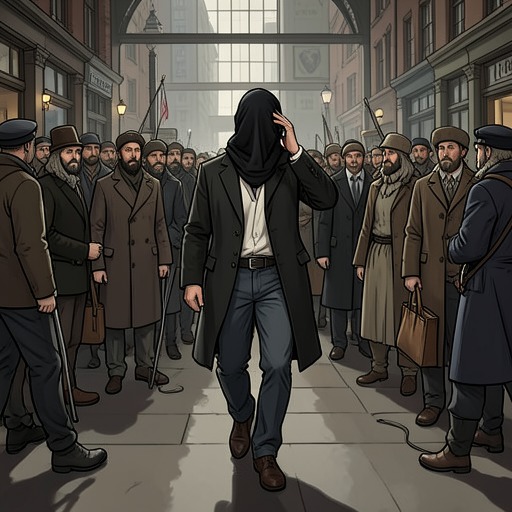
Kovalyov’s attempt to keep the loss private collapses when a carriage stops nearby and a uniformed gentleman comes out. He recognizes the figure as his own nose. After waiting anxiously for it to return to the carriage, he sees it emerge in a gold-embroidered uniform, with a stiff high collar, chamois-leather trousers, a sword, and a plumed hat that marks it as a state councillor. Its business appears to be making duty-calls: it looks about, tells the coachman to drive on, and leaves in the carriage.
The rank displayed by the nose makes the bodily impossibility a social confrontation. Kovalyov follows the carriage to the Grand Bazar of Moscow and eventually finds the nose inspecting goods outside a shop. When he insists that it is his own, the nose rejects the relationship, declares itself to be itself, and argues that their uniforms belong to different departments. It turns away. Kovalyov is left unable to reconcile intimate bodily ownership with the nose’s confident performance of an independent, higher-status identity.
That encounter also interrupts Kovalyov’s effort to present himself as a desirable man of standing. He adjusts his cambric collar and the seals hanging from a gold chain, then turns his attention to a graceful young woman in a white dress, accompanied by an older woman and a tall lackey. At the sight of her, he remembers the blank on his face, his eyes fill with tears, and he turns back to challenge the nose. It has already gone, apparently continuing its calls. The episode binds bodily loss to the social occasions Kovalyov fears he can no longer enter with confidence.
Rank, Reputation, and the Search for Redress
The discovery is framed by the account of Kovalyov’s own investment in rank. He had served as a Caucasian committee-man, but continued to remember that former position and preferred the title of Major because it enhanced his importance. He regularly walked on the Neffsky Avenue in a stiff, clean collar, wore seals including armorial bearings and the days of the week, and had come to St Petersburg seeking a position appropriate to his rank—ideally vice-governor, though he would accept a departmental bailiff’s post. He was also willing to marry, provided a prospective wife brought a dowry of two hundred thousand roubles. In this context, the nose’s state-councillor uniform is not a decorative oddity: it stages, in grotesque bodily form, the hierarchy by which Kovalyov measures himself and others.
At the advertising office, Kovalyov asks for an announcement offering a reward to whoever brings the fugitive nose to him. He resists giving his name because he fears that his acquaintances—Madame Tchektyriev, the wife of a state councillor, and Madame Podtotchina, the wife of a colonel—might hear of the loss. He suggests that the notice identify him instead as a committee-man, or preferably as a Major. His effort to obtain public assistance thus immediately becomes an effort to control how the event will be known.
The official refuses to print the notice, saying it could compromise the newspaper. He recalls a previous advertisement for a supposedly lost black-haired poodle, which was actually a satire referring to an establishment’s cashier, and treats the proposed notice as the sort of questionable material that could make the paper appear to publish nonsense or lies. Kovalyov insists that his case is not a joke, but the distinction that matters to him does not persuade the office. The institution’s concern is its own credibility, not the recovery of his nose.
Kovalyov then goes to the police commissary, arriving as the official reclines on a couch and congratulates himself on the prospect of making money. The commissary gives him a cold reception, says that respectable people do not have their noses stolen, and invokes the need to rest after eating. The remark wounds Kovalyov because, although he can tolerate criticism of himself as an individual, he cannot endure a reflection on his rank or social position. He leaves with his head raised and declares that he has nothing more to say after such insulting treatment. His appeal for help is met not with investigation but with a judgment about respectability.
Failed Remedies and the Event’s Significance
The doctor Kovalyov summons examines the empty place with a series of probing gestures: he raises Kovalyov’s chin, flicks the spot where the nose had been, turns the face first one way and then the other, and flicks it again. The examination yields a definite refusal. The doctor says the nose cannot be replaced and warns that an attempted remedy would be worse than the disease. Kovalyov pleads that he must appear in good society and has two parties that evening; he asks for even an imperfect attachment that he could hold in place with his hand. The doctor instead recommends washing the place with cold water and preserving the nose in spirits or warm vinegar mixed with brandy, adding that it could later be sold.
The episode therefore accumulates failed forms of recognition. Kovalyov knows what has happened to his own body, but the advertising official converts the report into a threat to the paper’s reputation, the commissary into evidence against the claimant’s respectability, and the doctor into a problem without a safe cure. Meanwhile, the nose’s uniform and refusal of kinship make social rank appear capable of overriding the most intimate physical relation. The discovery establishes the story’s central absurdity not as a single impossible sight, but as an impossible loss that becomes more, rather than less, consequential when everyone treats it through familiar rules of status, propriety, and professional judgment.