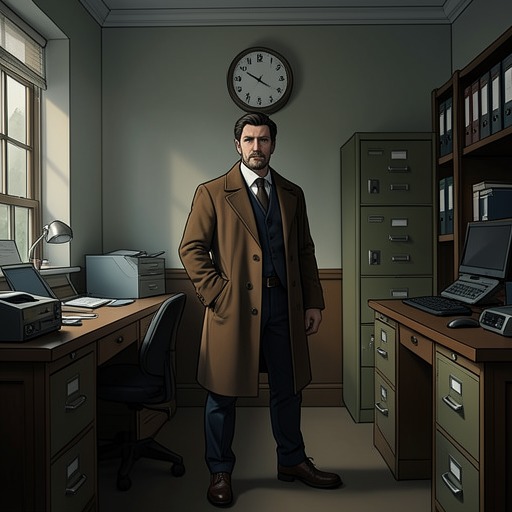
Kovalyov’s Attempt to Advertise His Missing Nose
The NoseKovalyov’s attempt to advertise his missing nose is a comic collision between an impossible bodily crisis and the city’s routine systems of information and authority. Afraid that the nose—now moving about independently in the rank of a state-councillor—will leave the city before he can find it, he hurries to an advertisement office. There, the institution that might publicize the loss refuses to recognize it as a reportable fact; his further appeal to the police also fails to secure help. The episode makes his predicament visible not only as a physical absence, but as a problem that official categories cannot accommodate.
Background and Urgency
Kovalyov’s panic is sharpened by the social life he wants to resume. A former Caucasian committee-man, he insists on the title of Major, and has come to St Petersburg seeking a position appropriate to his rank. He would accept even a bailiff’s post, and is willing to marry if a prospective wife brings a dowry of two hundred thousand roubles. His seals, stiff clean collar, daily walk on the Neffsky Avenue, and acquaintance with women of standing all belong to a carefully maintained public identity. Without his nose, he fears he cannot present himself in the society where that identity matters.
The immediate trigger for the advertisement plan is his encounter with the nose itself. Dressed in a gold-embroidered uniform, with a high collar, sword, and plumed hat marking it as a state-councillor, it calls to its coachman and rides away. When Kovalyov confronts it, the nose denies that it is his and claims there can be no close relation between them because their uniform buttons indicate different departments. The nose’s independent status turns a missing feature into a competitor in the same bureaucratic world Kovalyov hopes to enter. He fears that delay will let it slip away secretly, making his search last a month, so he abandons the idea of going first to the police and orders his coachman to drive straight to the advertisement office.
The Advertisement Office
Kovalyov arrives out of breath at a small room where a grey-haired official, wearing an old coat and spectacles, holds a pen between his teeth while counting copper coins. The official is occupied with routine transactions, returning notes to housekeepers and porters and tallying sums in kopecks. Against that mundane business, Kovalyov’s request is both urgent and difficult to state: he wants an advertisement promising a reward to anyone who brings the culprit to him. When asked for his name, he hesitates to disclose it, worried that his lady friends—Madame Tchektyriev, the wife of a state-councillor, and Madame Podtotchina, a Colonel’s wife—might hear of his disgrace. He suggests that the notice identify him simply as a committee-man, or preferably a Major.
The clerk initially mistakes Kovalyov’s description for a human fugitive, perhaps a serf, and asks whether the man who has run away has stolen a considerable sum. Kovalyov must correct the basic category of the request: it is his own nose that has absconded. He explains that it is walking about the city as a state-councillor and insists that the notice should ask whoever catches it to return it or at least tell him where it lives. His practical argument mixes physical need with social consequence: a nose is no small toe, which could be hidden inside a boot, and without this prominent feature he cannot appear before the women he visits. On Thursdays he calls on Madame Tchektyriev; Madame Podtotchina has a pretty daughter. The loss threatens the routines through which he maintains his prospects and standing.
After reflecting, the official refuses to print the notice. His stated concern is not whether Kovalyov’s loss is real, but whether publishing it could compromise the paper. If one person can advertise a lost nose, he reasons, others might submit nonsense and lies. To defend that standard, he recalls a recent advertisement for a lost black-haired poodle. Although it appeared innocuous, it was actually a satire in which the poodle stood for an establishment’s cashier. The example reveals the clerk’s working rule: a strange notice might be understood as a joke or disguised attack, so its apparent subject cannot be accepted at face value. Kovalyov counters that this is his own nose, almost himself, but the clerk repeats that he cannot insert the advertisement.
The refusal becomes more absurdly tangible when the official offers Kovalyov his snuff-box while concealing its lid, which bears a portrait of a woman. Kovalyov angrily rejects the gesture: the missing nose is precisely what prevents him from taking snuff. The ordinary courtesy of offering a snuff-box has become an unintentional demonstration of what he has lost. The clerk, however, has already converted the emergency into a matter for a doctor and treats Kovalyov as a witty man making a joke. The advertisement office does not investigate the extraordinary claim; it files it outside the boundaries of plausible public information.
Appeal to the Police
Leaving the office in profound irritation, Kovalyov goes to the police commissary. He arrives while the official is reclining on a couch and congratulating himself on the prospect of making a little money. The commissary is described as a patron of the arts and industries who values a cheque above all, praising its convenience and durability. This introduction places Kovalyov’s appeal before an authority whose stated habits suggest self-interest rather than an eager search for redress.
The commissary gives him a cold reception. He says the afternoon is an unsuitable time to bring a case, invokes the need to rest after eating, and declares that respectable people do not have their noses stolen. The remark shifts attention from the reported loss to the respectability of the person suffering it. Kovalyov is unusually sensitive to any slight against his rank or social position: he can endure criticism of himself as an individual, but not an insult to his status. He takes the commissary’s words as a direct affront, raises his head proudly, and leaves with dignity rather than continuing to plead. The encounter supplies no remedy, and turns an attempt to enlist public authority into another occasion on which his standing is challenged.
Aftermath and Significance
The rejected advertisement and the rebuff from the commissary leave Kovalyov without the public notice he had hoped would mobilize the city on his behalf. The failure is not simply that an absurd event defeats ordinary procedure. Each institution translates his account into a more familiar problem: the clerk hears a possible joke or satirical notice, while the commissary answers with a judgment about respectable people. The greater the urgency of the loss, the more insistently the officials rely on categories that make it impossible to address.
That mismatch also exposes how thoroughly Kovalyov understands himself through public recognition. He worries about the names printed in the advertisement, about visits to women of rank, and about appearing in society; meanwhile, the nose claims a higher bureaucratic identity than its former owner. The episode’s central reversal is thus social as well as physical: the nose can move through the city as an official, but Kovalyov cannot persuade the newspaper office to describe its disappearance as fact. The later circulation of rumors about the nose’s public appearances makes the contrast sharper. The city can turn the marvel into entertainment and spectacle, yet Kovalyov’s own attempt to communicate the loss through an official channel is refused.