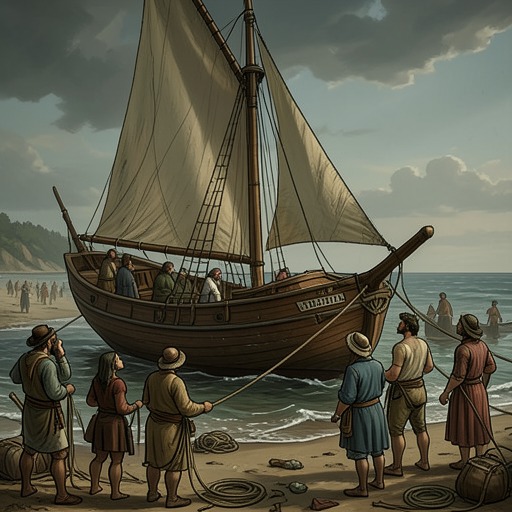
“And all the days of Noah were nine hundred and fifty years; and he died.”
The Passage (Justin Cronin Edition)The verse “And all the days of Noah were nine hundred and fifty years; and he died.” links the biblical name of the project to two distinct reckonings with mortality: Bradford Wolgast’s discovery of why he was selected, and Anthony Carter’s struggle to understand his own past. Its recurrence does not resolve either man’s predicament; instead, it makes time—its extraordinary extension and its irreversible end—the measure against which their choices are made.
The clue behind the project’s name
When Sykes explains that the project’s name does not stand for an acronym, he directs Wolgast to the story of Noah and the ark and tells him to look up how long Noah lived. That night, in his Denver apartment, Wolgast follows the instruction using an online concordance; he owns no Bible and has apparently not seen one since his wedding day. The search leads him to the verse about Noah living nine hundred and fifty years before he died.
The quotation gives Wolgast the missing piece in Sykes’s explanation. The choice of Wolgast was personal, not merely professional: the agency selected him because of Eva, his daughter, whose death he had been forced to witness. The verse’s extraordinary span of life therefore points him toward the project’s concern with mortality, while the revelation turns its allusion back onto his own bereavement.
A phrase returned to Carter
The verse reappears in a later exchange with Anthony Carter, but now it is an incomplete echo rather than an answer Wolgast has found in a concordance. Carter touches the moisture on the glass, rubbing the beads between his thumb and fingers with absorbed attention. He tells Wolgast that he needs time to figure out what happened with the woman—the recognition and the act that remain unresolved for him.
At that moment, the verse surfaces again: “And all the days of Noah were nine hundred and fifty years …” Its trailing ellipsis leaves the sentence suspended before its ending, just as Carter’s understanding is unfinished. Wolgast answers with a promise of time, saying he can give Carter all the time in the world, an ocean of time. Carter nods, accepting the possibility of delay rather than claiming that he already understands.
Meaning through recurrence
Across the two appearances, the verse shifts from a practical clue into a charged refrain. In Denver, reading its completed form lets Wolgast infer the reason behind his selection; in the encounter with Carter, the fragment accompanies a man who cannot yet make sense of what he has done. The difference matters: the first recurrence produces recognition, while the second holds open the possibility that understanding may take time.
The verse’s biblical image of extreme longevity does not erase death. Its full wording ends with Noah’s death, and Wolgast’s discovery is rooted in the death of Eva; Carter, meanwhile, faces the need to reckon with the woman’s death and his part in it. The phrase thus joins extended time to a limit neither of them can simply undo. Its repeated, unfinished presence gives the story a compact motif for the distance between surviving, remembering, and finally understanding.