Anthony Carter–Rachel Wood Relationship
The Passage (Justin Cronin Edition)The Anthony Carter–Rachel Wood Relationship begins with Rachel’s practical kindness and ends in a death that Anthony Lloyd Carter cannot fully understand. Rachel helps Carter find a place to live and organizes work for him among her neighbors; later, after a frightening encounter and a struggle at her home, he drowns her in the pool. Carter admits that he killed her, but remorse does not bring comprehension. His request for time to figure out what happened becomes the point at which Bradford Wolgast recognizes that the case may be more complicated than its courtroom account.
An act of help becomes a relationship
Rachel Wood first encounters Carter standing beneath an overpass with a sign asking for help. She takes him home, makes him a sandwich, and contacts a group home whose work she supports. She then asks her friends in River Oaks to give him jobs around their houses. Carter cuts lawns and tends hedges, including Rachel’s lawn, turning an initial act of assistance into a regular working relationship that continues for about two years.
The arrangement is both personal and practical. Rachel treats Carter kindly, pays him for his work, and brings him iced tea on hot days. She also mobilizes a wider circle of neighbors to employ him. To Carter, those repeated gestures remain part of what makes the later violence so difficult to reconcile: he remembers Rachel as someone who had been good to him, not as an adversary.
The encounter at Rachel’s home
The relationship changes when Carter arrives to cut the lawn and Rachel’s five-year-old daughter, home sick from school, is in the yard. The girl knows Carter from his regular visits, but on this occasion something frightens her and she begins screaming. The account raises the possibility that Carter touched her, but the court psychiatrist is uncertain about that detail; the precise cause of the child’s alarm is not established.
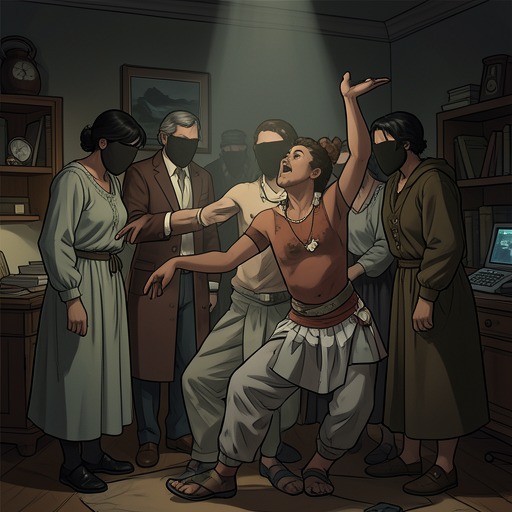
Rachel comes outside, and the encounter escalates into a struggle. She falls or is pushed into the pool. Carter goes into the water after her, perhaps to help, but Rachel continues to resist him. The struggle ends with Rachel drowned in front of her daughter. A neighbor hears what is happening and calls the police; when they arrive, Carter is sitting beside the pool and Rachel is in the water. The sequence preserves uncertainty about how the confrontation began and how Rachel entered the pool, while making its fatal outcome plain.
Admission, punishment, and unresolved remorse
Carter does not deny killing Rachel. The prosecution emphasizes that she had been a strong swimmer, and he is sentenced to death for her murder. In prison he recalls her kindness and says he is sorry, but he cannot understand the event that led to her death. The contradiction remains central to his experience: he accepts responsibility for the killing, yet does not believe that the explanation available to him is complete enough to make his approaching execution intelligible.
Rachel’s husband visits Carter once, tells him that he has chosen to forgive him, and speaks of the loss of his wife and the children’s mother. Carter thanks him and apologizes. The visit offers no change to the sentence, and no one else comes to see Carter during his remaining years in the unit. Forgiveness therefore does not resolve the relationship’s central fracture: the family’s loss is acknowledged, but Carter’s unanswered question about what happened remains.
The request that carries the relationship forward
When Wolgast and Phil Doyle meet Carter as part of a proposal that could take him out of prison, Wolgast has tea served with a saucer, spoon, lemon, and sugar. The glass recalls Rachel’s iced tea and the ordinary kindness Carter associates with her. Watching Carter attend to the cool, wet glass, Wolgast suspects that the official account does not capture everything about the day Rachel died. That is Wolgast’s inference, not a new finding that settles what happened.
Carter’s stated reason for accepting the offer is modest and specific: he needs time to figure out the thing that happened with Rachel. Wolgast promises him time, and Carter’s unresolved connection to her becomes the hinge between his prison story and the larger narrative. The relationship is defined neither by a simple tale of rescue nor by a complete explanation of violence. Its enduring tension lies in the gap between Rachel’s documented kindness, Carter’s admission and remorse, and the cause of the fatal encounter that he still cannot understand.