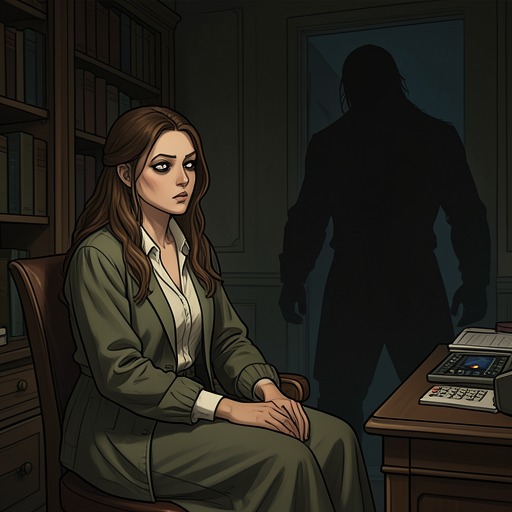
Babcock’s dream
The Passage (Justin Cronin Edition)Babcock’s dream is a recurring kitchen vision that turns an imagined act of violence into a test of Theo Jaxon’s identity and agency. A voice urges Theo toward a knife and tells him that Babcock is not merely another being but a shared presence; the dream’s force comes from joining that intimate threat to a collective consciousness. Theo wakes from it with the knowledge that, without a little girl’s intervention, he might have obeyed, and with a lasting fear of sleep.
The Kitchen and the Voice
The dream places Theo in a kitchen with an open drawer and a knife lying inside it. Its domestic setting is repeated rather than explained: the drawer is described as holding the knife as a baby might be held in a crib. Against that ordinary, intimate image, a voice addresses Theo by name and commands him to take the knife and kill a woman. The kitchen becomes the setting for a threat that follows him both in dreams and during his waking confinement.
Theo is held in a cell and struggles to stay awake, exercising and hurting himself to resist sleep. As his exhaustion accumulates, the distinction between waking and dreaming becomes difficult to maintain. The voice seems to inhabit that uncertainty: it speaks with confidence, but Theo cannot be sure whether it is truly a voice or something in his own mind. The dream therefore works not as an isolated episode but as pressure that persists across the boundary between sleep and waking.
Babcock, the Many, and the Ring
When Theo resists the voice, it changes its approach. It first uses his name, then invites him to accept a different one: Babcock. The voice explains Babcock as a shared identity, describing him as Theo, itself, and everyone in the region, and as a new kind of god imagined collectively. Theo responds inwardly by repeating his own name and family identity: he is Theo Jaxon, son of Demetrius and Prudence Jaxon, and a member of the First Family. That self-reassertion shows the dream’s central conflict in miniature: a named individual tries to hold onto his history while the voice offers absorption into a collective self.
Theo recognizes the name Babcock as belonging to one of the Twelve. The voice calls the collective the Many and the We of Babcock, and returns to its demand that Theo close his eyes and kill the woman. Later, Olson explains to Peter that the Many are the virals associated with Babcock and that Babcock is not simply their controller: he is them. Olson also says the first settlers were children brought by train, that they intended to hide in the tunnels inside Yucca Mountain, and that Babcock was already there when the dream began. According to Olson, killing the woman in the dream binds a person to Babcock and the ring. The kitchen vision thus connects Theo’s personal ordeal to the Haven’s history and its system of fear and sacrifice.
Theo’s Resistance and the Girl
The command intensifies as Theo grows too tired to defend himself reliably. He tries to hold onto thoughts of Mausami, but as he falls further into the dream he reaches for the knife. At that moment a little girl appears at the kitchen table with a stuffed animal in her lap. She identifies it as her rabbit and calls it Peter. The interruption changes the course of the dream: Theo later tells Mausami that the girl stayed his hand and that, without her, he would have killed the woman—or anyone—and done what the voice wanted.
The dream ends not with Theo’s confidence restored but with an unsettling recognition of his vulnerability. He says that once he understood how close he had come to acting, he could not unknow it: whoever he had thought he was, he might be somebody else entirely. This is not evidence that he accepted Babcock’s identity; rather, the dream makes the threat of losing his own identity feel possible to him. His effort to resist is real, but it does not make the revelation harmless.
Aftermath and Significance
Afterward, Theo tells Mausami that the dream is gone, but its fear remains. He is afraid to close his eyes because he might find himself back in the kitchen, and he remembers that exhaustion had brought him close to doing what the voice demanded. Mausami holds him as he speaks, and their silence afterward gives the account the weight of a disclosure rather than a simple report of a nightmare. Sleep, ordinarily necessary, has become associated with a danger he cannot dismiss by waking.
Babcock’s dream links coercion, identity, and collective belonging through repetition. Its kitchen, drawer, and knife provide a stable scene, while the voice’s changing appeal—from command, to personal address, to an invitation to become Babcock—reveals the wider stakes gradually. The dream’s influence extends beyond Theo: Olson’s explanation makes it part of the story of the children who founded the Haven and of the ring’s hold over those drawn into it. Yet Theo’s account preserves a distinction between being targeted by that power and willingly belonging to it. His survival of the vision does not free him from its psychological consequence; it leaves him with knowledge of how fragile his resistance can become under exhaustion and fear.