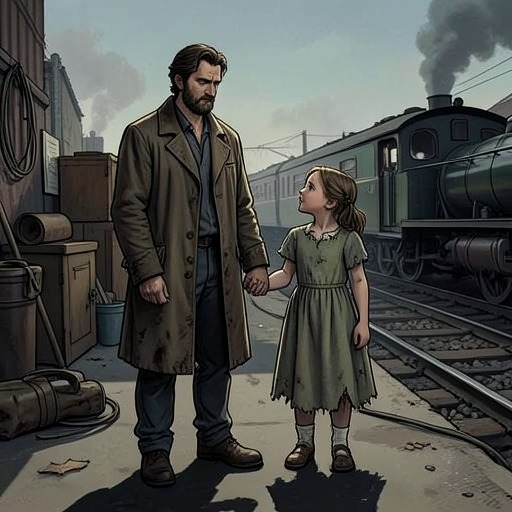
Brad Wolgast and Eva
The Passage (Justin Cronin Edition)Brad Wolgast and Eva share a father-daughter bond that remains physically vivid to Wolgast after her death. His grief does not simply mark a loss: it shapes his recognition of suffering in Anthony Carter, his sense of himself as emotionally dead, and the fatherly tenderness with which he comes to care for Amy.
Identity and Early Bond
Eva is Wolgast’s daughter, loved by both her parents. Wolgast remembers holding her on the night she was born, taking her from the bassinet in the hospital room where the family was sleeping and pressing her bare skin against his. In the story he later tells Amy, that first touch makes the bond feel bodily and inward: Eva is inside him, in his heart.
Illness, Death, and Grief
Eva’s heart began to shrink while her body continued to grow; eventually, the rest of her stopped growing as well. Wolgast says he would have given her his own heart, because he felt it had belonged to her from the beginning, but he could do nothing to save her. She died three weeks short of her first birthday.
Her death also ended the life Wolgast understood himself to have had. He recalls that he died with her, and that afterward he and her mother could no longer love one another because their love had become bound up with sadness and the absence of their daughter. The account presents grief not as a single moment but as a lasting condition that altered his marriage and his sense of self.
The Bond’s Afterlife
During his imprisonment, Wolgast reflects that he had walked the earth since Eva’s death like one of the living dead, or like a man holding a ghost: the empty space in his arms where she had been. He sees this loss as part of why he understood Anthony Carter and the other men involved in the project; he was like them, carrying the consequences of choices and injuries that were not wholly their own.
On the third day after Amy comes to him, Wolgast tells her Eva’s story in full, including the birth, the illness, and the helplessness of losing her. He does not care that someone may be watching through the camera over his shoulder. The private account becomes a way to make the loss speakable, though its telling cannot undo it.
Eva and Amy
As the story ends, Wolgast tells Amy that finding her felt like Eva had come back to him. His words reveal the emotional connection he draws between the two girls, while keeping their identities distinct: Amy does not replace Eva, but her arrival gives Wolgast a new relationship through which his love and grief can be expressed. The remembered child remains present in the image of the empty arms; Amy’s return offers a fragile answer to that absence.