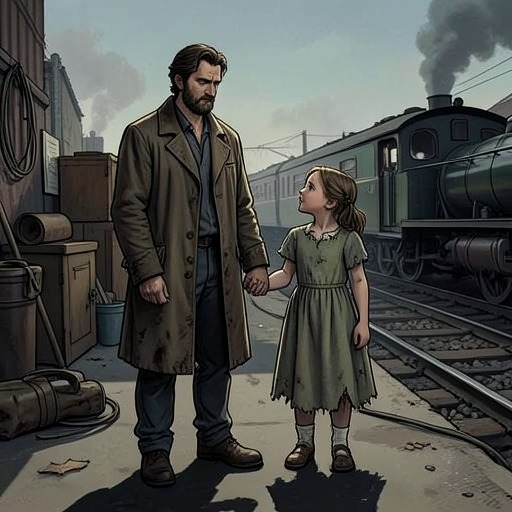
Brad Wolgast and Lila
The Passage (Justin Cronin Edition)Brad Wolgast and Lila are a married couple whose shared hope of raising a family is broken by the death of their daughter, Eva. The loss does not simply leave them bereaved: as Brad later tells Amy, their love becomes inseparable from sadness and longing for the child, and the man he had been seems to disappear with her. Their relationship is therefore both the intimate history behind Brad’s grief and the key to his later recognition that his care for others is rooted in the same wound.
Marriage and plans for a family
Brad was thirty-five and Lila thirty-one when they married in September at a small yacht club on Cape Cod. Most of the guests belonged to Lila’s large family. Brad, overcome with happiness, drank too much champagne, gave a sincere, maudlin toast from a chair, and sang a verse of “Embraceable You” before the couple left beneath a shower of rice. Lila was already four months pregnant, though Brad did not know it at the time.
They bought a house in Cherry Creek with Lila’s money, which far exceeded Brad’s income, and prepared for the baby. They knew they were expecting a girl. Lila proposed the name Eva, after her grandmother; Brad liked it, and the name became theirs. Their plan was for Lila to work until the due date, then for Brad to stay home with Eva for a year while Lila returned to the hospital part-time when he went back to the Bureau. They understood that the arrangement might be difficult, but expected to make it work together.
The pregnancy brought worry before the birth. In her thirty-fourth week, Lila’s blood pressure rose and her obstetrician ordered bed rest. Lila reassured Brad that the baby was not in danger, but he worried that she had worked too hard at the hospital. Three weeks before the due date, he came home to find her in severe distress. At the hospital, the labor became a frightening ordeal, and Brad felt powerless as events unfolded. Just before dawn, Lila was ready to deliver; after she pushed, Eva was born.
Eva and the life they imagined
Brad cut Eva’s umbilical cord and held her after the nurse had checked and wrapped her. She weighed five pounds. As Lila recovered, Brad held their daughter for a long time, repeating her name before she was taken to the nursery. The birth gives concrete form to the future the couple had planned: Brad’s year at home with Eva, Lila’s return to work, and a family life they had believed they could arrange despite the difficulties.
Later, Brad recalls the first night after Eva’s birth, when he took her from her bassinet and held her bare skin against his own. He describes that moment to Amy as the beginning of an enduring inward bond: Eva was inside him, in his heart. The recollection explains why her death is not, for him, a loss that can be contained in the past. His sense of himself remains organized around the child he once held.
Bereavement and the marriage’s end
Eva’s heart began to shrink while the rest of her body grew; then her growth stopped, and she died three weeks short of her first birthday. Brad tells Amy that he would have given Eva his heart if he could, and that nothing could save her. In his account, her death is also the death of the person he had been. The grief becomes a shared condition of the marriage: he says that he and Lila could no longer love one another as before because their love had become nothing but sadness and missing their daughter.
The marriage’s collapse is not presented as a lack of love. Its earlier scenes establish happiness, joint plans, and Brad’s devotion to the family they expected to build; his later explanation makes the tragedy the transformation of that attachment into a grief the couple cannot live through together. The evidence does not describe the practical circumstances of their separation, but it makes clear that Eva’s death leaves them unable to sustain their relationship as it had been.
The loss carried into Brad’s later bonds
By the time Brad reflects on the past during his imprisonment, he sees himself as someone who has walked through life like the living dead, or like a man holding a ghost: the empty space in his arms marks Eva’s absence. He connects that loss to the first real idea he had had in years, an idea that came after his life with Lila and Eva had ended. His work with Anthony Carter and the others, he understands, was possible partly because he recognized something of himself in them. The connection is not a substitute marriage or a simple repetition of family life; it is Brad’s belated recognition that his response to people in danger is shaped by his own history of loss.
That history also informs his attachment to Amy. On the third day of telling her about Eva, Brad reaches the end of the story and tells Amy that finding her felt like Eva had come back to him. He urges her to come back, repeating the plea as the day ends. Elsewhere, while separated from Amy, he thinks of her with the intensity of a prayer and fears she may be lonely and afraid. The parallel does not erase Eva or undo the loss of Lila; it shows how Brad’s capacity to care remains bound to the family he lost. The relationship with Lila thus persists in the narrative through its consequences: their daughter’s death leaves Brad grieving, and that grief shapes the protective bonds he forms afterward.