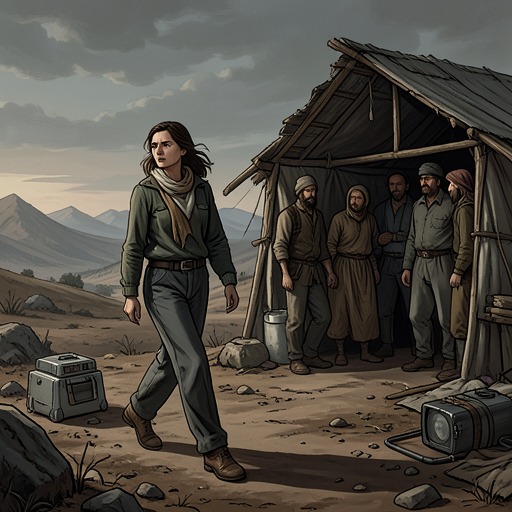
Bradford Joseph Wolgast
The Passage (Justin Cronin Edition)Bradford Joseph Wolgast is a forty-four-year-old Special Agent whose private losses become inseparable from his work recruiting prisoners for Project NOAH. The assignment first appears to offer him a manageable final year in the Bureau; the revelation that his daughter’s death helped make him a candidate recasts that apparent routine as a choice shaped by grief and institutional calculation.
Identity and Background
Wolgast is still in decent shape at forty-four, though he has thinning hair and assorted aches. His antagonism toward Texas is rooted not simply in its weather, landscape, highways, billboards, trucks, and conspicuous state flag, but in a childhood rupture: his parents moved him there from Oregon during junior high. He remembers fishing near the mouth of the Coos River and spending long hours in the woods, then finding himself in Houston, walking to school through oppressive heat. The adult agent’s expansive dislike of Texas carries the proportions of that boy’s sense of exile; the place remains bound to the feeling that his world had ended.
That history also gives his travel with Phil Doyle a personal undertow. Driving north from Houston toward Livingston, Wolgast hopes the recruitment visit will be finished by dinner, leaving time to return to Houston, surrender the rental car, and catch a flight to Colorado. He prefers assignments that do not linger. When a prisoner hesitates or draws out the decision, even though the men eventually agree, Wolgast feels queasy and recalls The Devil and Daniel Webster. The comparison casts his recruiting role as a bargain in which he occupies the devil’s place, an image that complicates his practical, official manner.
Assignment and Motive
Project NOAH initially seems to Wolgast like a dead end and an easy final assignment. He joined the mission after his divorce from Lila had gone through; the marriage, he thinks, had evaporated rather than ended in a single decisive break. The decree nevertheless leaves him unexpectedly blue. A few months of travel seem like a way to clear his head, and he considers leaving the Bureau altogether.
The alternative he imagines is strikingly ordinary: returning to Oregon and opening a small shop, perhaps a hardware or sporting-goods store. He pictures shelves of baseball gloves or hammers, objects whose purposes are plain at a glance. Against the secrecy and moral uncertainty of his work, this imagined life offers legibility and simplicity. He sees NOAH as a cakewalk and a reasonable way to spend his last year in federal service, if he chooses to quit afterward. The later realization that the assignment is much more than paperwork and babysitting breaks that expectation; he also wonders whether Doyle somehow understood the danger better than he did.
The Army’s recruitment plan gives the assignment its concrete stakes. Between ten and twenty death-row prisoners, all men aged twenty to thirty-five and without living first-degree relatives, are sought for the third-stage trials of an experimental drug therapy. In exchange for consenting, they are promised commutation to life without parole. Wolgast is to obtain their signatures, report directly to Colonel Sykes, and have no other contact with the project; officially, he remains employed by the Bureau. Because NOAH is a matter of national security, the prisoners will be declared legally dead and held for life under assumed identities in a federal white-collar prison camp. The stated legal vetting and the clandestine erasure of the men’s public identities coexist uneasily in the arrangement.
The Personal Cost Behind the Selection
At home in Denver, Wolgast follows Sykes’s instruction to look up the biblical source of the project’s name. He does not own a Bible and has not looked at one since his wedding day, so he finds an online concordance. Reading the line about Noah living nine hundred and fifty years and then dying, he recognizes what Sykes left unsaid: the missing consideration was already in his file, and it explained why the Army had selected him from among federal agents.
The answer is Eva. Wolgast has had to watch his daughter die. The revelation changes the meaning of his recruitment: his suitability is not merely professional, but connected to a bereavement that the institution knows about and can use. The biblical reference to Noah’s long life and death thus sits beside a selection process shaped by the death of Wolgast’s child, linking the project’s name to the intimate loss hidden inside his official assignment.
That grief recurs in a dream on the morning after his discovery. He dreams that Lila is calling him back to say the baby has been born—not a child of Lila and David, but their own. For an instant he feels happy; then he wakes in a motel in Huntsville and recognizes where he is. His handheld chirps, and he answers an encrypted call without checking who is calling. The movement from imagined shared parenthood to the motel and the work awaiting him compresses his longing into a brief, involuntary return to a family life that no longer exists.
Recruiting Anthony Carter
Wolgast’s role as recruiter becomes visible when he and Doyle meet Anthony Carter in prison. Carter sits behind glass with a telephone wedged between his ear and shoulder. He is small, his loose jumpsuit making him look almost like a toy, and Wolgast reads his condition as resignation rather than fear or anger: Carter appears worn down by a world that has slowly taken from him. The observation registers Wolgast’s attention to the person behind the prisoner’s file, even as his task is to obtain a consent signature for a covert experiment.
When Wolgast sees Carter’s shackles, he turns to the two correctional officers and asks them to remove them. One officer refuses, calling the restraints standard procedure. The gesture does not undo the institutional arrangement or change the men’s power over Carter, but it distinguishes Wolgast’s conduct from a purely mechanical delivery of the Army’s terms. In this first encounter, official purpose and human recognition remain in tension: Wolgast is there to recruit a condemned man into a secret trial, yet he notices the degrading restraint and asks for it to be taken away.
Narrative Significance
Wolgast’s characterization is built from contrasts between what he expects and what he discovers. He imagines a final, uncomplicated assignment, while the prisoners are to be legally erased and subjected to an experimental therapy; he dreams of useful, plainly understood shop goods while working for an opaque national-security project. His private story likewise moves between a childhood memory of Oregon and Texas as an emotional wound, and between the family life he once had with Lila and Eva and the solitary rooms of motels and apartments in which he carries out his work.
The revelation about Eva makes the recruiting mission personal without removing its institutional stakes. Wolgast is both an agent tasked with securing consent under an extraordinary arrangement and a bereaved father selected, at least in part, because of that bereavement. His request to remove Carter’s shackles offers a small, concrete counterpoint to the machinery of the project: not an escape from its coercive structure, but evidence that his awareness of individual suffering survives inside it.