Colonel Sykes
The Passage (Justin Cronin Edition)Colonel Sykes recruits Bradford J. Wolgast into the covert Project NOAH operation, making him the military program’s point of contact and explaining its bargain with condemned men. Sykes presents the work as orderly, legally vetted, and potentially transformative; the secrecy and concealed authority surrounding it make his assurances part of the project’s moral tension.
Identity and Introduction
Sykes is a uniformed, senior military officer who works directly with Wolgast on the recruitment operation. When Wolgast reports what happened at the prison, Sykes responds over an encrypted line, says he will make the necessary arrangements, and estimates that the delay will be no more than a day. He tells Wolgast to wait for the call and then obtain Anthony Carter’s signature. Even before their face-to-face meeting, Sykes is thus positioned as the officer who can authorize next steps and keep the operation moving.
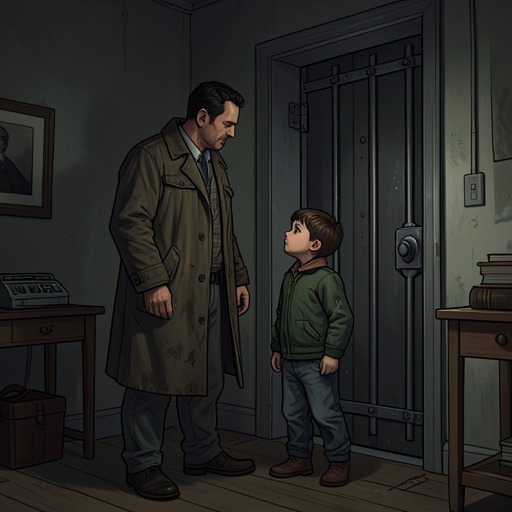
The meeting takes place at the Chalet, a large, three-story Tudor building within the military compound. Its exterior stands among barracks, military vehicles, and other working structures, but inside its original architecture has been stripped away in favor of gray carpeting, institutional lights, and office-like uniformity. Sykes’s own office extends that impression: he rises from behind a neat desk, and even the framed photographs appear placed for efficiency. A thick manila folder rests at the desk’s center. Wolgast suspects it is his personnel file, an object that quietly underlines how much the institution has already gathered about the agent it is recruiting.
The Project NOAH Bargain
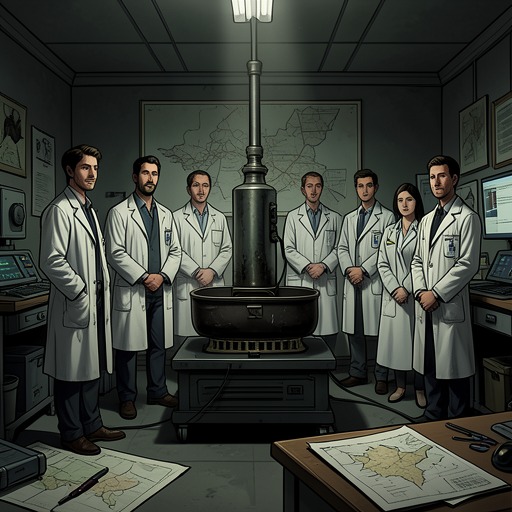
Sykes describes the assignment as straightforward. The Army needs between ten and twenty men on death row for the third-stage trials of an experimental drug therapy, code-named Project NOAH. Wolgast’s task is to obtain their signatures; the men are to consent in exchange for commutation to life without parole. They will be declared legally dead because the project is a matter of national security, then held for the rest of their lives in a federal penal camp under assumed identities.
Sykes gives the selection criteria as well as the terms: participants will be men between twenty and thirty-five with no living first-degree relatives, chosen according to several factors. Wolgast asks whether he must pick them, and presses the ethical and practical problem behind the paperwork: he cannot explain the project in detail, but the men are being asked to sign away their whole lives, so he must tell them something. The recruitment is therefore not merely administrative. Sykes needs Wolgast to obtain consent while accepting that the people being asked to consent cannot be given the full account.
The Explanation and Its Limits
After Richards leaves the office, Sykes offers Wolgast the background he is permitted to share, explicitly qualifying it as the layman’s version and only the part he can tell. About ten years earlier, the Centers for Disease Control and Prevention had received a report from a doctor in La Paz about four American patients with symptoms resembling hantavirus: high fever, vomiting, muscle pain, headache, and low blood oxygen. The patients had been terminal cancer sufferers who had joined an ecotour deep in the jungle. They said they belonged to a group of fourteen, had become separated from the others, and had wandered for weeks before reaching a remote trading post run by Franciscan friars, who arranged their transport to La Paz.
Sykes emphasizes why this unusual report drew attention: hantavirus itself was not rare, but the four patients’ terminal cancer made their apparent circumstances striking. The tour had been organized by Last Wish, an outfit Wolgast associates with experiences for people near death. The exchange shows Sykes translating a complicated scientific and institutional history into enough context for a recruiter, while keeping the central uncertainties and undisclosed information beyond Wolgast’s reach.
Authority, Persuasion, and Narrative Significance
Sykes’s manner combines procedural control with personal persuasion. He apologizes for the trouble with the van as simply how the organization operates, offers coffee, and patiently explains the task. When Wolgast questions the arrangement, Sykes argues that the potential benefits justify the expense: the military is paying, he says, and he would like to live long enough to meet his great-great-great-grandchildren, hit a golf ball three hundred yards at a hundred, and return home to make love to his wife. He frames Project NOAH as a wager on extended life, turning a secret experiment involving condemned men into a promise of ordinary human futures.
Wolgast accepts Sykes’s case, and they shake hands. But when Wolgast asks what the name NOAH stands for, Sykes glances at Richards before replying that it stands for nothing and invoking the Bible. That brief look changes the apparent balance of the meeting: Wolgast suspects that Sykes, despite being formally in charge, also reports to Richards, who may connect the military operation to other agencies or whoever is actually directing it. Sykes therefore serves both as the project’s accessible official face and as evidence of the limits of what that face can disclose. His calm explanations make the operation legible, while the folder, the dead identities, the incomplete briefing, and Richards’s presence preserve the underlying secrecy.