Conroy
The Passage (Justin Cronin Edition)Conroy is a stray dog who arrives at the farmstead where Theo and Mausami are living with their infant, Caleb. Mausami welcomes him into the household, while Theo’s initial wariness gives way to care. Conroy’s death during an attack turns the new companion into a loss the family must reckon with, and his grave joins the farmstead’s existing yard of graves.
Arrival at the Farmstead
Conroy first appears at night, when Theo is armed and alert to danger. A noise at the door sends Theo spinning, and a dog bounds into the yard. The animal stops in front of Mausami, uncertain and wary; Theo warns her to be careful. The reveal that the intruder is a dog briefly changes the scene’s register: what Theo had met as a possible threat becomes a living creature whose intentions are unclear, but whose presence is not immediately hostile.
By morning, Mausami has begun treating him as a companion. She rubs his mane, talks to him affectionately, and offers him breakfast. Theo, embarrassed to realize he is still holding the shotgun ready to strike, relaxes. He names the dog Conroy, and Mausami embraces the name, taking the dog’s face in her hands and making him nod. Naming him marks a small but consequential shift: the animal is no longer just an unexpected visitor outside the door, but someone the couple recognizes as part of their household.
Life with Theo and Mausami
Theo does not want to let Conroy into the house, but Mausami is determined to keep him. Once inside, Conroy explores the rooms and settles on the sofa. Mausami feeds him fish and potatoes fried in lard, then gives him water; after eating, he returns to the sofa. She plans to bathe him, partly because he has taken up residence on the furniture. These ordinary acts of feeding, sheltering, and cleaning make Conroy’s arrival a domestic event rather than a passing encounter.
The dog appears to have been cared for before. He is thin, with matted fur and burrs, but otherwise seems healthy; Theo recognizes that he has likely lived among people. The story does not explain where Conroy came from or how he reached the farmstead. His uncertain history remains beside the couple’s practical acceptance of him: they cannot identify his former home, but they can offer him food and a place to sleep.
Death and Burial
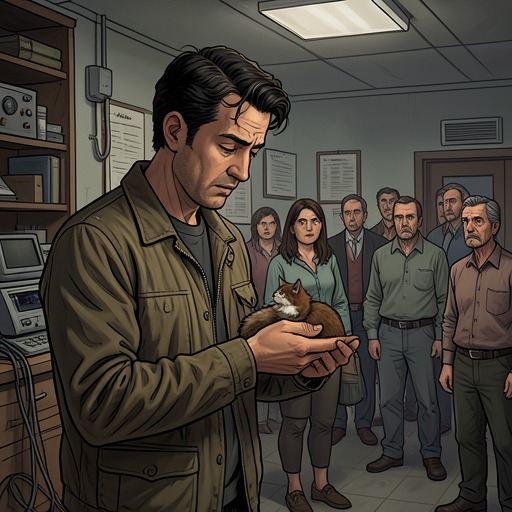
Later, Theo searches for Conroy in the dark, carrying a shotgun and lantern. He finds the dog dead at the base of a house. Theo immediately understands that Conroy has been killed, and the discovery is followed by Mausami’s scream from inside the house. The narrative places the dog’s death within a wider attack on the family, making his loss part of the danger that reaches even the household’s newest and most vulnerable member.
When Peter and the others return, Mausami asks first that Conroy be buried. She says she would have done it herself but could not, with Theo and the baby to care for, and explains that he had been left where he died for three days after the attack. Peter carries the remains to the yard of graves, where Hollis and Michael have dug a hole and marked its edges with stones in the same manner as the other graves. Conroy is thus given a place among the dead the household remembers, rather than being left as an unnamed casualty of the attack.
Narrative Significance
Conroy’s short arc moves from alarm to welcome and from companionship to mourning. The first response to his arrival is defensive: Theo has a shotgun, and Mausami has to tell him not to shoot. Their later care for the dog is concrete and shared, from giving him a name to feeding him and making room for him in the house. The contrast makes his death matter not only as a practical consequence of the attack, but as the loss of a relationship the family had just begun to form.
The story leaves Conroy’s origins unexplained, but gives him a clear presence through the household’s responses. Mausami’s decision to bury him and Peter’s act of carrying him to the graveyard extend the family’s care beyond his life. Conroy’s grave, marked like the others, places an animal within the community’s practice of remembering its dead.