Ghost signal
The Passage (Justin Cronin Edition)The Ghost signal begins as a nearly inaudible fragment in the Lighthouse’s radio haze and becomes a precise, consequential military transmission. Michael Fisher identifies its frequency, timing, and growing strength; the signal’s pattern ultimately reveals that someone is calling for the colony’s mainframe. The movement from unexplained noise to an address awaiting an answer makes the signal both a technical puzzle and an image of contact arriving from beyond the colony’s known world.
Detection and Pattern
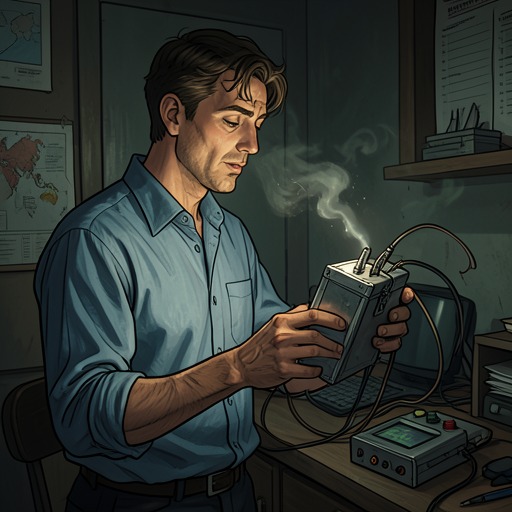
Michael, the First Engineer of Light and Power, first encounters the signal while listening in the Lighthouse. It sits at the top of the audible spectrum, where nothing should be, and seems to flicker in and out of existence. The radio operator’s manual classifies its frequency as unassigned. At first, Michael can make out only a fragment of a fragment: a digital string whose meaning eludes him.
The signal’s apparent randomness gives way to a schedule. Michael and Elton establish that it returns every ninety minutes, transmits for exactly 242 seconds, and then falls silent. It is detectable at 1,432 megahertz, and its strength increases hour by hour, especially at night. To Michael, it seems to be moving directly up the mountain. Its cycle rules out a natural source, and Michael also determines that it is not a satellite or a product of the battery stack. The more regular it becomes, the less it resembles mere interference.
The numbers themselves acquire a second, suggestive order. While walking in the interval between transmissions, Michael notices that 1432 consists of the first four positive integers in sequence; repeated, the string reads 1432143214321432, with the sequence closing and beginning again. He recognizes that this could be coincidence, but the signal does not feel coincidental. Its measured recurrence and its numerical pattern invite interpretation without yet disclosing what, or whom, it addresses.
The Lighthouse and Its Listeners
The signal changes the work and atmosphere of the Lighthouse. Michael stops looking for other things and spends his time at the panel, counting down to each return. He and Elton listen through headphones; Elton becomes unusually irritable and withdrawn, barely speaking and showing little interest even in powering up the lights at Second Bell. Michael notices the change but cannot tell what the signal is doing to him. The transmission is not merely an object of study: its repeated arrival begins to occupy the listeners’ attention and unsettle their ordinary routine.
Michael’s fixation also grows amid grief and self-reproach. He still cannot believe Theo is gone, and he feels responsible for a chain of events connected with the loss, though Alicia has told him the motherboard was not to blame. He recalls that he had already found another way to obtain the processing power he needed, making the equipment seem too small a cause to justify Theo’s death. Against this private accounting of responsibility, the signal offers a new problem that can be measured but not yet understood.
During a walk to the Sunspot, Michael sees Mausami sitting alone at the base of the Stone. She makes clear through her glance that she wants to be left by herself, but Michael, after hours in the hut with the signal and Elton, is willing to risk rejection for a little company. This encounter places the signal’s isolating pull beside the colony’s human losses: Michael has been listening for an unseen source while the people around him bear absences he cannot solve.
Identification as a Military Call
The decisive interpretation comes just after dawn. Michael realizes that the frequency is not truly unassigned: it had been assigned to the military. The transmission is a short-range digital signal, cycling every ninety minutes and searching for its mainframe. Its rising strength means it is now practically on the colony’s doorstep. What first seemed to be a remote, almost spectral fragment is revealed as a purposeful signal approaching a receiver.
Identifying the source category does not complete the task. Michael still needs to break the encryption and find the handshake—the reply that will make the transmitter, wherever and whatever it is, link with the mainframe. Only after establishing that connection can the data be uploaded. The signal thus poses a question in machine form: it keeps calling, but the colony must discover the correct answer before it can learn what the transmission carries.
Elton’s remark, remembered by Michael, supplies the plain-language key: someone is calling them. The word someone shifts the signal’s meaning from a periodic technical phenomenon to an attempted contact. Michael knows what equipment he needs: an Army handheld stored in the Lighthouse and old lithium cells that can still hold a charge for a few minutes. Working against the clock, he plans to connect the handheld to the computer, capture the signal’s embedded ID during the next interval, and program the device from the panel. While a commotion takes place outside, he remains focused on intercepting the transmission.
Meaning and Narrative Function
The Ghost signal’s force comes from the way its name and its measurable details pull in opposite directions. Michael calls it a ghost because it appears and disappears in the haze, seeming almost absent; its exact frequency, ninety-minute cycle, 242-second transmission, and military assignment make it increasingly concrete. It is not supernatural evidence, but neither is it empty noise. Its ghostliness describes the colony’s limited knowledge: the source remains out of sight even as the signal’s approach can be tracked.
The sequence also gives communication the structure of a test. Repetition establishes that the signal is deliberate; growing strength locates its approach; the military identification reveals what kind of system is seeking a connection; and the missing handshake leaves the exchange unfinished. Until Michael can answer correctly, the transmission remains both an invitation and an enigma. The signal’s meaning is therefore relational: it becomes intelligible not in isolation, but through the receiver it seeks and the response the colony may be able to send.
Its repeated call gains additional weight beside the characters’ experiences of loss and memory. Earlier, Wolgast describes the counselor’s name for moments when grief makes the past feel present again: the time machine. Those recollections can make him want to call Lila, though he understands that the impulse comes from his mind revisiting their shared past. The Ghost signal is different in kind, but the contrast is telling: one call arises from memory and bereavement, while the other is an external transmission seeking a machine. Both make distance feel traversable without making the missing thing fully present.
The signal’s unanswered intervals preserve suspense while giving Michael a concrete course of action. Its transmissions arrive with a clocklike regularity, but the information they carry remains inaccessible until he discovers the right protocol. In that gap between repeated call and possible reply, the Lighthouse becomes a listening post and Michael’s technical attention becomes a form of anticipation. The Ghost signal marks the moment when the colony’s radio silence begins to look less like isolation than the threshold of contact.