Greer
The Passage (Justin Cronin Edition)Greer is a major in the Second Expeditionary force, a long-range patrol commander whose authority is shaped by the forest campaign and whose practical care helps Peter Jaxon’s party move from capture toward a possible return to the garrison. He represents an army still fighting for territory and supplies, but his conduct also makes room for trust, protection, and individual choice within that military purpose.
Identity and Introduction
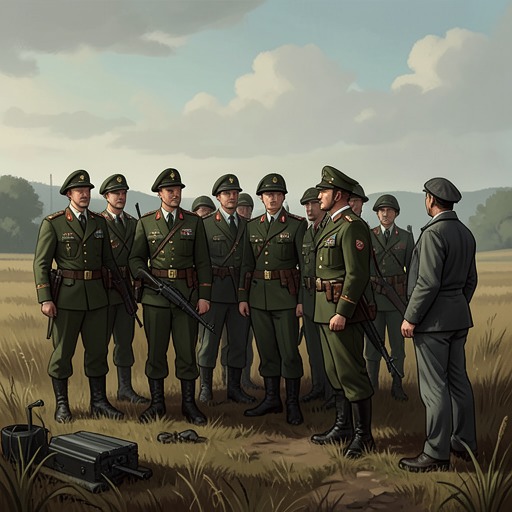
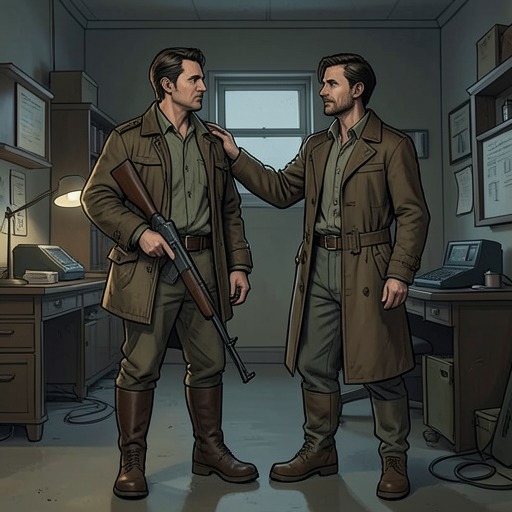
Greer appears as the commander of a fifteen-man long-range patrol that has been in the woods for weeks. He is tall and strongly built, with a deeply furrowed brow, a shaved head beneath a wool cap, and loose camouflage cinched at the waist by a broad belt. His pockets are full of equipment; a black pistol hangs at his waist, and he carries a rifle. Like his men, he has streaked his face with mud and charcoal. Their painted faces make them resemble wolves or the forest itself, a visual expression of how thoroughly the patrol has adapted to its surroundings.
The patrol captures Peter’s group in a net and takes them toward the garrison without their weapons. The group gets its packs back, but remains under restriction: they are not formally prisoners, yet cannot leave as they please. Greer’s word for this arrangement is “under protection.” The distinction captures his role at this point—he has the force to detain the travelers, but the stated purpose is shelter rather than punishment. As the rain begins, he drinks from his canteen and gestures toward the ridge ahead, promising that the garrison is close.
From Capture to a Working Alliance
The initial encounter is a standoff, with neither the patrol nor Peter’s party willing to identify itself first. Michael breaks the impasse after the net leaves him sick and smeared with vomit: he surrenders, identifies the group as coming from California, and asks to be shot so the ground will stop spinning. In the hours that follow, Peter senses the beginnings of friendship between Greer and the captured travelers. Greer’s authority remains real, but the relationship begins to change through shared circumstances rather than a formal agreement.
On the march, Greer tells Peter that the garrison lies just beyond the next ridge. Later, inside a canvas command tent, Peter studies a map whose lines of beaded pins form a broad V across central Texas, Oklahoma, southern Kansas, and New Mexico, converging near Colorado, where they have arrived. Greer stands beside him and welcomes him to the war. The map expands the meaning of the patrol’s capture: the group has entered not simply a remote camp, but a military campaign whose reach spans a large part of the surviving country.
Greer’s manner shifts according to who is present. Outside the tent, his relationship with General Vorhees is rigidly formal; alone with him inside, the two visibly relax into friendship. This private ease gives Greer access to candid strategic talk, while his public bearing preserves the chain of command. Peter’s group is thus received into a world where trust is possible, but always bounded by military roles and immediate necessities.
Military Outlook and the Haven
Greer wants to understand the Haven, the settlement Peter’s party has encountered. Hearing about it, he compares it to Homer, an Oklahoma community discovered by the Third Battalion about a decade earlier. Vorhees recounts that Homer held more than eleven hundred survivors who lived without lights or fencing and seemed not to know about the infected. They declined an offer of transport. The story complicates the military’s assumption that surviving communities must want rescue: some people refuse incorporation into the army’s plans, even when those plans are offered as help.
Greer also listens when Vorhees describes a Walker woman from his childhood, an older woman who had appeared at the gates and claimed she could hear what the infected were thinking. The children mocked her but were fascinated by her; Vorhees says such stories are not new, though he has never heard of a young Walker like Amy. When Greer asks what became of the woman, Vorhees recalls that she took the trip and hanged herself in her house. The grim account does not lead Greer away from the army’s immediate work. Vorhees describes their task as clearing infected, laying in supplies, locating hotspots, and burning them out, while acknowledging that the effort may never add up to a victory he lives to see. Greer remains engaged with that practical campaign even as the conversation exposes how little it can explain about people like Amy.
Protection, Choice, and the Road South
When Peter is considering what to do with the remaining virus vials, Greer believes the decision belongs to him. Peter recognizes the limit of that view: the choice cannot be his alone, because the group must agree. He plans to use the farmstead as the place for the attempt and expects that he may need to be tied up in an empty house, with Greer responsible if things go badly. Greer’s military competence here becomes part of Peter’s safeguard, but Peter insists on collective consent rather than treating the major’s judgment as sufficient.
Greer later gives Sara precise instructions for the journey: from the fuel depot, take Highway 191 south, pick up Route 60 at Eagar, and follow the Roswell Road toward the garrison. He has marked fortified bunkers on Hollis’s map, identifiable by red crosses and spaced roughly a hundred kilometers apart; they offer fuel, ammunition, and other basic supplies. He warns the travelers to avoid Albuquerque, which is crawling with infected, and tells Hollis to keep all eyes open. The directions turn Greer’s knowledge of the military network into a practical line of survival for a party traveling with a baby and limited room in its single Humvee.
Before the group reaches the Colony, Alicia tells Peter she will claim responsibility for killing the men if they are arrested, so the authorities will not take him, Amy, or the Circuit. Greer understands the seriousness of her warning and nods when Peter asks whether he has understood. The gesture is brief, but it places him within the group’s defensive pact: he is not only a commander arranging a route but also someone expected to stand with the travelers if their return brings punishment. That warning proves unnecessary once they see the Colony’s Wall ahead, its catwalks empty and gates open, with no Watch in sight.
Character and Narrative Role
Greer’s characterization rests on the contrast between military control and personal accommodation. He takes the travelers’ weapons, leads them under protection, and speaks from within an armed campaign; at the same time, his emerging friendship with Peter’s party, his willingness to secure their passage, and his acceptance of Peter’s need for a collective decision prevent him from becoming merely an instrument of command. His authority is most legible in concrete acts—moving a patrol through the woods, reading a map, planning around fuel and weather, and marking safe bunkers—not in grand claims about the war’s ultimate meaning.
That practicality also gives Greer a particular narrative function. He connects the isolated travels of Peter’s party to a larger military geography, and his instructions make the route toward the garrison materially possible. Yet the book does not make military order a solution to every problem: the Haven resists easy comparison, the Walker stories exceed the army’s explanations, and the Colony’s open gate overturns the expectation of a secure return. Greer can offer shelter, maps, supplies, and protection; the larger crisis remains beyond what those tools can guarantee.