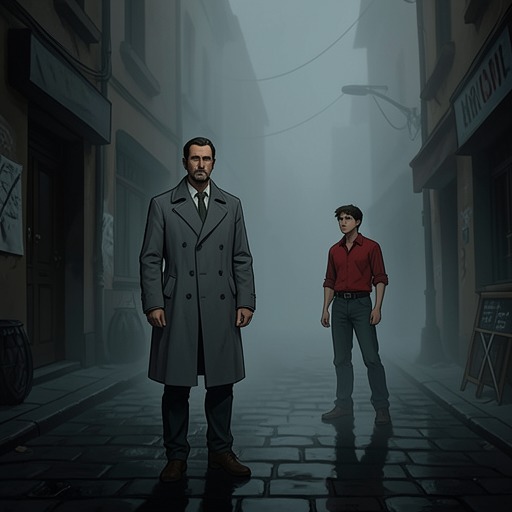
I was called Fanning
The Passage (Justin Cronin Edition)The expression “I was called Fanning” enters Grey’s waking day as a message he cannot place or dismiss. Repeated in his mind after sleep, it makes an unknown name feel less like information than an imposed rhythm, foreshadowing the psychic connection through which Zero reaches him.
The phrase and its source
At the opening of the episode, Grey wakes with the words already lodged in his thoughts: “I was called … Fanning.” He has never met anyone named Fanning, cannot remember hearing the name, and has no explanation for its arrival. The phrase is not presented as something Grey consciously recalls; it seems to have taken up residence while he slept.
The canonical wording is especially consequential because it joins a name to a past identity: the speaker says that he “was called” Fanning. Grey, however, initially receives only the sound, without the knowledge needed to interpret it. The gap between the phrase’s apparent certainty and Grey’s bewilderment makes it an early, incomplete disclosure rather than an explanation.
Repetition becomes physical disturbance
The words recur throughout Grey’s day, from waking through bathing, dressing, breakfast, smoking, and waiting for night. Their repetition is compared to a song whose lyrics have worn a rut into the mind. Even ordinary actions—the channel changer, scratching his head, lighting a cigarette—seem to fall into the phrase’s rhythm, as though it supplies a backbeat to his movements.
Grey hears the line in fragments synchronized with small actions: “I(flick) … was(light) … called(draw) … Fanning(exhale).” The expression thus crosses from language into bodily timing. Rather than giving Grey a clear thought to examine, it organizes his attention and movement, making the intrusion palpable before he can identify its cause.
Grey’s disrupted routine
The experience unsettles Grey’s usual ability to let time pass in the barracks. He feels jumpy and out of sync with himself; television no longer holds together as words and images, and he cannot settle into the near-trance that ordinarily carries him through empty hours. The gray afternoon outside seems to echo his name, while his own insides buzz with restless energy.
The disturbance also has practical consequences. Grey has slept through his 05:00 alarm and missed his morning shift, then faces another eight hours of watching Zero that night. He needs sleep, but the phrase and its accompanying agitation have left him feeling as though he has not rested. The expression’s first effect, then, is not comprehension but disruption: it alters the texture of Grey’s day and interferes with the routine surrounding his watch over Zero.
Narrative significance
The line follows a dream and recalls the prison shrink Dr. Wilder’s use of a deep hypnotic state, which Grey associates with a pen tapping its way into his mind. That earlier image gives the new repetition a suggestive precedent without explaining it away: Grey recognizes the sensation of something entering his thoughts, but does not know what the name means or who is speaking.
As an expression, “I was called Fanning” compresses identity and intrusion into a few words. Grey hears a voice-like claim before he possesses the context to understand it, and the phrase’s insistent return makes the reader experience that asymmetry with him. Its significance lies in this combination of withheld meaning and immediate force: the name remains unexplained to Grey, while the disturbance announces that his mind is no longer an entirely private space.