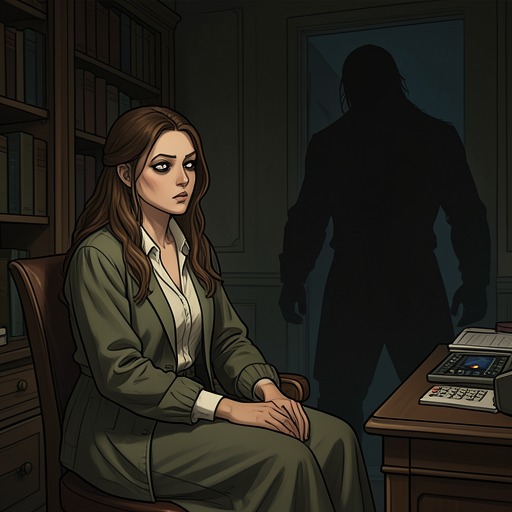
Lacey's post-traumatic stress disorder
The Passage (Justin Cronin Edition)Lacey’s post-traumatic stress disorder shapes both her guarded life in the convent and her decisive protection of Amy. As a child in Sierra Leone, she survived the killing of her family and was found by United Nations peacekeepers after spending hours in a field. She grew up without conscious access to the full memory of what had happened, but the past remained active in her responses to danger and in the part of herself that seemed to Sister Arnette always to be elsewhere.
The concealed history
Only the sisters’ superiors had received the psychiatric report that explained Lacey’s history; Sister Arnette learned its details later, and the other sisters initially knew nothing of the truth. Lacey had never told them that soldiers killed her family and remained with her in the field for hours. Instead, she said that her parents and sisters were still in Sierra Leone, living as before. Arnette understood this as a merciful protection from memory, though the account also shows the cost of that protection: Lacey’s past could not be openly acknowledged or shared with the people caring for her.
This gap between the story Lacey told and the history she could not tell shaped how others interpreted her. She was, in most respects, a model sister, but Arnette found her self-contained and unusually mystical in her devotions. The psychiatric report gave the sisters a name for the lasting effects of what Lacey had experienced: post-traumatic stress disorder. Sister Claire recognized in it an explanation for Lacey’s protective feelings toward Amy, her reluctance to leave the house, and her sense of living among the sisters while remaining partly separate from them.
The past returns around Amy
When Amy came into Lacey’s care, Sister Arnette sensed that the explanation for the child’s presence was unconvincing and that something was wrong, though Lacey’s history remained hidden from her at first. At the zoo, as Lacey fled with Amy amid the panic, the surrounding animal cries and gunfire-like noise brought the childhood field back into her awareness. She sensed a threatening man coming for Amy and understood the danger through the pattern of her own remembered terror: the man would take the girl to the place where Lacey had once lain beneath the branches.
The memory returns not as a complete account calmly recalled, but as a bodily and emotional recognition that directs Lacey’s actions. In the field, she had separated herself from what was happening by sending her mind upward toward heaven, while the child in the field became someone she did not remember as herself. At the zoo, that older division between danger and escape resurfaces even as Lacey remains physically present, holding Amy and searching for a way out. She reaches the exit, but a guard catches her just short of it. Her trauma does not simply leave her helpless: it makes the threat legible to her, while intensifying her determination to keep Amy safe.
Protection, separation, and misreading
After the zoo incident, Lacey’s response confounded the adults trying to make sense of what had happened. When she saw Wolgast, she insisted that he loved Amy. Sister Arnette wondered whether Lacey understood something the others did not, but her certainty did not fit the officials’ account or the apparent facts. Lacey offered no fuller explanation; she repeated her judgment and smiled. To Arnette, the moment was troubling precisely because Lacey’s history seemed to explain her protectiveness without explaining how she knew what she claimed to know.
Arnette later told the other sisters about the massacre and concluded that the experience had stayed inside Lacey. Yet she also blamed Lacey’s lie about Amy’s arrival for bringing the men to the convent, even as she recognized that Lacey had acted protectively and carried an unspoken burden. This contradiction matters: the sisters’ care for Lacey coexists with their tendency to interpret her through a diagnosis, a concealed past, or the consequences of her decisions. Her trauma is real, but it does not make her actions reducible to a symptom.
Narrative significance
Lacey’s history connects an old catastrophe in Sierra Leone to the immediate danger surrounding Amy, showing how a past that has been pushed out of conscious memory can still shape present perception and choice. The novel reveals the history first through what Arnette learns and observes, then makes it recur in the zoo, where sounds and danger bring Lacey’s childhood experience into the present. That structure gives her protectiveness both a personal origin and an urgent practical force.
The account also holds two meanings of survival in tension. Lacey’s loss of conscious memory has protected her from the full knowledge of her family’s deaths, but it has left her isolated, difficult for others to understand, and unable to explain why she recognizes danger. Her care for Amy becomes a form of action grounded in that divided past: she may not narrate the childhood events to those around her, yet when the old terror returns, she acts to keep another child from being taken into its pattern.