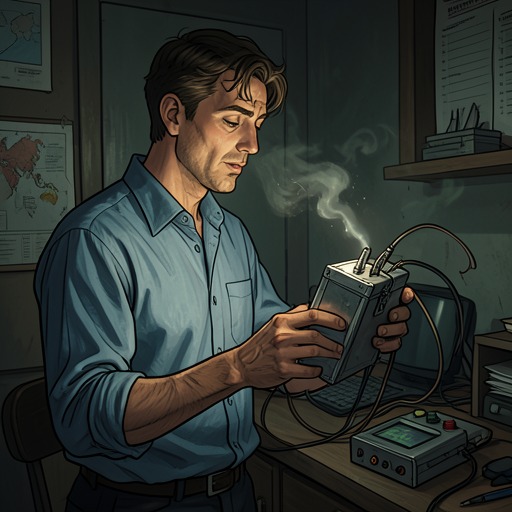
Michael's radio equipment
The Passage (Justin Cronin Edition)Michael’s radio equipment is the instrument through which the First Colony’s ghost signal becomes evidence of a long-running summons for Amy. A handheld device begins to buzz when Michael recognizes the signal; later, his search through the colony’s records links it to a military beacon that has continued transmitting the same message since the outbreak’s first spring. The equipment makes an invisible connection tangible, turning a puzzling arrival into a question about who placed a transmitter in Amy’s neck and why they still want her returned.
The handheld and the ghost signal
When Sara explains that the girl is a Walker, Michael falls silent. Peter can see him thinking, and Michael suddenly looks at the object he is carrying as if its significance has changed. His startled recognition—“Holy shit. Holy shit. It’s just like Elton said.”—is followed by an identification: it is the ghost signal. He asks everyone to be ready, and the handheld begins to buzz.
Alicia asks what it is. Michael holds up the device, identifying it simply as a handheld, and explains that the Walker is calling them. The equipment does not itself reveal what the signal means or where its transmitter is located. Michael reasons that the transmitter must be somewhere on the girl, but he cannot specify its appearance; it would need to be large enough to contain a power source. The handheld therefore provides a first, physical confirmation of a signal whose source remains hidden in Amy’s person.
From present reception to an old record
Michael’s explanation moves from the device in his hand to a much older piece of equipment: the colony’s logbook. He says he went back through it to check whether the colony had ever received a signal from the same coordinates. The answer is yes. Eighty years earlier, the colony had picked up a beacon broadcasting those coordinates on a military distress frequency, using old-style Morse code.
The record is more than a technical trace. Beside the entry is the instruction, “If you found her, bring her here.” The logbook gives the ghost signal a history and a direction: the message concerns finding a girl and bringing her to whoever is waiting. What had seemed like an isolated transmission now connects the present encounter with an earlier appeal preserved in the colony’s own records.
A message that has not stopped
The decisive discovery is that the beacon is still transmitting. Michael explains that getting a decent signal took so long because he had to run a cable up the Wall. His work connects the handheld’s immediate buzz with a distant, persistent source; the equipment is not just receiving a remnant preserved in an old log but detecting an active transmission.
When Peter asks what is transmitting, Michael repeats the words from the old record: “If you found her, bring her here.” The repeated message collapses the distance between past and present. Its wording has survived in the logbook, but Michael’s equipment shows that it is also being sent now. The handheld supplies the shock of contact; the cable and the labor of improving reception make that contact legible; the book confirms that the message has endured across decades.
Amy as the signal’s hidden source
The device does not prove Michael’s theory about Amy, but it gives him grounds to propose one. He contrasts her with a viral: she is not one, yet she heals unusually, survived outside, and protected Peter. He also points to the gap between her apparent age—about fourteen—and the nearly hundred years she has lived. Since the transmitter is broadcasting on a military frequency and appears to be associated with her, Michael wonders whether the Army infected her and then did something that restored her to normal. He suggests that she may be the cure, while Peter recognizes the idea as a major leap.
Michael’s account further specifies the history he believes the message reveals: in the spring of Year Zero, in Telluride, Colorado, someone placed a nuclear-powered transmitter in the neck of a six-year-old girl. The girl is now Amy, sitting in quarantine while appearing to belong to the Time Before. Michael concludes that whoever placed the transmitter has been asking for her back for ninety-three years. The equipment cannot identify that person or explain the purpose of the summons, but it makes the duration and persistence of the search impossible to dismiss.
Narrative function
The handheld’s buzz is a material turning point: Michael first recognizes the device he is already carrying, and its sudden activity converts speculation into an observable event. The radio equipment extends that discovery through other media—the old Morse record, the cable run up the Wall, and the continuing transmission—so that a brief sound opens onto a decades-long chronology. Each object carries a different kind of evidence, and together they make the signal feel less like a rumor than an unfinished communication.
The equipment also preserves the distinction between what is known and what remains conjectural. Michael can establish that a beacon used the same coordinates, that the logbook records a request for a girl to be brought somewhere, and that the words are still transmitting. The connection to Amy is supported by the circumstances of her arrival and the suspected transmitter on her person; the claim that she is a cure remains a hypothesis. That gap gives the object its dramatic force: it can bring the past into the room, but it cannot yet explain the intentions behind the message.