Roswell Garrison
The Passage (Justin Cronin Edition)Roswell Garrison is a large, fortified military settlement that becomes the destination of Peter’s party after their journey by train and road. Its walls and constant military traffic make it a place of refuge, but also one governed by command structures and formal scrutiny; arrival brings safety, an expected debriefing, and fresh uncertainty about the group’s standing.
Setting and Defenses
From inside, Roswell Garrison appears almost as large as the Colony. Its gigantic concrete walls are reinforced with metal struts extending down into the parade ground, giving the structure the appearance of an inside-out spider. Beyond the walls lies a broad expanse of tents and fixed buildings, an improvised but extensive military town rather than a single barracks or outpost.
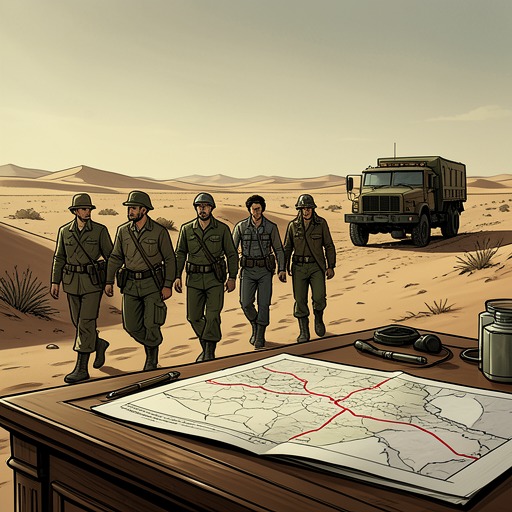
The garrison’s defenses are part of a wider system of fortified travel. Before the party sets out, Greer directs them south from the fuel depot along Highway 191, then toward Route 60 at Eagar, identified as the Roswell Road. He says fortified bunkers stand about every hundred kilometers and marks them on Hollis’s map with red crosses; those stops are meant to provide fuel, ammunition, and other necessities. The route links the isolated party to a chain of military provisions and ultimately to the garrison.
Arrival and Relief
The train carries the survivors roughly four hundred kilometers from the place where it began its final journey, but its rails end at Caliente. The party disembarks in a railyard crowded with abandoned engines, tankers, and flatbeds, in a landscape of tall grass, cottonwoods, running water, and birdsong. The abrupt end of the railway leaves the survivors to continue toward their destination by vehicle.
That vehicle does not last. After a night in a bunker, the party finds the Humvee overturned, its engine smashed, its hood thrown a hundred meters away, and its tires torn apart. With the garrison still ahead and Theo unable to manage the remaining walk, the group leaves him behind with Mausami and the baby, promising to send a vehicle back. The distance proves considerably greater than fifty kilometers, but a patrol collects the walkers shortly after half-day. Lieutenant Eustace is among the patrol, and a Humvee is sent back for those who stayed at the bunker. By the time the account is written, the party is safe within the garrison walls.
Military Life and Authority
Roswell Garrison is active on a scale that distinguishes it from the earlier Colorado installation. Vehicles continue arriving through the evening: tanker trucks and five-ton trucks carrying men, weapons, and crates of supplies, their cabs fitted with banks of lights. Engines roar amid burning fuel and the sparks of torches. The abundance of movement and equipment suggests a functioning military center, not merely a fortified refuge waiting out the night.
The party’s welcome is nevertheless not uncomplicated. Its commanding officer, Crukshank, is described as a general, but unlike Vorhees he gives the impression of a man who has never smiled. Greer appears to be in serious trouble, and the concern seems to extend to the rest of the newcomers. They are due to be debriefed at 06:00, so their safe arrival is followed immediately by the prospect of having to account for their journey and its events.
Refuge and the Larger Journey
For Sara, the garrison offers both practical help and a possible place to serve. She plans to look for the infirmary and find out whether she can assist there; women are present, mostly in the medical corps, and may move freely so long as they remain in civilian areas. Yet Roswell is a waystation in a continuing journey rather than a final home. Greer’s directions point onward along the Roswell Road toward the garrison, and Sara is already thinking ahead to Kerrville, where she hopes Michael will be present when she shares her news and gives her away.
The location’s significance lies in this double promise. Its concrete walls, supply vehicles, and patrols restore a measure of security after the party’s transport fails, while its hierarchy, debriefing, and restricted spaces reveal the terms on which that security is offered. Arrival means survival for now—and entry into another community whose resources and authority will shape what can happen next.