Sanctuary
The Passage (Justin Cronin Edition)Sanctuary is the former F. D. Roosevelt Elementary School repurposed as a protected residence and school for the Colony’s children. It is both a refuge from the dangers outside the walls and a system of controlled knowledge: children live there until age eight without being told about the Virals or the Great Viral Cataclysm, then learn the truth as they leave. The contrast between the safe world children imagine and the world they inherit makes Sanctuary one of the Colony’s most consequential institutions and a setting where its protective purpose can turn into a source of anguish.
Place and founding memory
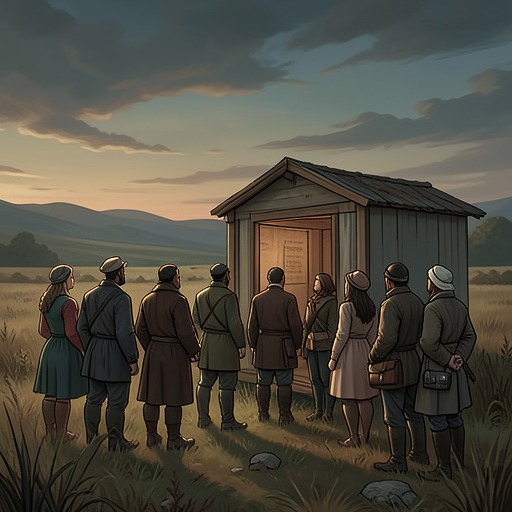
Sanctuary began as a school building but acquired a new meaning with the arrival of the children evacuated from the old world. Ida Jaxon remembers being brought there with Terrence Jaxon after the evacuation. The children had been taken by bus to the Colony, where they saw its walls, the unlit towers for the lights, soldiers, and supply trucks. Watchers recorded their names, gave them clean clothes, and led them to the room where the youngest children still sleep. Terrence told Ida that this was where they would live, with the walls and lights keeping them safe. He compared it to Noah’s ark, though neither could know whether they would see their parents again.
The promise became tangible on First Night. Terrence and Ida went outside as darkness fell; the gates were sealed and the lights came on so brightly that they blotted out the stars. Ida remembered that moment as the confirmation that the Colony would be their home. Sanctuary belongs to the same founding landscape of protection, but its walls do more than separate children from danger: they also mark the boundary between the childhood world inside and the history adults keep outside.
Rules and the childhood world
Under the Colony’s rules, each child must remain within Sanctuary until turning eight. On the eighth birthday, the child leaves, selects a Trade subject to the Colony’s needs and the approval of the Household and Board of Trades, and takes an equal share into the wider community. The rule gives the institution a defined role in the Colony’s social order: it is not merely a school, but the place where childhood is spent before work and adult obligations begin.
The children are also to know nothing about the world in its present form outside the Colony. They are not to be told about the Virals, the Watch’s duties, or the Great Viral Cataclysm; knowingly telling a minor child such things can be punished by putting the offender outside the walls. The secrecy shapes the children’s understanding of ordinary life. Sara Fisher remembered believing that her parents came to visit her and her brother Michael at bedtime and then simply had to go. She did not ask where they slept until one evening, when her mother’s response made her suspect that something was being withheld.
Among the Littles, the coming eighth birthday is imagined as a release into a wonderful unknown. They whisper about who will leave next and speculate about castles, animals, food, and toys beyond the building. The actual departure is carefully controlled. On Sara’s birthday, her peers say goodbye and ask her to remember them; she carries a bag with her clothes, slippers, and one permitted toy, a small rag doll. Teacher leads her through the Big Room and courtyard into an unfamiliar, empty room, where the anticipated adventure gives way to a direct explanation of the world outside. Sara’s understanding of her childhood breaks apart, and her parents take her home while she cries and her mother apologizes.
Teachers, memory, and inherited care
The role of Teacher is larger than any single person. Peter Jaxon reflects that many women have held the position, but that in a deeper sense there has only ever been one Teacher: each successor inherits the same responsibility for caring for the Littles and telling them the truth at eight. The work means living largely inside Sanctuary, with little adult company beyond women who are pregnant or nursing. Because Teacher delivers the revelation that ends the children’s sheltered understanding, she bears their resentment as well as their dependence. She rarely leaves the building, and Peter finds it difficult to meet her eyes even while feeling sorry for her.
This continuity turns the institution into a keeper of collective memory as well as a site of education. The children’s version of life is a dream of the past, protected from knowledge of the Virals; adults, meanwhile, carry memories of the evacuation and the lives lost since. Ida, later called Auntie, records the old world and the Colony’s beginnings in a handmade memory book. Her account of the train, Terrence, and the First Night preserves experiences that might otherwise disappear with the first generation. The Sanctuary’s own ritual of release passes knowledge forward, but only at a chosen moment and through the person appointed to speak it.
Crisis and the limits of refuge
Sanctuary’s protective purpose is tested when a Viral breaks through a window into the Big Room. Little Jane Ramirez, who had risen from her cot for water, sees the intruder land near her. Teacher rushes toward it with a concealed blade, but Jane drops to the floor and does not see what happens next. She hears a cry and a fall, followed by adults shouting; then a woman carries Jane and the other Littles upstairs. The children are removed from immediate danger, yet Jane is left to interpret what she witnessed without an explanation. She later understands that Teacher’s familiar care and the sudden force of her defense belonged to the same person.
After the attack, the building’s rooms bear the practical signs of a place being made usable again: the cots and cribs are removed from the Big Room, a broken window is boarded up, and the surfaces are washed. Mausami Patal sits there alone, trying to knit baby booties, while remembering that the virus takes away the person a loved one had been. The emptied room therefore holds more than the memory of danger. It becomes a place where the survivors return to ordinary tasks while grieving what has changed.
Later, during another night of violence, Sara Fisher is in Sanctuary’s Infirmary with a girl whose identity is not disclosed in the scene. Shortly before the lights go out, the girl sits upright and makes a continuous low sound, apparently unaware of Sara. For two minutes and fifty-six seconds, as Michael later measures it, Sara remains fixed on her while commotion rises outside; then the girl falls silent and curls back up. Sara keeps the incident to herself. When Peter and his companions approach Sanctuary near dawn, they hear Sara scream. Peter finds the outer room disturbed, Sara bloodied, Amy crouched against the far wall, and the ward full of bodies. The place meant to shield the Colony’s youngest inhabitants has again become a scene of attack.
Narrative and communal significance
Sanctuary gathers the Colony’s central contradiction into one familiar building: it offers children a protected life, but its protection relies on withholding the reality for which they are being prepared. The eighth-birthday disclosure is a formal break between two worlds, and Sara’s experience shows its emotional cost as well as its necessity within the community’s rules. The walls do not erase the danger beyond them; they postpone knowledge of it.
The building also links generations through repeated care. Terrence promises to look after Ida, and later reaches out to Lucy Fisher and her brother; Teacher after Teacher shepherds children through their sheltered years and their departure. But the institution’s continuity is vulnerable: teachers die, children witness events adults have not explained, and violence reaches even the rooms designed to keep the youngest safe. Sanctuary is therefore not simply a refuge or a prison. It is the Colony’s attempt to preserve childhood amid catastrophe, and the physical place where the costs and limits of that attempt become visible.