Special Weapons
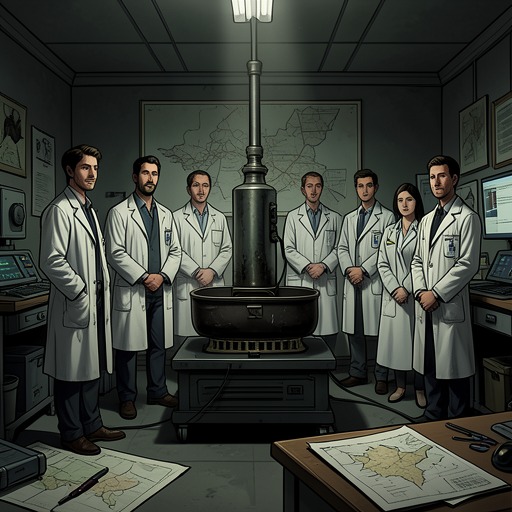
The Passage (Justin Cronin Edition)Special Weapons is the covert military-security apparatus that supports Project NOAH and helps transform its biological research into a proposed military weapon. The organization’s decisive significance lies in the gap between its promise of strategic control and the consequences of the virus it develops: secrecy protects the project, but it also helps carry an inadequately understood danger toward a wider world.
Origins and Strategic Ambition
Special Weapons is present in the project through its demands for security, its involvement in the handling of its subjects, and the chain of decisions that moves the research toward military use. Five years before the main events, Cole visited Richards in Ankara to recruit him as a practical, off-the-books operative. Cole framed the research as a new Manhattan Project, one that would weaponize the human form and produce a lasting strategic advantage. Richards was wanted not only for his practical abilities but for the people skills that could help assemble and secure the project. The visit, including Cole’s conspicuous Hawaiian shirt, was a bid to win Richards’s commitment and lock another piece into place.
The intellectual basis for the ambition was the research associated with Lear: the possibility of using a virus to restore the thymus gland and significantly lengthen human life while increasing physical robustness. In practice, the project’s research developed a family of viruses through successive refinements. What Special Weapons treated as a possible strategic asset was also a profound biological risk. The story’s retrospective account places the project within a larger chain: an expedition in South America, the deaths of most of its participants, the survival of Fanning and a small number of others, and the subsequent attempt to study and contain the result.
Secrecy, Recruitment, and Control
The organization’s operating logic depends on keeping both the work and its consequences out of public view. Cole sought personnel who could work off the books, and Richards’s role connected that secrecy to practical administration. The project did not simply require scientific findings; it required control over people, information, and access. The very need for secrecy, however, also shaped what could be acknowledged and explained. When Richards later reflected on the beginnings of NOAH, the South American events had been erased from the system, while the official order concerning those who failed to reach the extraction point left little room for recovery or disclosure.
That secrecy did not make the danger manageable. Richards learned that the experimental subjects had endured severe outcomes, and that the surviving inmates were not ordinary research participants but infected beings with extraordinary physical capacity. Their condition made the original military metaphor of weaponization increasingly literal. The subjects’ resilience and the virus’s transmissibility also strained the distinction between a contained research program and a threat that could escape its assigned boundaries.
The Subjects and the Limits of Containment
The human trials followed a long series of animal experiments and early failures. The first human subjects died within hours; later refinements weakened the virus enough for eleven former death-row inmates to survive. Babcock was the first, followed by Morrison, Chávez, Baffes, and the others. The change from immediate fatality to survival did not amount to reliable control. The subjects remained dangerous, and even the means of killing them were uncertain. Richards understood the experimental population as a continuing containment problem rather than a completed scientific success.
The danger also extended beyond the subjects themselves. A technician was exposed in a decontamination chamber, became acutely ill, and died. Richards noticed the incident on a monitor and sealed the level; after the chamber was purged and the scrubbers showed no virus, he kept the area closed for seventy-two hours before reopening it. This episode makes containment concrete: it depends on vigilance, equipment, isolation, and the ability to respond quickly to an exposure whose cause was not understood. Richards’s willingness to close the project under the Elizabeth Protocol reflects how little confidence the system could offer that the virus would remain safely contained.
From Project NOAH to Operation Jumpstart
The project’s military direction becomes explicit when Special Weapons advances it from research toward deployment. By the time Richards learns the scope of the infected population, the program has produced twelve subjects, thirteen counting Fanning, and an order arrives to graduate Project NOAH to Operation Jumpstart. The subjects are to be moved to White Sands in a week, transferring the next stage beyond Richards’s immediate control. The administrative language of graduation marks a transition in purpose: the research is no longer only an attempt to understand or contain the virus, but part of a larger operational plan.
Cole had described the subjects as potential bunker busters, imagining their use in locations such as caves in northern Pakistan, the eastern deserts of Iran, and the Chechen Free Zone. Richards recognizes the scale of the danger in that proposal. Even if the plan were framed as a strategic operation, the infected could not be assumed to remain within the intended target area. His doubts sharpen the novel’s central institutional irony: a program designed to create a controllable weapon is advancing a force whose defining feature is its resistance to control.
Narrative Significance
Special Weapons is represented less through a formal organizational chart than through its decisions, orders, and systems of secrecy. Its power appears in what it can classify, relocate, and authorize: the removal of information from official records, the handling of experimental subjects, and the transition from Project NOAH to Operation Jumpstart. The organization’s reach is therefore shown through consequences rather than ceremony.
Its role also gives the book’s biological threat a political origin. The catastrophe is not presented simply as a natural event discovered too late; the account traces it through deliberate research, strategic ambition, institutional concealment, and the choice to treat infected people as military assets. Special Weapons embodies the conflict between national-security reasoning and the danger of acting on incomplete knowledge. Richards’s growing alarm does not halt the program, and the move toward deployment turns that unresolved risk into the story’s governing warning: secrecy and command can organize an experiment, but they cannot guarantee mastery over what the experiment releases.