Teacher
The Passage (Justin Cronin Edition)Teacher is the educator and caretaker at the Sanctuary whose lessons shape the Littles’ daily lives, whose revelation at Sara’s eighth-birthday departure breaks the secrecy surrounding their upbringing, and whose defense of the children during a viral attack becomes, in Jane’s frightened imagination, a story of love. The character’s significance rests on this double role: she sustains a routine of safety while also serving as the person who must reveal that the children’s protected world is not what they believed.
Identity and Daily Role
Teacher leads lessons and routines for the Sanctuary’s Littles. In Sanjay’s recollection, she gathers the children in the Big Room after lunch, claps to quiet them, and asks them to discuss friendship. Her attention is a reward for his good behavior; the moment turns painful when Sanjay names Babcock as his friend and realizes that this private presence is not known to everyone. Teacher does not understand the name, but her question exposes Sanjay to the other children’s attention and ridicule. The scene places her at the center of the children’s social world without suggesting that she knows everything taking place within it.
For Sara, the Sanctuary’s childhood world is structured by lessons, circle time, meals, cots, and repeated expectations. Teacher tells the Littles not to talk about what awaits them outside, but the children whisper among themselves about their eighth birthdays and imagine a wonderful place beyond the walls. Teacher’s role is therefore not simply to teach facts: she maintains the boundary between what the children are allowed to know and what they are about to face.
Sara’s Eighth-Birthday Revelation
Sara expects her eighth birthday to bring release into a special outside world, though she does not know what that means. The children’s farewells reinforce her excitement. In the Big Room, Peter, Maus Patal, Ben Chou, Galen Strauss, Wendy Ramirez, and the others touch her and ask her to remember them. She carries a small bag containing clothes, slippers, and a rag doll—the one toy she is allowed to take—as Teacher leads her through the courtyard and into an unfamiliar, empty room.
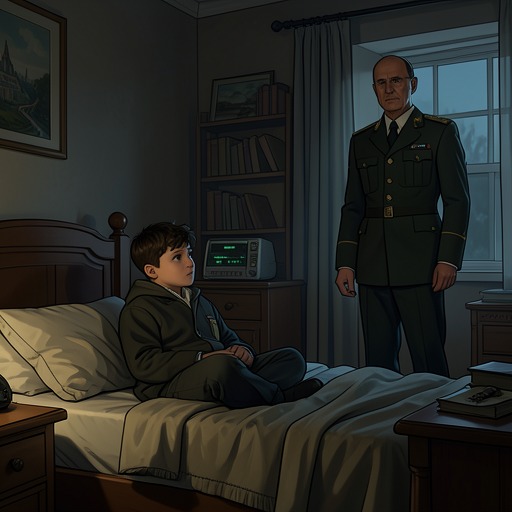
After sealing the door, Teacher crouches to Sara’s level and asks what she thinks lies beyond the building and what she makes of the men who come and go at night. Sara guesses that there may be a castle. Teacher tells her that it is not a castle, then reveals the truth about the world the children inhabit and the meaning of the life beyond the Sanctuary. The evidence does not spell out the full content of this explanation in the scene, but it makes clear that the revelation overturns Sara’s understanding of her childhood and of what awaits her.
Sara initially cannot accept what Teacher has told her. She experiences the discovery as a division within herself: the part that believed in the Sanctuary’s familiar world is forced to part from the part that somehow already knew. Teacher takes her by the hand and leads her out of the building to her parents, who are waiting to take her home—a home Sara did not know existed. Her mother cries and apologizes as Sara protests that the revelation cannot be true. Teacher’s disclosure is consequently both an act of care and a rupture: she gives Sara knowledge the Sanctuary has withheld, but cannot make that knowledge painless.
Years later, when Sara approaches the old brick schoolhouse bearing the inscription F. D. Roosevelt Elementary, this memory returns to her. The contrast between the extraordinary importance of the revelation to the child and the ordinary appearance of the building to the adult gives the scene its lasting force. Teacher’s truth-telling is not a passing lesson; it becomes part of how Sara understands the Sanctuary and the threshold out of childhood.
Defense of the Littles
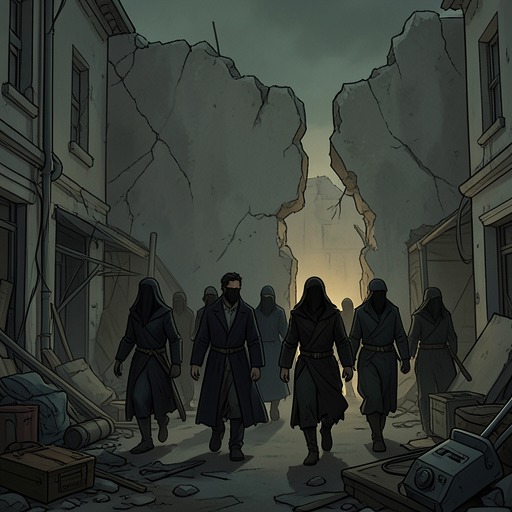
During the attack that breaks into the Big Room, Little Jane Ramirez sees Arlo Wilson come through a window. She first reads him as a man, but notices that he is unclothed and that his eyes, mouth, and glow mark him as something other than an ordinary person. Teacher rushes toward him with the blade she carries concealed beneath her skirt. Jane drops to the floor and scrambles away, so she does not see the ensuing struggle, but hears a cry, a tearing sound, and something fall before the adults’ shouts and screams fill the room.
The Littles are taken upstairs, and Teacher is nowhere to be seen. Some children whisper that she is dead, but Jane doubts it. She remembers Teacher’s sudden leap and forceful movement as unlike the steady, orderly caretaker she knows. That contrast changes Jane’s understanding of her: the woman who ordinarily embodies the Sanctuary’s mild routine has acted with a strength Jane had never witnessed. The episode establishes that Teacher’s care is not confined to instruction or comfort; when the children are threatened, she moves to confront the danger.
Memory, Fear, and Jane’s Dream
Jane does not tell anyone what she saw. The following night, she tries to make sense of the attack through a story in which the glowing intruder becomes a bear-prince who has come to take Teacher to a forest castle. In that imagined version, Teacher’s disappearance becomes a fairy-tale departure, and the children have merely been moved upstairs to await her return. Jane’s construction draws on the castle stories she had imagined before learning that the outside world was not the place she expected.
The dream turns that consoling story into a nightmare. The bear becomes threatening, Teacher appears beside Jane’s bed, and the dream recasts the Littles as being in danger. Jane’s remembered image of Teacher’s missing neck and her helplessness within the dream belong to this nightmare, not to a clear, direct account of the attack itself. The distinction matters: the dream does not establish what happened to Teacher after Jane fled. It shows instead how a child tries to contain an event she cannot understand, first transforming it into a romance of rescue and then into a fear of being left alone with danger.
Jane’s first interpretation of Teacher’s action is that love must have lifted her toward the glowing figure. She imagines that Teacher has gone to her rightful place as a forest queen and that the Littles will celebrate when she returns. This is Jane’s fantasy, not a confirmed account of Teacher’s fate. Its emotional truth lies in what Jane has recognized: Teacher’s action in the attack breaks the boundaries of ordinary routine, and Jane understands that the care she had taken for granted can involve risk and force.
Significance in the Sanctuary
Teacher’s scenes link the Sanctuary’s two forms of protection. In Sara’s story, protection depends on controlling knowledge until a child reaches the age at which she is told the truth. In Jane’s, protection appears as an immediate response to physical danger, witnessed only in fragments and then reshaped by a child’s imagination. The first account makes Teacher the keeper of a painful threshold; the second makes her the caretaker whose actions exceed the gentle routine Jane had known.
The evidence also keeps Teacher’s knowledge and power limited. She does not recognize the name Babcock when Sanjay blurts it out, and Jane cannot report the outcome of Teacher’s confrontation with Arlo. Her importance does not depend on omniscience or on a fully disclosed fate. It comes from the concrete responsibilities she bears: teaching the Littles, ending their childhood ignorance when they leave the Sanctuary, and acting to protect them when danger enters their room. Through Sara’s remembered revelation and Jane’s altered dream, Teacher becomes a point of contact between institutional secrecy, childhood fear, and the care that persists within a threatened world.